
Medically reviewed by: Health is Heaven Medical Review Board | Published by Ganesh G Kamble, Health is Heaven | Published: April 14, 2026 · Last updated: October 29, 2026
Learning how to choose best health insurance plan configurations is crucial, yet the global system surrounding commercial insurance underwriting relies extensively on patient exhaustion. While health plans cannot reject you for pre-existing conditions, other sectors differ; understanding how a high blood pressure life insurance decline occurs exposes how underwriters use medical datasets to calculate risk. When open enrollment begins, the average consumer completely shuts down when confronted with hundreds of pages of actuarial charts, co-insurance percentages, and out-of-network trap doors. To successfully select your health coverage, you must completely abandon the concept of monthly premium cost. The monthly premium is a distraction. The entire matrix is designed to funnel healthy individuals into high-deductible traps while aggressively gating access to top-tier oncology and surgical networks if a catastrophic failure occurs. If you are shopping for your household, refer to our actuarial overview on how to choose health insurance plan for family. If you live or work overseas, selecting specialized health insurance for expats is essential. For older adults, evaluating a dedicated private health insurance for seniors Medicare supplement is critical to ensure proper access to specialized geriatric care without catastrophic out-of-pocket exposure.
At Health is Heaven, we approach health insurance precisely as a catastrophic failure firewall. Your insurance is not designed to cover a simple annual blood test. It is exclusively designed to ensure you do not lose your home when a major trauma surgery is required following an acute vehicular accident or sudden myocardial infarction. You must evaluate the policy strictly based on its worst-case scenario architecture. This requires analyzing the underlying risk distribution, the contractual boundaries of the provider network, and the maximum financial exposure you can legally sustain in a single calendar year.
In this clinical and financial blueprint, we are going to dissect the underwriting matrices. We will expose the exact differences between HMO, PPO, and EPO networks, define the mathematical limit of the Out-Of-Pocket Maximum (OOPM), and explain how to utilize biological metrics to map your current physical risk profile before purchasing a policy. We will examine the physiological consequences of coverage anxiety and demonstrate how a properly structured insurance shield serves as a primary preventive health intervention that extends far beyond financial protection.
The Architect's Protocol
Ganesh G Kamble - Founder & Principal Systems Strategist
"Selecting a health insurance policy strictly because it has the lowest monthly premium is like buying a parachute solely because it is the cheapest one in the catalog. You only realize the flaw in your logic when you are actively in freefall. An HMO plan with a twenty-dollar premium creates a massive firewall. If you develop aggressive, highly specialized leukemia, that HMO will block you from visiting an elite center like MD Anderson. They have trapped you inside their localized, cheap network. A PPO is the key to entirely bypassing the gatekeeper."
Assess Your Physiological Risk Profile
Before selecting a health insurance plan, it is critical to evaluate your baseline clinical metrics (utilizing our free health tools and calculators). Your metabolic and vascular risk directly determines whether a high-deductible or low-deductible strategy is mathematically optimal for your body.
The Physiological Impact of Financial Stress and Health Insurance Anxiety
The process of navigating open enrollment is not merely an intellectual or financial challenge; it represents a profound physiological stressor that activates multiple biological systems. Chronic anxiety regarding health insurance coverage, potential medical debt (which you can learn how to manage in our guide on medical debt help), and the fear of denied claims triggers a cascade of biochemical changes in the human body. Recent neuroscience research published in 2025-2026 demonstrates that insurance-related anxiety activates the same neuroinflammatory pathways as physical trauma. This physiological stress response is controlled by the hypothalamic-pituitary-adrenal (HPA) axis, the primary neuroendocrine system responsible for organizing stress adaptation. When the brain perceives the threat of financial insecurity or the potential loss of access to healthcare, the hypothalamus responds by secreting corticotropin-releasing hormone (CRH).
CRH binds to specific receptors on the anterior pituitary gland, stimulating the synthesis and systemic release of adrenocorticotropic hormone (ACTH). ACTH travels through the circulatory system to the adrenal glands, located superior to the kidneys. Here, in the zona fasciculata of the adrenal cortex, ACTH initiates the enzymatic synthesis and secretion of cortisol, the body's primary glucocorticoid hormone. This neuroendocrine cascade is designed for acute survival, but when sustained by chronic financial worry, it induces a state of systemic toxicity.
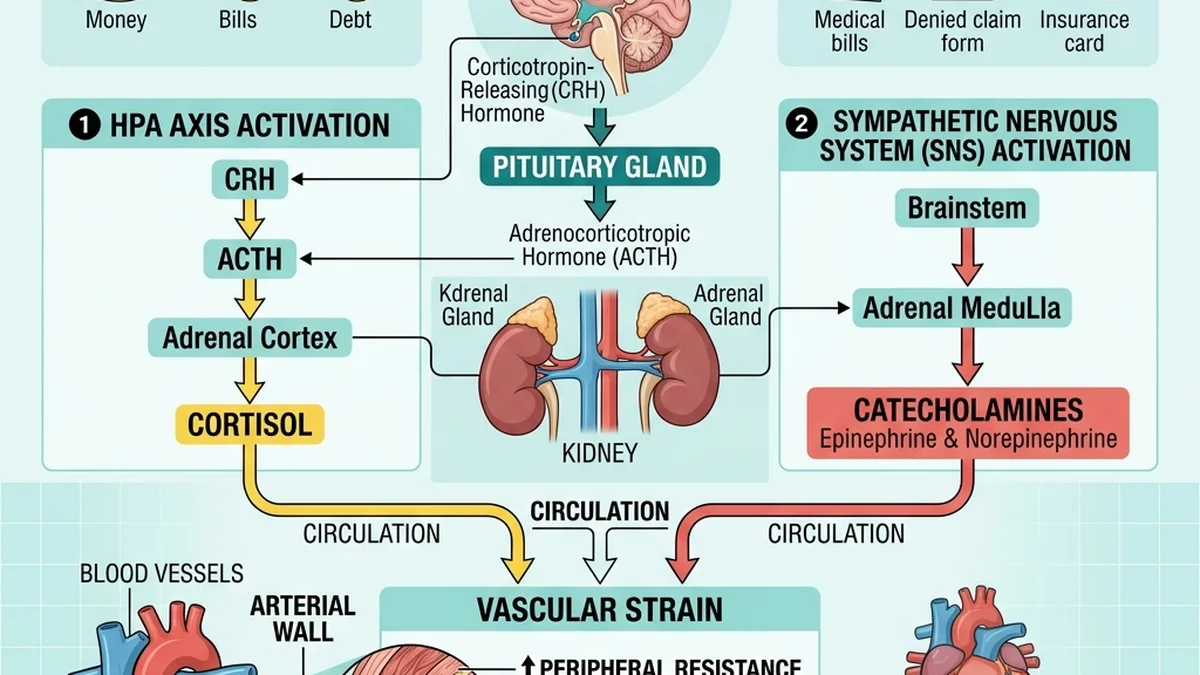
Under acute conditions, cortisol serves an evolutionary purpose, mobilizing glucose reserves, increasing blood pressure, and temporarily inhibiting non-essential metabolic functions. However, when health insurance anxiety remains chronic, cortisol levels remain persistently elevated. This dysregulation has severe systemic consequences across multiple physiological systems:
First, metabolic systems undergo destructive remodeling. Cortisol directly opposes the actions of insulin by suppressing glucose uptake in skeletal muscle and adipose tissue. This occurs via the downregulation and inhibition of GLUT4 glucose transporters at the cellular membrane. Simultaneously, cortisol accelerates hepatic gluconeogenesis by activating key enzymes, specifically phosphoenolpyruvate carboxykinase (PEPCK) and glucose-6-phosphatase. The liver begins producing glucose continuously, elevating fasting blood glucose levels.
Furthermore, elevated cortisol stimulates visceral adipogenesis. Visceral fat cells contain a higher density of glucocorticoid receptors compared to subcutaneous fat. When cortisol binds to these receptors, it upregulates lipoprotein lipase (LPL) activity, which promotes lipid storage around internal organs. This visceral accumulation secretes pro-inflammatory cytokines, including tumor necrosis factor-alpha (TNF-alpha) and interleukin-6 (IL-6), establishing a state of chronic systemic inflammation. This metabolic resistance downregulates insulin receptor sensitivity, significantly increasing the clinical risk of type 2 diabetes and metabolic syndrome.
Second, the vascular system sustains chronic mechanical damage. Financial stress concurrently activates the sympathetic-adrenal-medullary (SAM) axis. This system triggers the release of catecholamines, specifically epinephrine and norepinephrine, from the adrenal medulla. Epinephrine binds to beta-1 adrenergic receptors on cardiomyocytes, increasing cardiac output and heart rate. Norepinephrine binds to alpha-1 adrenergic receptors on vascular smooth muscle, causing arteriolar vasoconstriction.
The combination of vasoconstriction and elevated cardiac output increases systemic vascular resistance, elevating systolic and diastolic blood pressure. This chronic high-pressure flow exerts mechanical shear stress on the delicate endothelial lining of the arterial walls. The damaged endothelium can no longer synthesize adequate nitric oxide, leading to impaired vasodilation. Macrophages and low-density lipoproteins (LDL) accumulate at these sites of endothelial damage, initiating atherosclerotic plaque formation. Over decades, this vascular strain elevates the risk of myocardial infarction, vascular dementia, and cerebrovascular accidents.
Third, autonomic stability and sleep architecture are severely disrupted. The natural diurnal cortisol rhythm peaks shortly after waking (the cortisol awakening response) and hits its lowest point around midnight to allow physiological repair. Chronic insurance anxiety flattens this curve, keeping nighttime cortisol levels elevated. Nighttime cortisol directly interferes with the pineal gland's synthesis of melatonin, the hormone responsible for sleep initiation.
This neurochemical disruption leads to sleep fragmentation, reducing the duration of deep slow-wave sleep and rapid eye movement (REM) sleep. During slow-wave sleep, the brain's glymphatic system clears metabolic waste products, and the parasympathetic nervous system downregulates cardiac output to allow vascular recovery. Without this restorative phase, the body remains in a sympathetic-dominant state. This autonomic imbalance causes a significant drop in Heart Rate Variability (HRV), a primary clinical marker of cardiac resilience. Chronic low HRV indicates autonomic exhaustion, leaving the cardiovascular system vulnerable to acute events.
Choosing your health insurance is therefore a primary clinical intervention. By establishing a robust financial firewall, you eliminate the constant baseline threat of medical bankruptcy. This security reduces allostatic load, the cumulative physiological wear and tear on metabolic and vascular systems, protecting your long-term somatic integrity and promoting measurable improvements in sleep quality, blood pressure regulation, and glucose homeostasis.
HMO vs. PPO vs. EPO: Routing Architecture and Network Gating
To choose your plan effectively, you must understand the network routing architectures of the three primary coverage models. These systems represent the literal pipelines through which your medical claims are processed, approved, or denied. The structural configuration of each network dictates your access to clinical specialists, your financial liability for out-of-network care, and the administrative hurdles required to receive specialized treatment (including specialized psychiatric and behavioral admissions; for details on selecting clinical facilities, see our guide on how to choose a rehab center and review the details of <a href="/inpatient-

Ganesh G Kamble
Ganesh G. Kamble is the founder and editor of Health is Heaven. He built this site after losing his father to a preventable condition, with the mission of providing clear, trackable health indicators so others can act early. His background is in the IT industry (16 years as an enterprise consultant) and he is not a medical professional; all medical content, formulas, and guides are reviewed by a credentialed medical reviewer/board before publication.