
How to Choose the Best Health Insurance Plan for Your Family in 2026

Medically reviewed by: Health is Heaven Medical Review Board | Published by Ganesh G Kamble, Health is Heaven | Published: June 11, 2026

There is a clinically significant distinction between protecting a single adult and protecting an entire family unit. When underwriting a single policy, the actuarial math is relatively static: one adult body with predictable healthcare utilization patterns. When you add children to the equation, the variables multiply exponentially. According to the CDC National Ambulatory Medical Care Survey (NHAMCS) 2023, children aged 0–4 have ER visit rates of 68 per 1,000 individuals annually — more than double the adult average. A sports injury, an RSV hospitalization, an unexpected Type 1 diabetes diagnosis, or a single NICU admission can cost $50,000–$150,000 before your deductible resolves.

This guide applies the same actuarial logic that group benefits consultants use when evaluating employer-sponsored plans — deconstructed for a family audience. You will learn how to read the true cost of a plan beyond the monthly premium, how embedded versus aggregate deductibles change your financial exposure, when an HDHP/HSA is the mathematically optimal choice, and how to score each plan candidate against your household’s specific healthcare utilization pattern.

🏠 Free Clinical Tool

SPONSORED CONTENT

Already Have a Plan? Check Your Real Healthcare Risk Score

Before locking in your family plan, use our Health Insurance Premium Estimator and BMI Calculator to model your household risk profile. Your biometric data directly affects your underwriting category and which plan tier gives you the best actuarial value.

Why the Monthly Premium Is the Wrong Number to Optimize

The single most dangerous mistake families make during open enrollment is selecting the plan with the lowest monthly premium. This optimizes for visible cash flow at the direct expense of catastrophic risk exposure — a fundamentally irrational actuarial decision. The correct framework for plan comparison is Total Annual Cost Modeling (TACM): the actuarial sum of premium expenditure plus expected out-of-pocket costs given your household’s projected healthcare utilization.

Consider a family of four comparing a low-premium PPO ($450/month, $6,000 family deductible) versus a higher-premium HMO ($680/month, $2,500 family deductible). If the family generates $18,000 in medical claims in a given year:

Cost Component Low-Premium PPO Higher-Premium HMO
Annual Premiums $5,400 $8,160
Deductible Exposure $6,000 $2,500
Post-Deductible Coinsurance (20%) $2,400 $1,200
Total Family Cost $13,800 $11,860

The “cheaper” plan costs $1,940 more annually under realistic utilization. The premium is only one variable in a six-variable equation. The six actuarial variables are: (1) monthly premium, (2) individual deductible, (3) family deductible structure, (4) coinsurance percentage, (5) out-of-pocket maximum, and (6) provider network breadth. Missing any one of them produces a materially incorrect plan comparison.
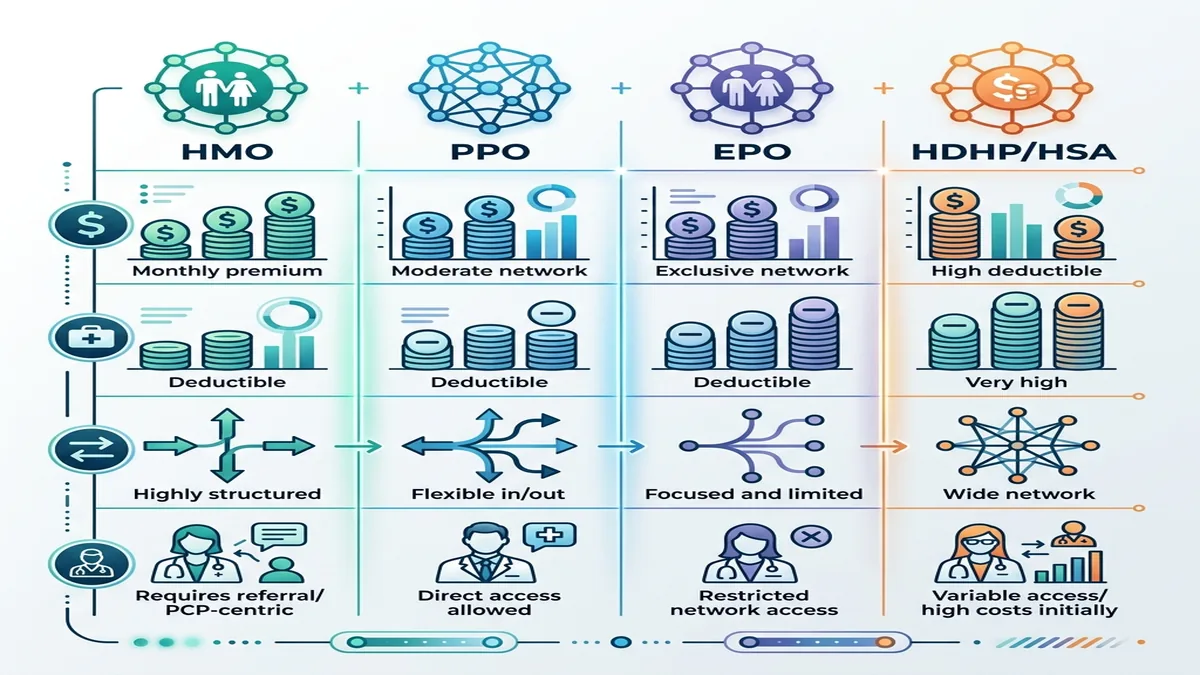
Family health insurance plan comparison matrix showing HMO, PPO, EPO, and HDHP-HSA network structures
The four main family health insurance plan types differ significantly in network flexibility, cost-sharing architecture, and referral requirements. Source: KFF Health Insurance Explainer, 2025.

The Four Plan Types: Clinical Breakdown for Families

HMO (Health Maintenance Organization)

HMOs operate on a capitated, gatekeeper model. Your Primary Care Physician (PCP) coordinates all specialist referrals. You pay a fixed capitation fee per enrolled member regardless of utilization, which allows insurers to offer lower premiums and predictable cost-sharing. The tradeoff is absolute network restriction: any out-of-network care (except true emergencies) is 100% your financial responsibility.

Best for families when: All family members have established PCPs within the HMO network, you live in an urban market with dense provider availability, and your children do not have complex or rare conditions requiring specialist access beyond the network. HMOs are actuarially strongest for low-to-moderate utilization families with predictable healthcare patterns.

PPO (Preferred Provider Organization)

PPOs allow direct specialist access without a referral and cover a percentage of out-of-network claims, typically at 60–70% after a higher out-of-network deductible. The dual-network architecture (in-network and out-of-network benefit tiers) is priced into significantly higher premiums. According to the KFF 2024 Employer Health Benefits Survey, PPO family premiums averaged $24,100/year versus $20,400 for HMO plans.

Best for families when: You have a child with a complex condition (pediatric oncology, rare autoimmune disease, complex cardiac) requiring best-in-class specialists who may not be in an HMO network. The additional premium is actuarially justified by specialist access flexibility. Also critical for families who travel frequently or split time between two states.

EPO (Exclusive Provider Organization)

EPOs are a hybrid: PPO-like access (no PCP referral required for in-network specialists) with HMO-like network exclusivity (zero out-of-network coverage except emergencies). Premiums sit between HMO and PPO tiers. EPOs are increasingly common in ACA Marketplace plans.

Best for families when: Your preferred specialists and pediatrician are in-network, you want self-referral flexibility for pediatric subspecialties, but you do not need out-of-network coverage. Verify the EPO network includes a children’s hospital within your region before enrolling.

HDHP/HSA (High Deductible Health Plan with Health Savings Account)

HDHPs have IRS-defined minimum deductibles ($1,650 individual/$3,300 family in 2026) and unlock access to the Health Savings Account (HSA), a triple-tax-advantaged savings vehicle. HSA contributions are pre-tax (reducing your taxable income), grow tax-deferred (you can invest the HSA balance in index funds), and withdrawals for qualified medical expenses are completely tax-free. The 2026 HSA family contribution limit is $8,550.

A family maxing out their HSA at the $8,550 limit in a 24% federal tax bracket saves $2,052 in federal taxes alone annually, before state tax savings. Over a 10-year period with 7% annual investment returns, an unused HSA balance becomes a substantial retirement medical fund exceeding $118,000. This makes the HDHP/HSA the mathematically dominant strategy for healthy, high-income families who have low annual healthcare utilization.
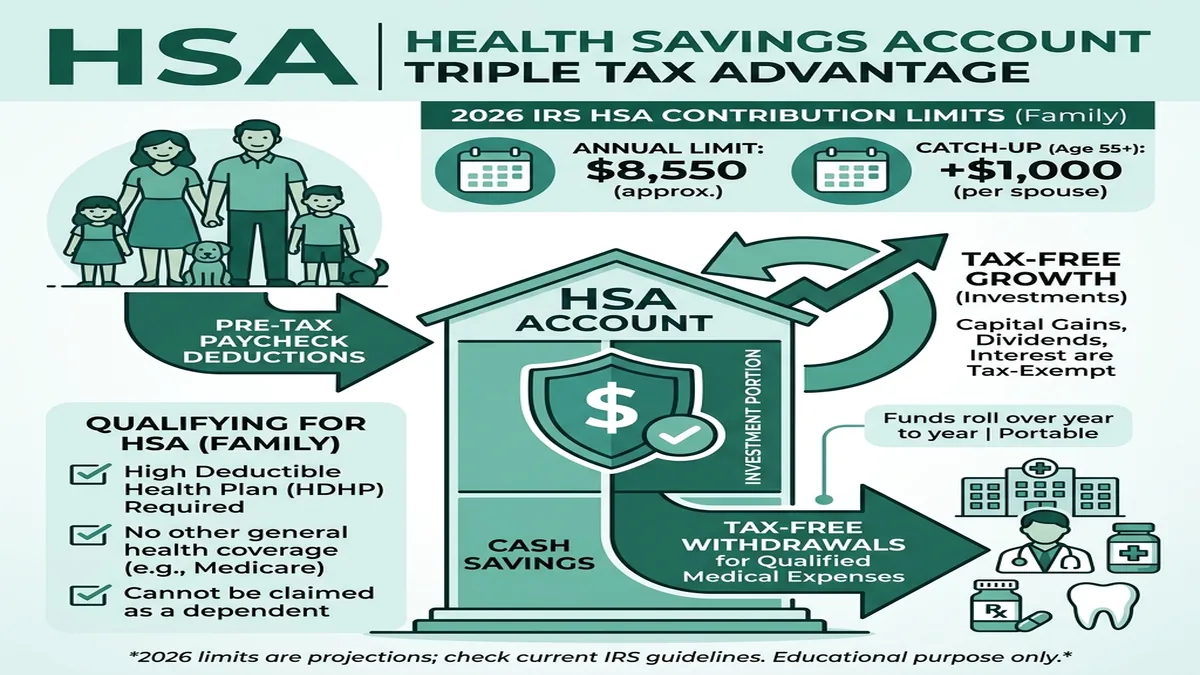
Health Savings Account triple tax advantage diagram showing pre-tax contributions, tax-free growth, and tax-free medical withdrawals for families
The HSA triple tax advantage: contributions reduce taxable income, the invested balance grows tax-deferred, and withdrawals for medical expenses are completely tax-free. 2026 family contribution limit: $8,550.

The Embedded vs. Aggregate Deductible Trap

This is the single most underestimated variable in family plan selection. The deductible structure determines how quickly each family member’s claims begin receiving insurance coverage, and it has multi-thousand-dollar implications for high-utilization households.

Aggregate-Only Deductible

With an aggregate-only deductible, the entire family must collectively spend the full family deductible before insurance pays for any individual family member at the post-deductible coinsurance rate. If your family deductible is $6,000 and three family members each generate $2,000 in claims, nobody receives post-deductible coverage — even though $6,000 has been spent collectively.

This is the worst-case structure for families with a single high-utilizer (one child with a chronic condition, a family member requiring surgery) because that member must reach the full family deductible alone before receiving coverage.

Embedded Deductible

An embedded deductible structure contains both an individual deductible AND a family deductible. Once any single family member meets their individual deductible (typically 50% of the family deductible), the plan begins paying for that member’s claims at the coinsurance rate — without waiting for the family aggregate to be met. This dramatically reduces exposure for families where one member generates the majority of claims.

Diagram showing embedded versus aggregate deductible structure for family health insurance plans
Embedded deductibles protect high-utilizer family members by allowing individual deductible thresholds independent of the family aggregate. Source: CMS Health Insurance Explainer Series.

Practical selection rule: If any family member has a known chronic condition (asthma, Type 1 diabetes, epilepsy, ADHD requiring frequent physician visits), always prioritize an embedded deductible plan. If all family members are healthy with low expected utilization, an aggregate deductible is acceptable because you are primarily buying catastrophic protection, not routine care coverage.

Pediatric Healthcare Risk: What the Data Shows

Families with children systematically underestimate pediatric healthcare utilization rates compared to adults. Incorporating age-stratified utilization data into your plan selection process is foundational to accurate Total Annual Cost Modeling.

Per CDC NHAMCS 2023 and American Academy of Pediatrics (AAP) guidelines:

Age Group ER Visits / 1,000/yr Preventive Visits / yr Common High-Cost Events
Infants (0–1) 142 6–7 (well-child) RSV hospitalization, jaundice, NICU follow-up
Toddlers (1–4) 68 4–5 Febrile seizure, ear infections (recurrent otitis media), fractures
School Age (5–12) 36 1–2 Sports injuries, asthma exacerbation, new ADHD/autism diagnosis
Adolescents (13–17) 28 1 Sports injuries (ACL/fractures), mental health, reproductive health
Adults 30–44 18 1 Musculoskeletal, preventive screenings

Infants have ER visit rates 8x higher than adult parents in their 30s. This pediatric utilization premium is priced into premium calculations but is rarely surfaced clearly during enrollment. Families with infants or toddlers should model their plan selection assuming at least 2–3 ER visits per child annually, plus full well-child visit series, plus any specialist referrals.

Pediatric healthcare risk matrix showing age-stratified ER visit rates and chronic condition prevalence for children aged 0-17
Age-stratified pediatric healthcare utilization data from CDC NHAMCS 2023. Infant ER visit rates are 8x higher than adult parents, making pediatric utilization modeling essential in family plan selection.

The 5-Step Family Plan Selection Protocol

Use this structured protocol during every open enrollment period:

Step 1: Audit Last Year’s Household Healthcare Utilization

Pull your Explanation of Benefits (EOB) statements from the past 12 months. Tally: total claims submitted, total insurance paid, total out-of-pocket paid, number of ER visits, number of specialist visits, prescriptions dispensed. This is your household utilization fingerprint — the most accurate predictor of next year’s utilization.

If you are enrolling for the first time or had a major life event (new baby, adoption, new chronic diagnosis), use the pediatric utilization table above to project forward based on your children’s ages and health status.

Step 2: Model Total Annual Cost for Each Plan Option

For each plan offered during enrollment, calculate the worst-case annual cost scenario: annual premium + Out-of-Pocket Maximum (OOPM). The OOPM is the statutory ceiling on your total annual family exposure. The 2026 ACA OOPM cap for family plans is $18,900. Any plan with a family OOPM above this is non-compliant (for ACA-regulated plans).

Then model the expected-case scenario: annual premium + estimated deductible spend + estimated coinsurance based on your prior-year utilization. Compare plans on both scenarios. The optimal plan minimizes expected-case cost while keeping worst-case cost within your family’s emergency cash reserve capacity.

Step 3: Verify Your Providers Are In-Network

Network adequacy is non-negotiable for families. Before enrolling, verify that your pediatrician, any active specialists (pediatric cardiologist, endocrinologist, therapist, orthodontist), and your preferred hospital or children’s hospital are all contracted in-network. Use the insurer’s provider directory tool — and call the provider directly to confirm current network participation, as online directories are frequently outdated by 6–12 months (per the GAO Report on Network Directory Accuracy, 2022).

Step 4: Evaluate Prescription Drug Tier Coverage

Every plan’s drug formulary is tiered (Tier 1–5 or similar). Check your family’s current medications against the formulary of each plan candidate. A brand-name medication moving from Tier 2 to Tier 3 can add $1,200–$3,600 annually in out-of-pocket prescription costs. Specialty medications (biologics, immunosuppressants for pediatric autoimmune conditions, GLP-1 receptor agonists) may require prior authorization and may only be covered at Tier 4 or 5 — generating coinsurance costs of 20–33% of the drug’s $8,000–$30,000/year list price.

Step 5: Assess Mental and Behavioral Health Coverage

The Mental Health Parity and Addiction Equity Act (MHPAEA) requires that mental health and substance use disorder benefits be covered at parity with medical/surgical benefits — but enforcement gaps remain. Verify that the plan covers:

  • Outpatient therapy — number of covered sessions annually (ACA-compliant plans cannot impose session limits, but check carefully)
  • Applied Behavior Analysis (ABA) therapy for autism spectrum disorder — coverage limits vary dramatically between plans
  • Adolescent psychiatric hospitalization — residential and inpatient behavioral health
  • Substance use disorder treatment — inpatient detoxification, residential treatment, outpatient programs

Given that 1 in 5 children ages 3–17 has a diagnosed mental, emotional, developmental, or behavioral disorder (CDC, 2023), mental health network adequacy is a critical family plan variable — not an optional consideration.

Special Enrollment Periods and Life Events

Family health insurance is not exclusively an open enrollment decision. Federal law (ACA and ERISA) grants Special Enrollment Periods (SEPs) triggered by qualifying life events. Failing to use an SEP correctly results in coverage gaps lasting up to 11 months until the next open enrollment window.

Qualifying life events that trigger a 60-day SEP include:

  • Birth or adoption of a child — triggers an SEP even if you were previously uninsured; the child must be enrolled within 60 days
  • Marriage — allows addition of spouse to an employer plan or enrollment in a new plan
  • Loss of other coverage — job loss, COBRA expiration, aging off a parent’s plan at 26
  • Relocation to a new coverage area — moving to a county with different plan availability
  • Change in household income — if income changes by more than 10%, premium tax credit eligibility changes

A critical tactical note: newborns added to a family plan are typically retroactively covered from the date of birth if added within 30 days (employer plans) or 60 days (Marketplace plans). If you miss this window, the newborn may be uninsured for the remainder of the plan year — a potentially catastrophic coverage gap given NICU probabilities (9% of US births require NICU admission, per March of Dimes).

COBRA: Pricing Family Continuation Coverage Correctly

COBRA continuation coverage allows families to maintain their employer plan after a triggering event (job loss, reduction to part-time), but the family pays the full premium including the employer’s contribution — typically 72–102% of the plan’s total premium. The average employer pays 71% of family premiums (KFF 2024), meaning COBRA costs are typically 3–5x what employees were paying.

For most families, COBRA is only actuarially justified when: (1) a family member is mid-treatment for a serious condition requiring continuity with specific in-network providers; (2) the deductible has already been substantially met in the current plan year; or (3) you are fewer than 90 days from the next employer open enrollment period. In all other cases, an ACA Marketplace plan or spouse’s employer plan will almost always be less expensive.

Medicaid, CHIP, and ACA Subsidy Eligibility

Families earning below 400% of the Federal Poverty Level (FPL) may qualify for substantial premium tax credits under the ACA. For a family of four in 2026, 400% FPL is approximately $124,800/year. Families below this threshold may receive premium subsidies that dramatically change the cost calculus in favor of Marketplace plans over employer coverage — especially if the employer plan’s family premium exceeds 9.02% of household income (the 2026 ACA affordability threshold).

Children-only Medicaid and CHIP: Even if adult household members are above Medicaid income limits, children in households up to 200–300% FPL (varies by state) qualify for CHIP (Children’s Health Insurance Program). CHIP covers all essential pediatric benefits including dental, vision, and behavioral health with minimal or zero premiums. If your children qualify, enrolling them in CHIP while adults maintain separate employer or Marketplace coverage is a highly cost-effective split-enrollment strategy.

Dental and Vision: The Hidden Family Budget Items

Under the ACA, pediatric dental and vision are Essential Health Benefits (EHBs) — meaning all individual and small-group plans must cover them. However, the coverage architecture varies: in some plans, pediatric dental is embedded within the medical plan; in others, it requires a separate standalone dental plan purchase.

Critical dental cost considerations for families:

  • Orthodontics: Standard dental plans do not cover adult orthodontics. Pediatric orthodontic coverage typically requires a separate orthodontic rider and has a lifetime maximum (commonly $1,500–$2,000) far below the $5,000–$8,000 average cost of comprehensive orthodontic treatment. Factor in out-of-pocket orthodontic costs when projecting family healthcare budgets for children ages 8–16.
  • Sealants and preventive care: Verify that the pediatric dental plan covers 100% preventive care (two annual cleanings, sealants, fluoride treatments) with no deductible on preventive services.
  • Vision: Pediatric vision benefits under ACA cover one comprehensive exam plus corrective lenses annually. Verify the plan covers contact lens allowances if relevant.

Family Plan Selection Checklist

Before finalizing your family’s health insurance enrollment, confirm each item on this checklist:

✓ Family Health Insurance Enrollment Checklist

  • ☐ Calculated Total Annual Cost (premium + expected OOPM) for each plan option
  • ☐ Verified deductible structure: embedded vs. aggregate
  • ☐ Confirmed all pediatricians and specialists are in-network
  • ☐ Verified preferred hospital/children's hospital is in-network
  • ☐ Checked formulary coverage for all current family medications
  • ☐ Assessed mental/behavioral health network and benefit limits
  • ☐ Evaluated HSA eligibility if selecting HDHP
  • ☐ Checked children's CHIP eligibility
  • ☐ Reviewed pediatric dental and vision benefit architecture
  • ☐ Confirmed catastrophic coverage (OOPM) fits family emergency fund capacity
  • ☐ Documented SEP trigger dates for any pending life events

Frequently Asked Questions

What is the best health insurance plan for a family with young children?

For families with infants or toddlers, an HMO or EPO with an embedded deductible and low-to-moderate copays for ER visits typically provides the best actuarial value. Young children have ER visit rates 4–8x higher than adults, so plans with low ER copays and embedded deductibles reduce your exposure significantly. If your children are generally healthy and you have a substantial emergency fund, an HDHP/HSA offers long-term tax optimization advantages that outweigh the higher deductible risk.

Can I have different health insurance plans for each family member?

Yes. “Split enrollment” is legally permissible under both employer and ACA rules. A common optimized approach: enroll children in CHIP (if income-eligible), adult parents in separate employer plans or a Marketplace plan. This can save families $3,000–$8,000 annually versus enrolling everyone under one employer plan. Each enrollment decision must be made independently and documented correctly to avoid enrollment gaps.

Is an HDHP with HSA a good choice for families?

An HDHP/HSA is mathematically optimal for healthy families with low-to-moderate expected utilization AND a cash reserve sufficient to cover the family deductible ($3,300 minimum for 2026) without financial hardship. The HSA’s triple tax advantage becomes increasingly valuable over time. However, families with a chronically ill child, frequent ER utilization, or tight monthly budgets may find lower-deductible HMO plans provide better cost certainty even at higher premiums.

How much does family health insurance cost per month in 2026?

Per the KFF 2024 Employer Health Benefits Survey, the average employer-sponsored family plan premium is $24,100/year ($2,008/month) total, with employees contributing an average of $7,000/year ($583/month). ACA Marketplace family premiums vary widely by income and subsidy eligibility — subsidized families earning 200–400% FPL may pay as little as $50–$300/month after premium tax credits are applied. Unsubsidized ACA Marketplace family premiums average $1,400–$2,200/month depending on plan tier (Bronze/Silver/Gold) and geographic region.

What happens if a family member gets care out-of-network?

The No Surprises Act (2022) protects families from surprise billing in emergency situations: insurers must cover emergency out-of-network care at the in-network benefit level, and you can only be billed at the in-network cost-sharing rate. For non-emergency out-of-network care, coverage depends on your plan type: PPOs pay 60–80% after a higher out-of-network deductible; HMOs and EPOs pay 0% except in emergencies. Always verify network status before non-emergency procedures to avoid unexpected bills.

⚠ Medical & Financial Disclaimer: This article is for educational purposes only. Health insurance plan selection is complex and situation-dependent. Consult a licensed insurance broker or benefits advisor before making enrollment decisions. Regulations vary by state and employer plan type. This article does not constitute financial, legal, or medical advice.
Ganesh G Kamble
About the Author

Ganesh G Kamble

Ganesh G Kamble is the founder and editor of Health is Heaven. He spent 14 years as a techno-functional consultant on enterprise ERP systems in Bangalore before turning his attention to health publishing. His background is technical, not clinical, and he is not a medical professional. He started Health is Heaven because most online health information is either too vague to act on, too technical to understand, or too commercial to trust. The site's mission is to provide clear, evidence-based answers to common health questions, with sources you can verify, alongside free interactive calculators built using standard medical formulas published by recognised authorities including the World Health Organization, the U.S. Centers for Disease Control and Prevention, the American Heart Association, the American Diabetes Association, and the National Institutes of Health. Every article is reviewed against authoritative sources before publishing, dated with both publish and last-updated timestamps, and clearly marked as informational only when covering medical topics. Articles dealing with diagnosis, treatment, or medication recommend speaking with a qualified healthcare provider. The site does not accept paid placements that influence editorial content; any future advertising is clearly labelled and separated from articles. Ganesh is based in Bangalore, India, and connects with readers and collaborators on LinkedIn.

🧠Stress
Scroll to Top
Connect & Follow