
Medically reviewed by: Health is Heaven Medical Review Board | Published by Ganesh G Kamble, Health is Heaven | Published: April 14, 2026 · Last updated: April 29, 2026
The global system surrounding commercial insurance underwriting relies extensively on patient exhaustion. When open enrollment begins, the average consumer completely shuts down when confronted with hundreds of pages of actuarial charts, co-insurance percentages, and out-of-network trap doors. To successfully select your health coverage, you must completely abandon the concept of monthly premium cost. The monthly premium is a distraction. The entire matrix is designed to funnel healthy individuals into high-deductible traps while aggressively gating access to top-tier oncology and surgical networks if a catastrophic failure occurs.
At Health is Heaven, we approach health insurance precisely as a catastrophic failure firewall. Your insurance is not designed to cover a simple annual blood test. It is exclusively designed to ensure you do not lose your home when a major trauma surgery is required following an acute vehicular accident or sudden myocardial infarction. You must evaluate the policy strictly based on its worst-case scenario architecture. This requires analyzing the underlying risk distribution, the contractual boundaries of the provider network, and the maximum financial exposure you can legally sustain in a single calendar year.
In this clinical and financial blueprint, we are going to dissect the underwriting matrices. We will expose the exact differences between HMO, PPO, and EPO networks, define the mathematical limit of the Out-Of-Pocket Maximum (OOPM), and explain how to utilize biological metrics to map your current physical risk profile before purchasing a policy. We will examine the physiological consequences of coverage anxiety and show how a properly structured insurance shield serves as a primary preventive health intervention.
SPONSORED CONTENT

The Architect's Protocol
Ganesh G Kamble - Founder & Principal Systems Strategist
"Selecting a health insurance policy strictly because it has the lowest monthly premium is like buying a parachute solely because it is the cheapest one in the catalog. You only realize the flaw in your logic when you are actively in freefall. An HMO plan with a twenty-dollar premium creates a massive firewall. If you develop aggressive, highly specialized leukemia, that HMO will block you from visiting an elite center like MD Anderson. They have trapped you inside their localized, cheap network. A PPO is the key to entirely bypassing the gatekeeper."
Assess Your Physiological Risk Profile
Before selecting a health insurance plan, it is critical to evaluate your baseline clinical metrics. Your metabolic and vascular risk directly determines whether a high-deductible or low-deductible strategy is mathematically optimal for your body.
The Physiological Impact of Financial Stress and Health Insurance Anxiety
The process of navigating open enrollment is not merely an intellectual or financial challenge; it represents a profound physiological stressor. Chronic anxiety regarding health insurance coverage, potential medical debt, and the fear of denied claims triggers a cascade of biochemical changes in the human body. This pathway is controlled by the hypothalamic-pituitary-adrenal (HPA) axis, the primary neuroendocrine system responsible for organizing stress adaptation. When the brain perceives the threat of financial insecurity or the potential loss of access to healthcare, the hypothalamus responds by secreting corticotropin-releasing hormone (CRH).
CRH binds to specific receptors on the anterior pituitary gland, stimulating the synthesis and systemic release of adrenocorticotropic hormone (ACTH). ACTH travels through the circulatory system to the adrenal glands, located superior to the kidneys. Here, in the zona fasciculata of the adrenal cortex, ACTH initiates the enzymatic synthesis and secretion of cortisol, the body's primary glucocorticoid hormone. This neuroendocrine cascade is designed for acute survival, but when sustained by chronic financial worry, it induces a state of systemic toxicity.
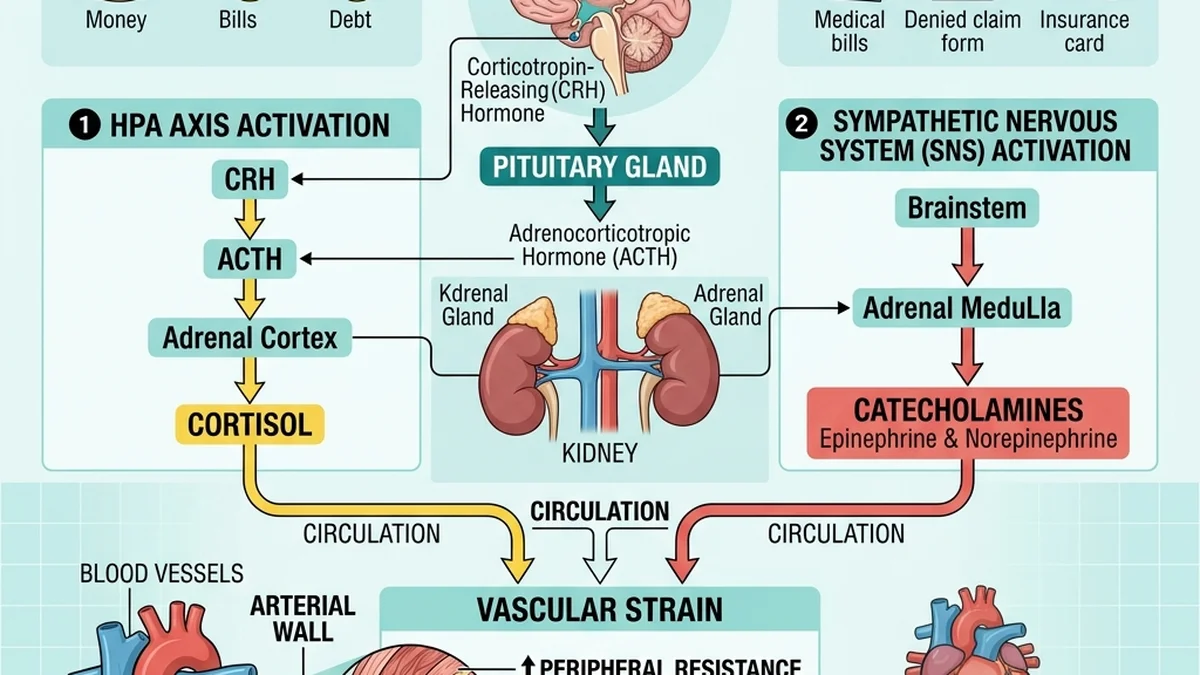
Under acute conditions, cortisol serves an evolutionary purpose, mobilizing glucose reserves, increasing blood pressure, and temporarily inhibiting non-essential metabolic functions. However, when health insurance anxiety remains chronic, cortisol levels remain persistently elevated. This dysregulation has severe systemic consequences across multiple physiological systems:
First, metabolic systems undergo destructive remodeling. Cortisol directly opposes the actions of insulin by suppressing glucose uptake in skeletal muscle and adipose tissue. This occurs via the downregulation and inhibition of GLUT4 glucose transporters at the cellular membrane. Simultaneously, cortisol accelerates hepatic gluconeogenesis by activating key enzymes, specifically phosphoenolpyruvate carboxykinase (PEPCK) and glucose-6-phosphatase. The liver begins producing glucose continuously, elevating fasting blood glucose levels.
Furthermore, elevated cortisol stimulates visceral adipogenesis. Visceral fat cells contain a higher density of glucocorticoid receptors compared to subcutaneous fat. When cortisol binds to these receptors, it upregulates lipoprotein lipase (LPL) activity, which promotes lipid storage around internal organs. This visceral accumulation secretes pro-inflammatory cytokines, including tumor necrosis factor-alpha (TNF-alpha) and interleukin-6 (IL-6), establishing a state of chronic systemic inflammation. This metabolic resistance downregulates insulin receptor sensitivity, significantly increasing the clinical risk of type 2 diabetes and metabolic syndrome.
Second, the vascular system sustains chronic mechanical damage. Financial stress concurrently activates the sympathetic-adrenal-medullary (SAM) axis. This system triggers the release of catecholamines, specifically epinephrine and norepinephrine, from the adrenal medulla. Epinephrine binds to beta-1 adrenergic receptors on cardiomyocytes, increasing cardiac output and heart rate. Norepinephrine binds to alpha-1 adrenergic receptors on vascular smooth muscle, causing arteriolar vasoconstriction.
The combination of vasoconstriction and elevated cardiac output increases systemic vascular resistance, elevating systolic and diastolic blood pressure. This chronic high-pressure flow exerts mechanical shear stress on the delicate endothelial lining of the arterial walls. The damaged endothelium can no longer synthesize adequate nitric oxide, leading to impaired vasodilation. Macrophages and low-density lipoproteins (LDL) accumulate at these sites of endothelial damage, initiating atherosclerotic plaque formation. Over decades, this vascular strain elevates the risk of myocardial infarction, vascular dementia, and cerebrovascular accidents.
Third, autonomic stability and sleep architecture are severely disrupted. The natural diurnal cortisol rhythm peaks shortly after waking (the cortisol awakening response) and hits its lowest point around midnight to allow physiological repair. Chronic insurance anxiety flattens this curve, keeping nighttime cortisol levels elevated. Nighttime cortisol directly interferes with the pineal gland's synthesis of melatonin, the hormone responsible for sleep initiation.
This neurochemical disruption leads to sleep fragmentation, reducing the duration of deep slow-wave sleep and rapid eye movement (REM) sleep. During slow-wave sleep, the brain's glymphatic system clears metabolic waste products, and the parasympathetic nervous system downregulates cardiac output to allow vascular recovery. Without this restorative phase, the body remains in a sympathetic-dominant state. This autonomic imbalance causes a significant drop in Heart Rate Variability (HRV), a primary clinical marker of cardiac resilience. Chronic low HRV indicates autonomic exhaustion, leaving the cardiovascular system vulnerable to acute events.
Choosing your health insurance is therefore a primary clinical intervention. By establishing a robust financial firewall, you eliminate the constant baseline threat of medical bankruptcy. This security reduces allostatic load, the cumulative physiological wear and tear on metabolic and vascular systems, protecting your long-term somatic integrity.
HMO vs. PPO vs. EPO: Routing Architecture and Network Gating
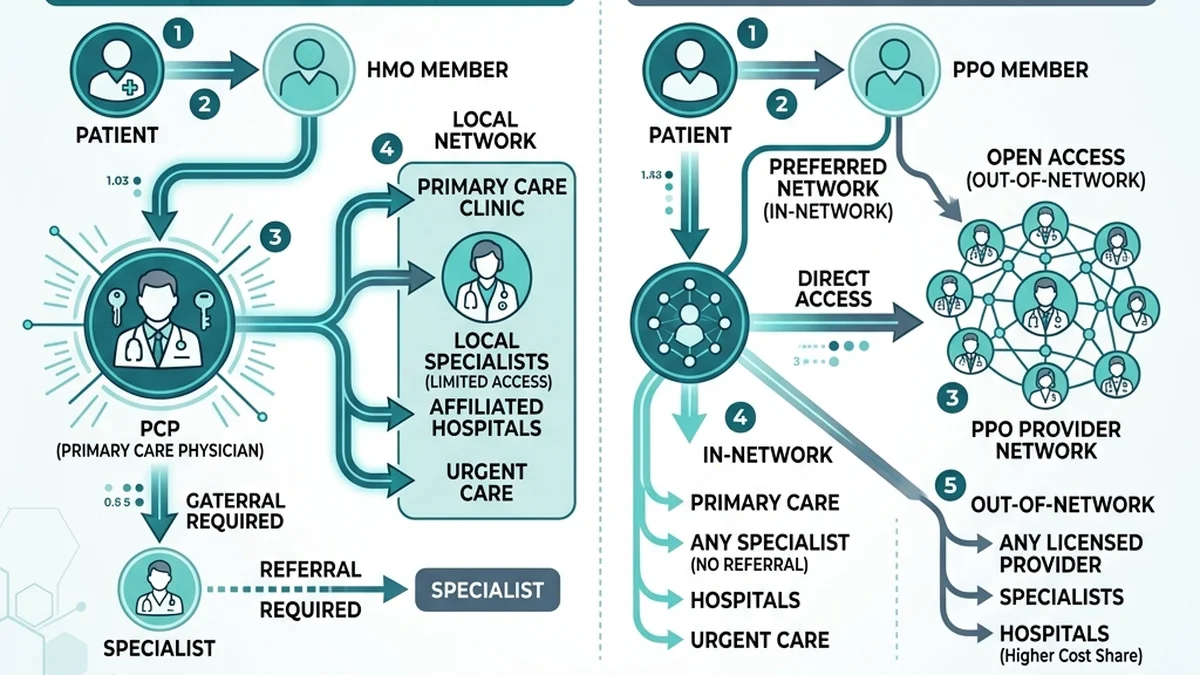
To choose your plan effectively, you must understand the network routing architectures of the three primary coverage models. These systems represent the literal pipelines through which your medical claims are processed, approved, or denied. The structural configuration of each network dictates your access to clinical specialists, your financial liability for out-of-network care, and the administrative hurdles required to receive specialized treatment.
1. The HMO (Health Maintenance Organization): The Closed Gatekeeper Grid
The Health Maintenance Organization (HMO) is designed around strict logistical control and centralized risk management. Under an HMO architecture, you are required to select a single Primary Care Physician (PCP) who acts as a clinical gatekeeper. If you develop a specialized pathology, you cannot simply schedule an appointment with a specialist. You must first visit your PCP, who evaluates the clinical necessity of your request. If the PCP agrees, they generate a formal referral. Without this referral, the insurance company will reject any claims submitted by the specialist.
Furthermore, HMO plans offer zero coverage for out-of-network providers, except in cases of immediate emergency room trauma. If you seek outpatient care, diagnostic tests, or elective surgeries from an uncontracted doctor, the HMO algorithm will process the claim at zero percent coverage. You are left with one hundred percent of the financial liability. While this closed model restricts consumer choice and introduces administrative delays, it offers the lowest premiums and lowest deductibles.
2. The PPO (Preferred Provider Organization): Open Access Routing
The Preferred Provider Organization (PPO) represents the gold standard for clinical freedom and catastrophic protection. A PPO completely eliminates the specialist referral gatekeeping framework. You do not need to select a PCP, and you can self-refer directly to any specialist in the network. If you need to see a cardiologist, neurologist, or endocrinologist, you can schedule an appointment directly with their office.
Crucially, PPOs possess an out-of-network safety valve. If you utilize an uncontracted hospital or physician, the PPO will still execute partial payment, typically covering sixty to seventy percent of the negotiated rate. This prevents total financial collapse in complex medical situations where local specialists are unavailable. The tradeoff for this open routing system is higher monthly premiums and higher deductibles.
3. The EPO (Exclusive Provider Organization): The Hybrid Trap
The Exclusive Provider Organization (EPO) represents a hybrid network architecture. Like a PPO, an EPO does not require PCP referrals to see specialists. You can self-refer and schedule appointments directly with in-network cardiologists, dermatologists, or surgeons. However, like an HMO, an EPO offers zero out-of-network coverage. If you receive care from an uncontracted provider (except in an emergency), the insurance carrier will pay nothing.
This hybrid structure is designed to appeal to individuals who want specialist access without PPO premiums but are willing to accept the risk of strict network containment. It is vital to verify that your local hospitals and emergency rooms are fully in-network, as receiving care at an out-of-network hospital under an EPO will result in complete claim denial.
| Feature Matrix | HMO (Health Maintenance Org) | PPO (Preferred Provider Org) | EPO (Exclusive Provider Org) |
|---|---|---|---|
| Primary Care Physician (PCP) Required | Yes (Mandatory) | No | No |
| Specialist Referrals Required | Yes (PCP gatekeeper) | No (Direct access) | No (Direct access) |
| Out-of-Network Coverage | No (Except emergencies) | Yes (60 percent to 70 percent coverage) | No (Except emergencies) |
| Monthly Premium Tier | Low | High | Moderate |
| Out-of-Pocket Cost Complexity | Low (Copays dominate) | High (Coinsurance dominates) | Moderate |
Actuarial Math: Deductibles, Coinsurance, and Out-of-Pocket Maximums
Selecting your health insurance requires understanding how deductibles, coinsurance, and out-of-pocket limits scale on a financial timeline. The monthly premium is only the ticket to enter the grid; the actual cost of a clinical event is determined by three variables.
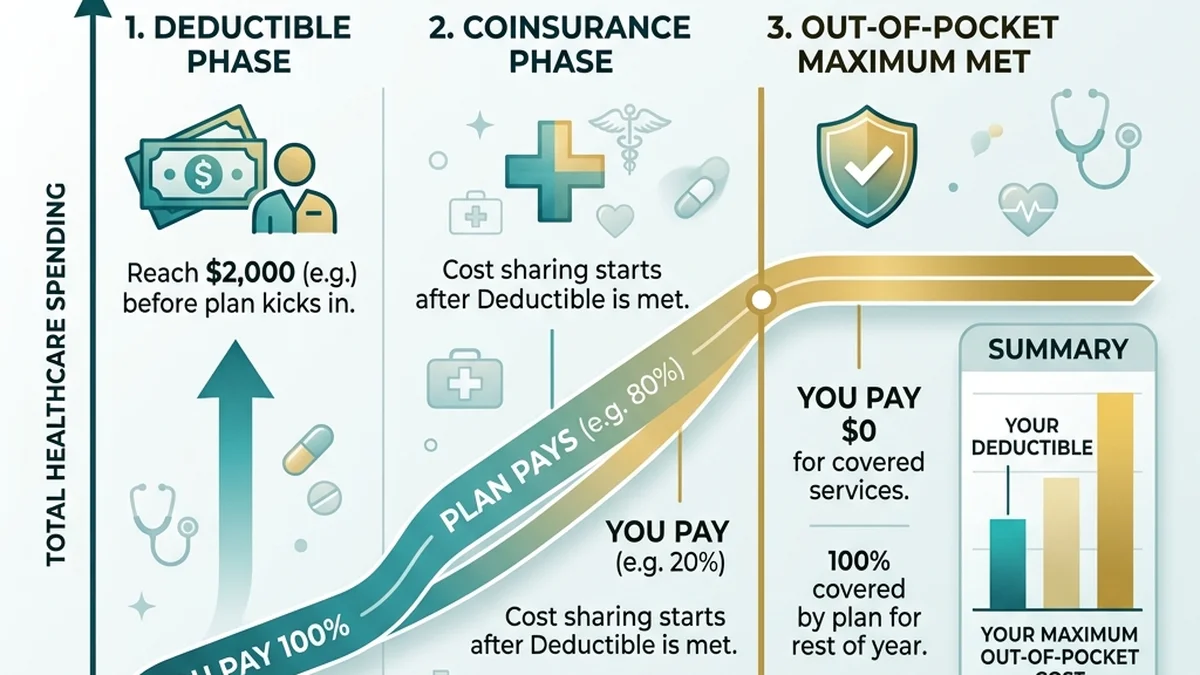
- The Deductible: This is the initial financial tier you must pay entirely out-of-pocket before your insurance carrier begins contributing. For example, if you choose a policy with a three thousand dollar deductible, you must pay the first three thousand dollars of all covered clinical services. Deductibles can be structured as individual or family plans. Family deductibles are typically double the individual rate. In some family plans, an individual deductible is embedded, meaning once a single family member hits their individual deductible, coinsurance kicks in for that member even if the overall family deductible has not been met. In aggregate family plans, the entire family deductible must be reached before anyone receives coinsurance coverage.
- Coinsurance: Once your deductible is met, you enter the coinsurance phase. This represents a shared cost percentage between you and the insurance carrier. If your policy has a twenty percent coinsurance rate, you pay twenty percent of the negotiated medical rate, and the insurance company pays eighty percent. Coinsurance applies to all covered services, including inpatient hospital stays, outpatient procedures, and advanced diagnostic testing, until your cumulative payments reach the annual maximum limit.
- The Out-of-Pocket Maximum (OOPM): This is the single most vital variable in your policy. It is the absolute, legally mandated limit on your annual out-of-pocket expenses. If your OOPM is eight thousand dollars, and your annual medical bills reach three million dollars due to a catastrophic oncology diagnosis, the absolute maximum liability you will face that year is eight thousand dollars. Once you hit the OOPM threshold, the insurance carrier must pay one hundred percent of all in-network covered services for the remainder of the calendar year. In the United States, under the Affordable Care Act (ACA), the federal government limits the maximum OOPM for all ACA-compliant plans. In 2026, these limits are capped at nine thousand two hundred dollars for individuals and eighteen thousand four hundred dollars for families.
A High Deductible Health Plan (HDHP) combined with a Health Savings Account (HSA) is often mathematically superior for healthy individuals. This combination allows you to invest pre-tax dollars into the market to build a dedicated health reserve, while utilizing the catastrophic OOPM as your ultimate financial backstop. Under IRS regulations, an HSA offers a triple tax advantage. Contributions are one hundred percent tax-deductible, funds grow completely tax-free, and withdrawals are tax-free when utilized for qualified medical expenses. If you do not spend the funds, they roll over indefinitely, transforming your health reserve into a powerful long-term wealth building tool.
The Strategic 7-Point Checklist to Choose the Best Health Insurance
To successfully choose your plan, you must execute a systematic audit of your options during the open enrollment window. Use this seven-point clinical and financial checklist:
- Verify Provider Network Alignment: Contact your trusted physicians and check if they are in-network for the specific plan you are considering. Do not rely on directory search engines; call the provider's billing office directly. Ask the billing coordinator: "Are you contracted with this specific network tier of this insurance company for the 2026 calendar year?" This prevents network mismatch errors where a doctor takes an insurance company's PPO but rejects their HMO or exchange plans.
- Audit the Prescription Drug Formulary: Every insurance plan classifies medications into cost tiers. Tier 1 represents low-cost generics, while Tier 5 represents high-cost specialty biologics. If you take chronic medications (such as thyroid hormone replacers or insulin sensitizers), verify their tier status to avoid unexpected co-payments. If a medication is not listed, you must apply for a formal formulary exception through your doctor, a process that can take weeks of administrative appeals.
- Calculate the Total Cost Scenario: Calculate the worst-case scenario using this formula: (Annual Premium + Out-of-Pocket Maximum) - Employer Contributions. The plan with the lowest premium is rarely the plan with the lowest worst-case cost. For example, a low-premium plan with an eight thousand dollar OOPM can be far more expensive than a high-premium plan with a two thousand dollar OOPM if you require emergency hospitalization.
- Analyze Out-of-Network Emergency Room Rules: Under federal regulations (such as the No Surprises Act in the United States), out-of-network emergency room care must be covered at in-network rates. Verify the plan's specific post-stabilization transfer policies. Once you are stabilized, the insurance carrier can demand that you be transferred to an in-network facility. If you refuse, any subsequent care will be billed at out-of-network rates, leaving you vulnerable to balance billing.
- Map Your Diagnostic and Imaging Risk: If you are managing chronic conditions, evaluate the cost structure of diagnostic imaging (such as MRIs and CT scans) and pathology tests (such as HbA1c or lipid panels). Some plans require pre-authorization for all advanced imaging. This introduces a clinical delay where your physician must submit clinical documentation to a third-party benefits manager before the scan can be performed.
- Check HSA Eligibility: If selecting an HDHP, confirm the plan meets federal HSA criteria. In 2026, the minimum deductible and maximum out-of-pocket limits must align with IRS regulations to qualify for triple tax advantages. For 2026, the IRS defines an HDHP as a plan with a minimum deductible of one thousand six hundred fifty dollars for individuals and three thousand three hundred dollars for families, with out-of-pocket limits not exceeding eight thousand three hundred dollars for individuals and sixteen thousand six hundred dollars for families.
- Review Pre-Authorization Requirements: Look for plans that limit pre-authorization barriers for routine imaging, physical therapy, and mental health consultations. Under some plans, even basic physical therapy sessions require ongoing clinical documentation reviews every six visits, which can disrupt your recovery timeline.
Expert Clinical Videos on Health Insurance Selection
To deepen your understanding of health insurance structures, watch these two educational presentations from authoritative healthcare policy and finance channels. Both explain the underlying financial designs and historical development of health networks.
This presentation from AHealthcareZ details the financial structures of PPO, HMO, and CDHP plans, explaining price transparency and network design.
In this episode of Healthcare Triage, Dr. Aaron Carroll explains the historical development and basic terminology of the modern health insurance system.
Conclusion: Executing Your Financial and Biological Firewall
Successfully navigating open enrollment is never a matter of luck. It is the direct outcome of combining structured financial analysis with an honest assessment of your biological baseline. The lowest monthly premium is a design template meant to lure in consumers who ignore their physiological risk profiles. By understanding network routing, calculating out-of-pocket maximum ceilings, and evaluating your cellular metabolic and vascular state, you can construct a robust safety net. Protect your health and your wallet by aligning your coverage with your biological reality.
Scientific References & Actuarial Sources
- Centers for Medicare & Medicaid Services (CMS): Official regulations and actuarial guidelines defining annual out-of-pocket maximum ceilings under federal law. Explore Federal CMS Regulations
- Kaiser Family Foundation (KFF): Actuarial analysis of employer-sponsored health benefit designs, showing trends in premiums, deductibles, and network coverage restrictions. Access KFF Underwriting Data
- Healthcare.gov (Federal Marketplace): Regulatory definitions and plan comparison frameworks for HMO, PPO, EPO, and HSA-qualified High Deductible Health Plans. Search ACA Framework Data
- American Journal of Managed Care (AJMC): Peer-reviewed research investigating the correlation between high out-of-pocket costs, patient stress, and prescription medication adherence.
Health is Heaven maintains absolute clinical integrity by sourcing data exclusively from high-authority, peer-reviewed medical and actuarial institutions. Every calculation and recommendation is cross-referenced against the latest biological benchmarks.
Frequently Asked Questions
What is the absolute difference between an HMO and a PPO?
An HMO (Health Maintenance Organization) requires you to get referrals from a Primary Care Physician to see specialists and covers zero out-of-network care. A PPO (Preferred Provider Organization) allows you to see specialists without referrals and provides partial coverage for out-of-network providers, though premiums are higher.
How does the Out-of-Pocket Maximum protect me from medical bankruptcy?
The Out-of-Pocket Maximum is the absolute legal limit you can pay for covered health services in a year. Once you pay this amount through deductibles, copays, and coinsurance, the insurance plan pays one hundred percent of all covered medical costs for the rest of that year.
Is an HSA-qualified High Deductible Health Plan a good choice for everyone?
An HSA-qualified HDHP is mathematically ideal for healthy individuals with low medical utilization, as it allows pre-tax savings to grow while keeping premiums low. However, if you manage chronic conditions that require frequent specialist visits and medications, a plan with a lower deductible may be more cost-effective.
What happens if I see a doctor who is out-of-network?
If you have an HMO or EPO, the plan will pay zero percent of the cost for out-of-network care, leaving you with the entire bill (except in emergency situations). If you have a PPO, the plan will cover a portion (usually sixty to seventy percent of the allowed amount), but you will pay the difference.
Does health insurance cover medical procedures performed out-of-state?
Yes, but coverage depends on network design. Emergency care is protected nationwide under federal law. However, for non-emergency care, an HMO will only cover it if you receive an out-of-network authorization, while a PPO will cover it at their out-of-network rate, which is higher than in-network rates.

Ganesh G Kamble
Ganesh G Kamble is the founder and editor of Health is Heaven. He spent 14 years as a techno-functional consultant on enterprise ERP systems in Bangalore before turning his attention to health publishing. His background is technical, not clinical, and he is not a medical professional. He started Health is Heaven because most online health information is either too vague to act on, too technical to understand, or too commercial to trust. The site's mission is to provide clear, evidence-based answers to common health questions, with sources you can verify, alongside free interactive calculators built using standard medical formulas published by recognised authorities including the World Health Organization, the U.S. Centers for Disease Control and Prevention, the American Heart Association, the American Diabetes Association, and the National Institutes of Health. Every article is reviewed against authoritative sources before publishing, dated with both publish and last-updated timestamps, and clearly marked as informational only when covering medical topics. Articles dealing with diagnosis, treatment, or medication recommend speaking with a qualified healthcare provider. The site does not accept paid placements that influence editorial content; any future advertising is clearly labelled and separated from articles. Ganesh is based in Bangalore, India, and connects with readers and collaborators on LinkedIn.