
Medically reviewed by: Health is Heaven Medical Review Board | Published by Ganesh G Kamble, Health is Heaven | Published: April 19, 2026 · Last updated: August 29, 2026
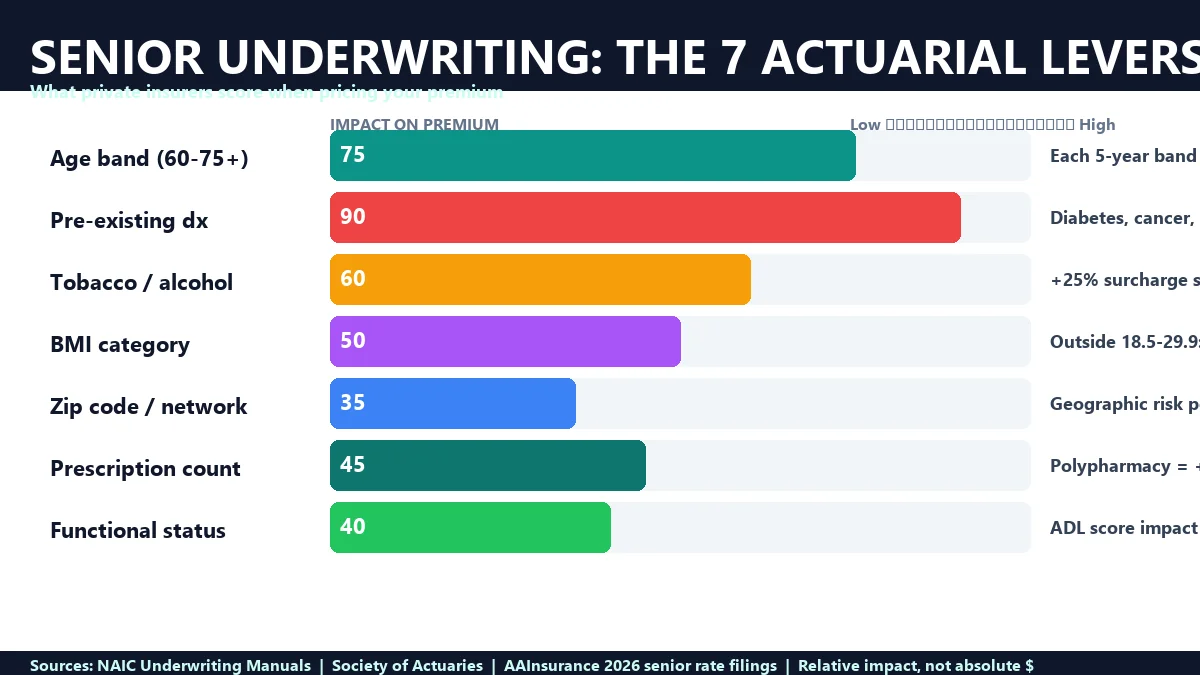
A 70-year-old in Phoenix can pay $9,250 out-of-pocket in a single bad year, or $0 for the exact same cardiac event, depending on a single piece of paper they signed at age 64. That paper is a senior health insurance contract, and in 2026 the actuarial gap between the cheapest plan and the smartest one is wider than it has ever been. Public baselines (Medicare, the NHS, provincial Medicare, Australian Medicare) provide the absolute floor. Selecting the right private health insurance for seniors Medicare supplement or expat plan is what determines whether the floor collapses during the most common, most expensive year of a senior's life. If you are comparing options for your household, you must learn how to choose health insurance plan for family coverage (before selecting senior-specific coverage, understanding how to choose best health insurance plan structures is essential to evaluate baseline deductibles and networks). This guide deconstructs the entire architecture across four national systems, maps the seven actuarial levers that drive your premium, and shows you how to integrate objective clinical metrics into the decision before you sign. For younger individuals living or working abroad, see our guide to the health insurance for expats.
Before analyzing the actuarial structure of a senior health insurance plan, you must first establish your clinical baseline. Insurers in every national system price coverage using a blend of biometric data (blood pressure, BMI, A1C), prescription medication load, and pre-existing diagnoses. A private insurance quote built on a foundation of unmeasured health risk is a quote that will be incorrect once your actual health metrics are disclosed during underwriting. To freeze your premiums and identify potential coverage gaps, complete these three objective self-assessments first.
Lock In Your Senior Coverage Baseline
Insurance actuaries price on biometrics. Verify yours before you accept a quote.
1. The Senior Coverage Gap: Why Public Healthcare Is the Floor, Not the Ceiling
The most expensive financial mistake a person can make in retirement is to assume that turning 65 (or 60, or 67, depending on jurisdiction) and enrolling in the public system has solved their healthcare risk. It has not. The public layer was designed to keep a baseline of acute care accessible; it was never designed to absorb the actuarial weight of a population whose per-capita medical consumption peaks at age 75.
In the United States, the federal Medicare program carries a 20% uncapped coinsurance on Part B services. There is no out-of-pocket maximum in Original Medicare. A single year of complex cardiac care, cancer treatment, or joint replacement can run a beneficiary into six figures of personal liability, where finding reliable medical debt help becomes a critical survival necessity. In the United Kingdom, the NHS provides comprehensive hospital and primary care, but dentistry, optical, hearing, and elective surgery waiting lists routinely exceed 18 weeks. In Canada, the provincial plans exclude prescription drugs, dental, vision, and most long-term care. In Australia, Medicare covers 75% of the schedule fee for in-hospital treatment by a public doctor, with no coverage for ambulance, dental, or physiotherapy. For seniors exposed to industrial toxins earlier in life, receiving a major diagnosis like lung cancer or understanding mesothelioma symptoms and diagnosis requirements is essential for choosing a plan that covers specialized oncology clinics.
Private senior health insurance is the actuarial instrument that closes these gaps. Its purpose is to convert catastrophic, uncapped, or chronically delayed risk into a predictable, monthly, budgetable line item. The question is not whether a senior needs private coverage. The question is which layer, in which national system, will provide the most protection per dollar of premium.
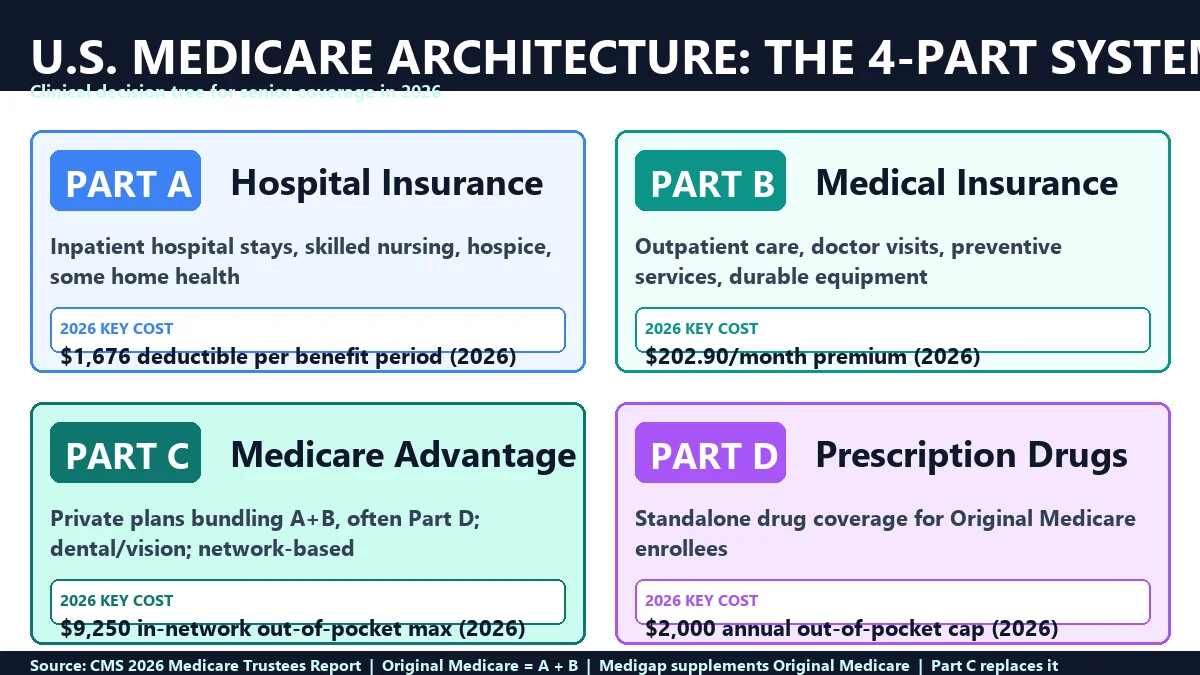
2. The U.S. Medicare Architecture: 4 Parts and 2 Critical Decisions
The U.S. senior system is unique among developed nations because there is no single public alternative to private insurance. Medicare is the baseline, but the architecture splits into four parts (A, B, C, D), and the senior must make two high-stakes structural decisions:
- Original Medicare with a Medigap supplement, or a Medicare Advantage (Part C) bundle
- How to handle prescription drugs (bundled into Part C, or as a separate Part D plan)
Each combination carries a different actuarial profile.
Original Medicare + Medigap (The Predictable Path)
Original Medicare consists of Part A (hospital insurance, $1,676 deductible per benefit period in 2026) and Part B (medical insurance, $202.90/month premium in 2026, $283 annual deductible). Once the deductible is met, Medicare covers 80% of approved amounts. The remaining 20% is the patient's responsibility, with no cap.
A Medigap (Medicare Supplement Insurance) policy is private insurance that sits on top of Original Medicare and pays the 20% coinsurance, deductibles, and copays that Original Medicare does not cover. Medigap Plan G is the most comprehensive standardized plan available to new enrollees in 2026. It covers everything Original Medicare does not, except the Part B deductible. Plan G premiums for a 70-year-old non-smoker in most states range from $120 to $250 per month. Plan N is a lower-premium alternative ($90 to $180 per month) that requires small copays for office visits and emergency room use.
The clinical advantage of Medigap is unrestricted provider access. You can see any doctor, any specialist, any hospital in the United States that accepts Medicare. There are no networks, no prior authorization requirements, and no referral gatekeeping. For a senior with a complex cardiac history, an active oncology workup, or a chronic condition requiring multiple specialists, this freedom has measurable clinical value. The actuarial disadvantage is that you will pay a higher monthly premium and you must purchase a separate Part D plan for prescription drugs.
Medicare Advantage (The Network Path)
Medicare Advantage (Part C) is a private alternative to Original Medicare. The federal government pays a fixed monthly amount to a private insurer (UnitedHealthcare, Humana, Aetna, Blue Cross Blue Shield, Kaiser Permanente, etc.) to administer your Medicare benefits. The plan must cover everything Original Medicare covers, and most plans add dental, vision, hearing, fitness benefits, and prescription drug coverage in a single bundled product.
The marketing emphasis is on $0 premium plans and extra benefits. The actuarial reality is more nuanced. Medicare Advantage plans operate as HMOs or PPOs. You must use in-network providers to receive the lowest cost-sharing. Out-of-network care is either not covered (HMO) or subject to substantially higher copays (PPO). Prior authorization is required for many procedures, including advanced imaging, home health, and post-acute skilled nursing stays. The 2026 in-network out-of-pocket maximum is capped at $9,250 (combined in- and out-of-network: $13,900). This is the first true cap in the U.S. senior system, and it is the single most important number in any Medicare Advantage decision.
The clinical risk is network adequacy. In late 2025 and early 2026, multiple major health systems began terminating Medicare Advantage contracts, citing prior authorization delays and denials that were compromising patient care. Beneficiaries received letters informing them their cardiologist, oncologist, or hospital system was no longer in-network. If your essential care providers are not contracted with the plan you select, you will either pay full out-of-network costs or be forced to change physicians mid-treatment. The financial cap of $9,250 is meaningless if the plan refuses to authorize the care that would push you toward it.
The Part D Prescription Drug Coverage Layer
Part D is the prescription drug benefit. Original Medicare enrollees purchase a standalone Part D plan from a private insurer. Medicare Advantage enrollees usually receive Part D bundled into their plan. The 2026 Inflation Reduction Act cap of $2,000 on annual out-of-pocket Part D spending has fundamentally reshaped senior pharmacy economics. Once you hit $2,000 in covered prescriptions, you pay $0 for the remainder of the calendar year. This is a 100% catastrophic cap, and it is the single most important piece of senior prescription legislation in two decades.
Formulary design is the operational catch. Each Part D plan has a formulary that lists covered drugs at specific tiers. A medication on Tier 1 (preferred generic) may cost $4. The same medication on a competitor's Tier 4 (non-preferred brand) may cost $180. Every senior should run their medication list through the Medicare Plan Finder during Open Enrollment (October 15 to December 7) to ensure their specific drugs are covered at the lowest possible tier.
 <figc<figc
Ganesh G Kamble
Ganesh G. Kamble is the founder and editor of Health is Heaven. He built this site after losing his father to a preventable condition, with the mission of providing clear, trackable health indicators so others can act early. His background is in the IT industry (16 years as an enterprise consultant) and he is not a medical professional; all medical content, formulas, and guides are reviewed by a credentialed medical reviewer/board before publication.