
Medically reviewed by: Health is Heaven Medical Review Board | Published by Ganesh G Kamble, Health is Heaven | Published: June 7, 2026 · Last updated: September 22, 2026
Receiving a flat denial letter for a policy because of a bad medical exam is a uniquely devastating experience. When an underwriter rejects your application, navigating a high blood pressure life insurance decline means recognizing that a multi-billion dollar corporation ran the math on your internal biology and determined that writing a policy on you was a guaranteed financial loss. They did the math, and they bet that your cardiovascular system would fail before you paid off the premiums.
At Health is Heaven, we approach the human body exactly the way an actuarial scientist does: as a complex system of interconnected probabilities. Life insurance companies do not care about your feelings; they care exclusively about structural hardware integrity. High blood pressure (hypertension) is the ultimate red flag because it is the root mechanical cause of catastrophic, sudden-death events like massive ischemic strokes and acute myocardial infarctions. Underwriters evaluate these cardiovascular risks (which can be mitigated by following clinically proven low sodium recipes for heart health) by referencing a standard normal blood pressure range by age chart to determine if your age-stratified metrics fall into preferred risk classes or signal chronic hypertension.
In this rigorously engineered clinical breakdown, we are going to expose the hidden, cold-blooded algorithms that underwriters use to deny high blood pressure life insurance. More importantly, we will outline the exact biological sequence required to force your metrics back into an acceptable underwriting tier so you can secure the vital protection your family needs (additionally, understanding how to choose best health insurance plan architectures is crucial for managing day-to-day vascular health costs).

The Architect's Protocol
Ganesh G Kamble - Founder & Principal Systems Strategist
"From a purely systemic layout, an insurance company evaluating hypertension is exactly like an IT auditor evaluating a critical server room. If they see that the main cooling lines are running at 180% above standard operating pressure, they will never issue a warranty on that hardware. They know the pipes will burst. The interactive calculators built on Health is Heaven are the exact diagnostics you need to evaluate your own hardware before the auditor shows up."
Verify Your Cardiovascular Metrics Before Your Insurance Exam
Do not walk blindly into a paramedical exam. Run your numbers through our clinical calculators to determine your exact risk category and optimize your parameters.
The Actuarial Algorithm: Why Pressure is Poison (High Overview)
To secure a high blood pressure life insurance policy, you must first understand why the company views this exact metric with absolute terror.
When your blood pressure is chronically elevated, meaning anything consistently over 130/80 mmHg, the sheer physical force of the blood ramming against the delicate inner lining of your arteries causes microscopic tears. The human vascular system is lined with a single layer of cells called the endothelium. Under high pressure, the mechanical friction, known as shear stress, degrades this protective layer. Your body attempts to patch these tears with cholesterol, specifically atherogenic apolipoprotein B (ApoB) particles. Over time, this cholesterol hardens into rigid plaque, a condition known as atherosclerosis.
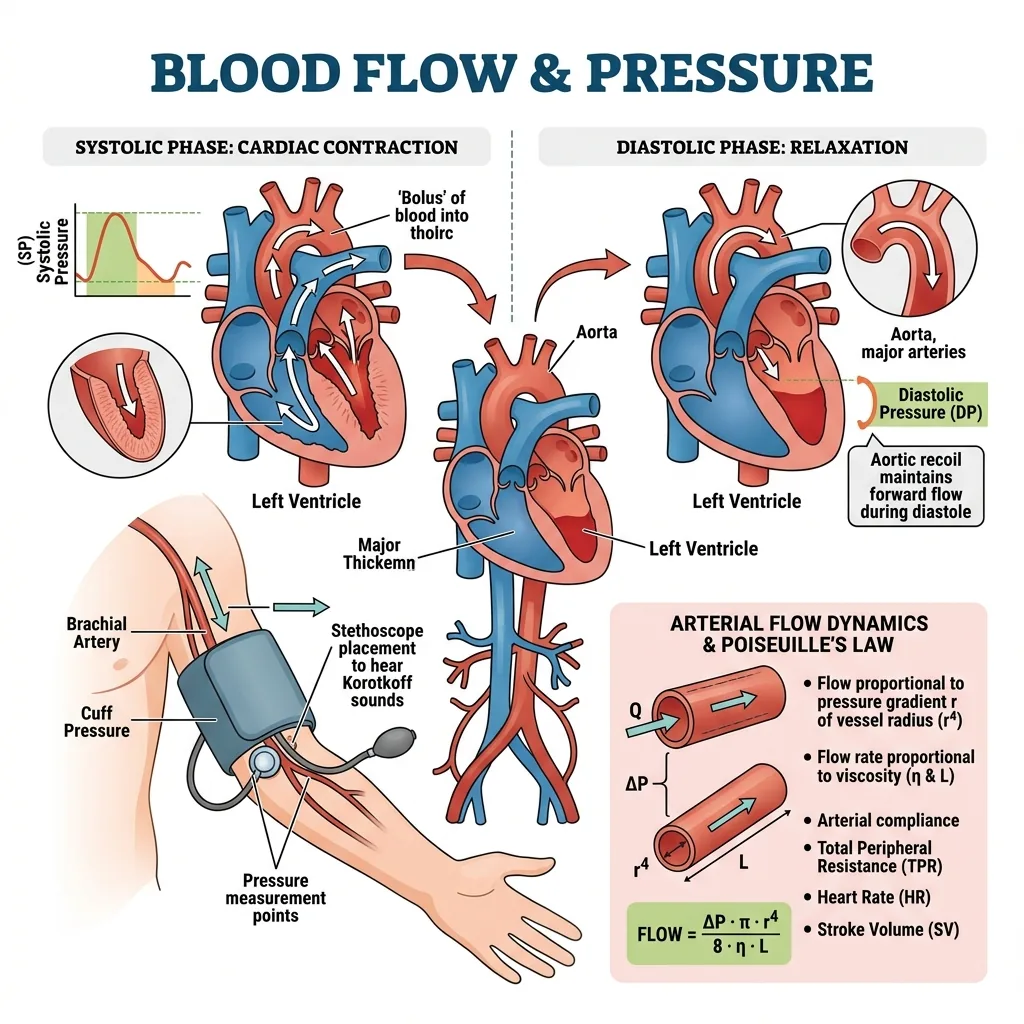
Insurance companies know that a rigid, plaque-filled artery is a ticking time bomb. If a piece of that plaque snaps off under the immense hydraulic pressure, it travels to the brain, causing an ischemic stroke, or to the heart, causing a coronary blockage (myocardial infarction). Because hypertension often presents with literally zero outward symptoms, underwriters heavily track your diagnostic history. They realize you are likely entirely unaware of the active damage occurring internally. They look at your readings as a measurement of how close your plumbing is to a catastrophic blowout.
Actuarial tables translate these physiological parameters into hard financial risk. According to long-term clinical cohort studies published in journals like the Lancet and the Journal of the American College of Cardiology, a sustained elevation of 20 mmHg in systolic pressure or 10 mmHg in diastolic pressure doubles the risk of cardiovascular death within a 10-year follow-up period. Research from 2024-2026 continues to refine these hazard ratios, confirming that even modest pressure reductions significantly improve long-term mortality outcomes. Underwriters use these evidence-based hazard ratios to adjust their premium structures, ensuring that patients with higher baseline pressures pay a heavy premium to offset their elevated mortality curve. The underwriters use mean arterial pressure (MAP) and pulse pressure calculations as primary indicators to evaluate systemic vascular resistance, assessing whether your cardiovascular system is experiencing constant mechanical damage.
The 5 Medical Tiers of Life Insurance Underwriting
When applying for high blood pressure life insurance, you do not simply pass or fail. You are ruthlessly sorted into specific risk tiers. Understanding these algorithmic buckets is critical because a single tier shift can save you thousands of dollars in annual premiums over the life of a policy.
1. Super Preferred (The Elite Tier)
This tier receives the absolute cheapest possible premiums. To hit this level, your blood pressure must be consistently under roughly 120/80 mmHg without the aid of any medication whatsoever. Your system is deemed structurally flawless, placing you in the lowest percentile of cardiovascular mortality risk. Actuaries view this as the gold standard of biological durability.
2. Preferred (The Acceptable Tier)
To qualify here, your readings can hover around the 130/85 mmHg mark. Importantly, many major carriers will grant you Preferred status even if you are actively taking a low-dose blood pressure medication, provided your readings have been totally stable for a minimum of 12 consecutive months. This demonstrates to the underwriter that your hypertension is controlled and the risk of acute vascular failure is minimized.
3. Standard (The Penalty Tier)
If you routinely float around 140/90 mmHg, you will be heavily penalized. You will secure coverage, but you will pay standard premiums which are significantly higher than preferred rates. In this tier, you are mathematically categorized as a high-risk structural asset because your blood vessels are actively undergoing arterial remodeling and thickening.
4. Substandard (The Rated Tier)
If your blood pressure is consistently between 145/95 and 159/99 mmHg, you will be placed on a table rating system (usually designated as Table A through Table H). Each table rating adds a 25% premium surcharge on top of the Standard rate. For instance, a Table B rating means you are paying standard rates plus an additional 50% premium penalty. Actuaries apply these ratings because they anticipate a significantly shortened lifespan compared to healthy peers.
5. Automatic Decline (The Red Zone)
If your readings exceed 160/100 mmHg during the paramedical exam, or if your medical records show wild, uncontrolled swings alongside severe comorbidities (such as Type 2 Diabetes, severe obesity, or previous cardiac events), you will be instantly declined. The company cannot mathematically justify the immense payout risk, as your risk of a sudden cardiovascular event is elevated to an uninsurable degree. Similarly, diagnoses of aggressive or late-stage cancers will result in an immediate decline, which is why early awareness of terminal markers like mesothelioma symptoms and diagnosis is critical for patients exposed to occupational hazards.
Comorbidities: The Visceral Loading Factor
Insurance companies never evaluate blood pressure in a vacuum. They look at the complete structural load on your body. If you have a blood pressure of 135/85 mmHg but also possess a BMI of 34 and a high body fat percentage, you will be heavily penalized or outright declined. This is because these metrics are not just independent risk factors; they compound each other exponentially.
Visceral fat, the deep fat wrapping around your internal organs, acts as an active endocrine organ. It secretes inflammatory cytokines such as tumor necrosis factor-alpha (TNF-alpha) and interleukin-6 (IL-6), which directly drive endothelial dysfunction. Additionally, visceral fat physically compresses your kidneys, triggering the renin-angiotensin-aldosterone system (RAAS) to raise blood pressure. When an underwriter sees a high BMI combined with elevated blood pressure, their algorithm calculates a massive increase in the risk of metabolic syndrome, sleep apnea, and progressive kidney damage.
Obstructive Sleep Apnea (OSA) is another major co-morbidity that underwriters closely monitor. The apnea-hypopnea index (AHI) is a key diagnostic metric. When your breathing stops during sleep, your oxygen saturation drops, triggering a massive release of catecholamines (adrenaline and noradrenaline). This leads to acute pulmonary vasoconstriction and sustained noctur

Ganesh G Kamble
Ganesh G. Kamble is the founder and editor of Health is Heaven. He built this site after losing his father to a preventable condition, with the mission of providing clear, trackable health indicators so others can act early. His background is in the IT industry (16 years as an enterprise consultant) and he is not a medical professional; all medical content, formulas, and guides are reviewed by a credentialed medical reviewer/board before publication.