Health Insurance for Expats & Digital Nomads 2026: Best Global Plans Reviewed

Medically reviewed by: Health is Heaven Medical Review Board | Published by Ganesh G Kamble, Health is Heaven | Published: June 7, 2026

There is a massive, incredibly dangerous misconception running through the global remote work and expatriate community. Millions of individuals crossing international borders believe that the cheap travel insurance tacked onto their flight checkout screen or purchased for a nominal monthly fee will protect them if they suffer a catastrophic biological failure in Southeast Asia, Central America, or Eastern Europe. It absolutely will not. Securing true, comprehensive health insurance for expats is not about covering lost luggage, delayed flights, or minor dental pain; it is a calculated, actuarial necessity designed to prevent total financial ruin when your biological system requires emergency intensive care three time zones away from your primary support network.

At healthisheaven.com, we approach global medical coverage exactly as a network engineer approaches server redundancy and system failovers. When you leave your domestic healthcare grid (such as the National Health Service in the United Kingdom, Medicare in the United States, or universal Medicare systems in Canada and Australia), you are stripping away your physiological and financial firewall. You are now operating in zero trust territory. If you suffer a ruptured appendix in Chiang Mai, a severe dengue fever hemorrhagic spike in Bali, or a sudden myocardial infarction in San Jose, the local private hospitals demand immediate, liquid capital before they grant you access to their advanced hardware (the operating room and intensive care ventilators). Expat insurance is the pre-configured authorization protocol that bypasses the localized financial paywall, ensuring your biological survival is not held hostage by administrative delays.

In this rigorously engineered clinical and financial breakdown, we are going to expose the hidden algorithms that underwriters use to process global claims and price risk. We will dissect the absolute difference between travel insurance and global medical policies, outline the biophysical and logistical mathematics of medical repatriation, and explain how to utilize our integrated tools to calculate your baseline physical risk before transitioning to a nomadic lifestyle. Biological hardware fails eventually; expat insurance is simply purchasing the backup server.

SPONSORED CONTENT

Interactive Tool

Verify Your Underwriting Risk Metrics

Use our free clinical estimators to evaluate your baseline cardiovascular, metabolic, and premium risk before applying for global expat coverage.

The Fatal Error: Travel Insurance vs. Expat Health Insurance

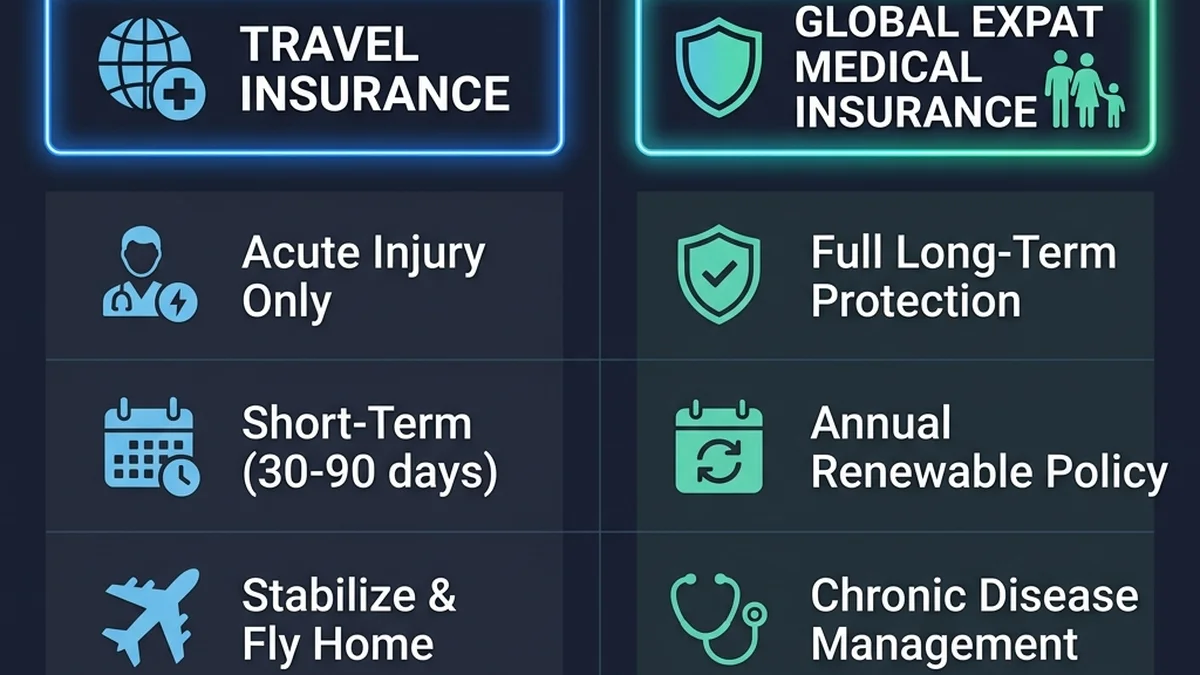
To accurately evaluate your international risk, you must first understand the actuarial difference between two completely isolated financial products. Travel insurance (such as the policies offered by World Nomads, SafetyWing Nomad Insurance, or credit card add-ons) is strictly designed for short-term vacations, typically capped at 30 to 90 days per trip. It is engineered solely for acute emergencies. If you fracture a bone, they will cover the cost of the cast and the emergency room visit to stabilize you. However, their primary goal is stabilization for travel: they will patch you up so you survive the flight back to your home country. The moment you land back in your home country, the travel policy terminates, leaving you completely unprotected for the necessary reconstructive surgery, physical therapy, and follow-up clinical visits.

In contrast, true expat health insurance is a fully integrated, annualized medical policy. It operates exactly like premium domestic healthcare, but on a global scale. It covers routine general practitioner visits, preventative blood panels, chronic disease management (such as the onset of Type 2 Diabetes or cardiovascular disease while living abroad), and massive inpatient treatments including oncology, cardiac surgery, and long-term psychiatric support. Most importantly, it includes continuous home country coverage (often up to 180 days per year), allowing you to return home to receive treatment from your trusted network of specialist clinicians without losing coverage. Expat insurance is designed for those who have moved their primary residence overseas, establishing a new lifestyle node outside their native healthcare system.

Let us look at a clinical scenario to illustrate this. An expat in Spain suffers a severe asthma attack requiring a three-day stay in an intensive care unit. Under a travel insurance policy, the insurer may cover the acute stabilization, but they will immediately mandate that the patient return to their home country for ongoing maintenance and inhaler prescriptions. If the patient refuses to return home, all further claims related to asthma are denied. Under a comprehensive global medical policy, however, the patient's ongoing asthma management (including specialist pulmonologist consultations, lung function tests, and daily preventative steroid inhalers) is fully covered in Spain, ensuring continuous care without forcing an unwanted international relocation.

travel insurance vs medical insurance comparison diagram
Actuarial risk models and coverage differences between travel policies and global comprehensive health insurance.

The Actuarial Science of Global Risk Modeling

Insurance underwriters calculate premiums by evaluating several distinct risk vectors. For expats, these vectors are categorized into strict risk bands. The primary driver is age. Actuarial tables indicate that the probability of biological system failure increases non-linearly after age 40. For instance, a 25-year-old digital nomad presents a low statistical risk for cardiovascular events, allowing underwriters to offer baseline premiums. However, once an individual enters the 45 to 55 age bracket, the risk of chronic conditions rises exponentially, leading to premium loading. Underwriters use these age-rated risk bands to ensure the pool of premiums collected is sufficient to cover the projected medical claims of the group.

Geographical rating zones are the second major factor. Global insurers divide the world into distinct zones, primarily based on the localized cost of healthcare hardware and medical labor. Zone 1 almost always includes the United States, where medical billing is highly inflated. Zone 2 covers the rest of the world, including high-cost areas like Hong Kong, Singapore, and Switzerland. Zone 3 covers worldwide excluding the US and Canada. By choosing a policy that excludes coverage in the US, expats can immediately reduce their annual premiums by up to 50 percent. This is because the billing rates in US hospitals are significantly higher than those in JCI-accredited facilities in other regions.

The deductible structure represents the third risk vector. A deductible is the amount of liquid capital you must pay out of pocket before the insurer's billing server begins to absorb the cost. By opting for a higher deductible, you assume a portion of the financial risk, which lowers the insurer's potential liability and results in a lower monthly premium. This is a key tool for digital nomads who maintain emergency cash reserves and wish to keep recurring costs low. Actuarial data shows that policies with a 2,500 dollar deductible can reduce premium costs by up to 35 percent compared to zero-deductible plans.

Furthermore, underwriters analyze the medical inflation rate of the expat's destination country. Countries with rapid healthcare development, such as Thailand or the United Arab Emirates, experience medical inflation rates of 8 to 12 percent annually. This inflation is driven by the purchase of advanced diagnostic hardware, such as 3T MRI machines and robotic surgery systems, as well as the recruitment of Western-trained medical specialists. Expat policies must adjust their pricing matrices annually to account for this rising cost of local care, meaning that your premium will likely increase even if your personal health status remains unchanged. Understanding these macro-economic trends helps expats plan their long-term financial budgets when living abroad.

Additionally, underwriters look at localized administrative costs. In some countries, private hospitals charge a premium for international administrative services, including English-speaking coordinators and direct insurance billing staff. These costs are factored into the insurer's claims data, causing regional premium variations. For example, an expat policy for an individual living in a major expat hub like Bangkok or Dubai will be priced higher than the same policy for someone living in a rural area of the same country, reflecting the higher hospital operational costs in major metropolitan centers.

Logistical Blueprint of Medical Evacuation and Repatriation

Never sign a global health policy that caps medical evacuation under 250,000 dollars. If you are trekking in a secondary geographical node (such as rural Vietnam or the Peruvian Andes) and you suffer a catastrophic traumatic brain injury or severe septic shock, the local clinic will not have the neurosurgical hardware or the life-support ventilators required to keep you alive. You must be airlifted to a primary medical hub like Singapore, Bangkok, or Houston. The logistics of this transfer are incredibly complex and require specialized assets.

The physics of high-altitude transport require a specialized air ambulance. These are typically modified light jets (such as a Learjet 35 or 45) outfitted as a flying Intensive Care Unit. The onboard environment must replicate ground-level barometric pressure to prevent gas expansion in the patient's body cavities, a critical factor in cases of pneumothorax or recent abdominal surgery. The crew must consist of at least one aerospace medicine trained physician and a critical care registered nurse. The flying ICU must carry advanced monitoring equipment, ventilators, and emergency drugs to manage the patient's vitals during transit.

medical evacuation and repatriation flight path diagram
An air ambulance transport requires specialized pressurization protocols and critical care staff to ensure patient stability during high-altitude transit.

The cost breakdown of such an operation is staggering. The aircraft positioning, specialized fuel, landing permits, medical crew staging, and ground ambulance transfers easily accumulate to between 100,000 and 150,000 dollars for a mid-range international transit. Without a comprehensive repatriation clause, the patient must secure this funding via liquid capital before the aircraft is allowed to take off. Expat health insurance removes this logistical barrier by issuing an immediate guarantee of payment to the air charter provider, allowing the medical team to launch within hours of the emergency request.

Moreover, the physiological stress of flight at high altitudes can worsen cardiorespiratory deficits. According to gas laws, specifically Boyle's Law, the volume of a gas is inversely proportional to the pressure exerted on it. As altitude increases and atmospheric pressure drops, any trapped gas within the patient's body (such as in the lungs, middle ear, or gastrointestinal tract) expands. For a patient with a collapsed lung or a recent surgical incision, this expansion can lead to tension pneumothorax or tissue rupture. The aerospace medical crew must continuously monitor and adjust the cabin pressure, often flying at lower altitudes to maintain safe barometric levels, which increases fuel consumption and overall logistical costs.

In addition to gas expansion, cabin humidity levels in high-altitude aircraft often drop below 10 percent, leading to rapid mucosal dehydration. This compromises the patient's ciliary clearance mechanisms, increasing the risk of respiratory infections and mucus plugging in ventilated patients. The medical crew must actively humidify the oxygen supply and administer intravenous fluids to prevent dehydration. This level of physiological management requires highly trained aerospace medical staff, making the inclusion of unrestricted medical evacuation and repatriation a non-negotiable requirement for any expat policy.

Underwriting Mechanics and Pre-Existing Conditions

Underwriters use two primary methods to evaluate your medical history: Full Medical Underwriting (FMU) and Moratorium Underwriting. Understanding the operational path of each is critical before submitting an application.

Under Full Medical Underwriting, you must declare every medical event, prescription, doctor visit, and symptom you have experienced, typically looking back five to ten years. The underwriting team reviews this data and may apply specific exclusions (such as refusing to cover any future spinal treatments if you have a history of herniated discs) or premium loadings. The advantage of FMU is certainty: once the policy is issued, you know exactly what is covered and what is excluded, leaving no room for claims disputes during an emergency. This is the preferred route for individuals with minor, well-managed chronic conditions who want to lock in coverage.

Moratorium Underwriting takes the opposite approach. You do not declare your medical history on the application. Instead, the insurer applies a blanket moratorium (usually two years) to all pre-existing conditions. If you have had any symptoms, treatments, or medicines for a condition in the past 24 to 60 months, that condition is automatically excluded. If you go consecutive two years post-policy signoff with zero symptoms, zero treatments, and zero medical advice for that condition, it may then be added to the covered list. This is highly risky for chronic conditions like hypertension or asthma, where continuous medicine is required to prevent systemic failure.

Additionally, look-back periods serve as a secondary audit during claims processing. If you file a major claim within the first year of a policy, the insurer's claims department will request your historical medical records from your home country. If they discover that you had sought medical advice or exhibited symptoms for the claimed condition prior to the policy start date without declaring it, the claim will be denied for non-disclosure. This highlights the importance of absolute honesty during the application phase, as any omission can invalidate your entire global medical policy.

Let us analyze the moratorium underwriting loop. Imagine an expat who experienced occasional knee pain eighteen months ago and took over-the-counter pain medication, but did not consult a doctor. Under a moratorium plan, this knee pain is considered a pre-existing condition because it occurred within the moratorium window. If they suffer a ligament tear in that same knee six months into the policy, the insurer will review the medical history and deny coverage for the surgery, arguing that the pre-existing knee instability contributed to the acute injury. This shows that moratorium plans do not bypass underwriting; they simply delay it until you file a claim, introducing significant financial uncertainty during critical times.

Diagnostic Comparison of Top-Tier Expat Providers

Selecting the right insurer requires analyzing their direct billing network. If an insurer lacks a direct billing agreement with the hospital you check into, you will be forced to pay the medical bill out of pocket and submit a claim for reimbursement. This process can take weeks and require thousands of dollars in upfront cash. The table below compares the four leading expat health insurance providers for 2026.

ProviderDirect Billing NetworkAge LimitsEvacuation CoverageBest Suited For
Cigna GlobalOver 1.6 Million ProvidersNo Upper Age LimitUp to $500,000 (Optional)Families & Seniors
Allianz CareExtensive European & Mid-East GridUp to Age 75 at entryUnlimited on Core PlansCorporate Relocations
SafetyWing (Nomad Health)Global Digital NetworkUp to Age 69Fully Included (to $250k)Digital Nomads & Remote Workers
Bupa GlobalElite Global Premium GridUp to Age 79Fully Included (Unlimited)High-Net-Worth Individuals
Comparative matrix of international medical underwriters for digital nomads and expatriates in 2026.

When analyzing these providers, Bupa Global represents the absolute premium tier of coverage. Bupa does not require pre-authorization for most major diagnostic procedures, such as CT scans and MRIs, which reduces the administrative burden on the patient. Cigna Global offers the highest degree of plan modularity, allowing you to select separate modules for inpatient care, outpatient care, wellness, and dental. This flexibility is ideal for budget-conscious expats who want to tailor their coverage to their specific needs. SafetyWing's Nomad Health is the first digital-first comprehensive policy, offering a subscription-based model that can be managed entirely via a mobile application, making it highly popular with the nomadic developer community.

Furthermore, Bupa Global's network extends to high-end private medical groups worldwide, providing access to top-tier oncology and cardiothoracic centers. Allianz Care is noted for its fast claims processing times, often settling out-of-network claims within 5 to 7 business days, compared to the industry average of 14 to 30 days. SafetyWing's Nomad Health covers routine preventative check-ups, cervical cancer screenings, and annual blood panels at 100 percent with no deductible, which is a major benefit for younger expats who want to focus on early metabolic monitoring.

Somatic Risk Factors and Premium Loading

Many digital nomads fail to realize that their daily physiological habits directly influence their long-term global insurance costs. Underwriters do not just look at your age and location; they evaluate your metabolic and cardiovascular biomarkers. A high Body Mass Index (BMI), elevated blood pressure, or poor blood sugar metrics are interpreted by underwriting algorithms as early markers of systemic disease. This results in premium loading (where your cost is increased by 20 to 100 percent) or the complete exclusion of metabolic syndrome related conditions.

For example, if you present with a blood pressure reading above 130/80 mmHg (which is classified as Stage 1 Hypertension by the American Heart Association), the underwriting algorithm flags you for cardiovascular risk. Similarly, a BMI above 30 indicates obesity, which correlates with an increased risk of Type 2 Diabetes, sleep apnea, and osteoarthritis. Underwriters use these metrics to calculate the likelihood of you filing a claim. By tracking these numbers using our online tools before you apply, you can identify areas of risk and make lifestyle corrections to secure lower rates.

clinical underwriting somatic risk factors illustration
Underwriters evaluate physiological markers like blood pressure, BMI, and metabolic indicators to determine premium costs and risk groups.

Additionally, insulin resistance is a major factor that underwriters look at. Underwriters may request a HbA1c test if your BMI or blood pressure is elevated. A HbA1c level of 5.7 to 6.4 percent indicates prediabetes, which indicates that your body is struggling to manage blood sugar. The underwriting algorithm sees this as a high probability of developing full-blown diabetes within five years. To offset this future risk, the insurer will apply a premium surcharge or exclude diabetic treatments. By focusing on glycemic control (reducing processed carbohydrates, increasing protein pacing, and incorporating post-meal walking) you can lower your HbA1c to a healthy range (below 5.7 percent) before you apply, ensuring a clean medical record.

From a biological standpoint, chronic stress also plays a significant role in cardiovascular underwriting. Chronic activation of the Hypothalamic-Pituitary-Adrenal (HPA) axis leads to elevated circulating cortisol levels. Cortisol increases vascular sensitivity to catecholamines, promoting systemic vasoconstriction and arterial wall shear stress, which eventually leads to endothelial damage and arterial stiffening. This pathophysiological process directly raises systemic vascular resistance, increasing your blood pressure. An underwriting audit that reveals persistent Stage 1 or Stage 2 Hypertension indicates vascular remodeling and potential future cardiovascular events, which is why insurers apply such heavy premium surcharges to individuals with uncontrolled blood pressure. Managing your stress levels and tracking your cardiovascular output are essential steps in securing affordable coverage.

The Pre-Application Clinical Screening Protocol

To secure the best possible rates and avoid exclusions, you should execute a systematic screening protocol before submitting your insurance application. This process allows you to establish a healthy baseline and present clean medical data to the underwriters.

  1. Monitor Your Cardiovascular Output: Use our Blood Pressure Checker to record your readings over a 14-day period. Ensure you take readings at the same time each morning to account for natural circadian cortisol fluctuations. If your average readings are elevated, focus on dietary sodium reduction and aerobic exercise.
  2. Analyze Your Body Composition: Calculate your baseline metrics using our BMI Calculator and Body Fat Calculator. Underwriters look at the ratio of adipose tissue to lean muscle mass. Reducing visceral fat lowers systemic inflammation and improves your underwriting profile.
  3. Run a Preventative Blood Panel: Request a comprehensive blood test from your doctor, focusing on Fasting Insulin, HbA1c, and a Lipid Panel. These markers show your metabolic health. A clean HbA1c (below 5.7 percent) proves to underwriters that you do not have insulin resistance.
  4. Review Your Medical Records: Obtain copies of your medical records from the last five years. Check for any vague diagnostic terms or symptoms that could be interpreted by an insurer as a pre-existing condition, and verify them with your physician.
  5. Establish a Redundancy Plan: Before transitioning to your new destination, research the JCI-accredited hospitals in the area. Make sure your chosen insurer has direct-billing agreements with these specific facilities.

By following this protocol, you can optimize your biomarker profile and enter the underwriting process with confidence. Many expats face significant financial losses due to undisclosed pre-existing conditions or avoidable premium surcharges. By taking control of your health metrics and verifying your data beforehand, you ensure that your global medical policy remains a valid, unbreakable shield during an emergency.

In addition to these screening steps, it is highly recommended to compile a detailed personal medical dossier. This dossier should contain copies of all blood tests, radiology reports, and specialist letters from the last five years, organized chronologically. If an underwriter flags a specific marker or medical event, you can immediately provide the complete clinical context, preventing delays in policy issuance. This proactive approach demonstrates to the underwriting team that you are actively managing your health, which can lead to more favorable underwriting decisions.

Expert Clinical Videos on Expat Health Insurance

To help you understand the details of global health insurance and medical underwriting, we have curated two informative videos from healthcare experts. These videos explain how to evaluate insurance options and understand medical costs.

Frequently Asked Questions

Does expat health insurance cover me when I visit my home country?

Yes, most premium global health insurance policies include home country coverage, but it is typically capped at 30 to 180 days per policy year. You must verify if your policy requires a specific rider for home country coverage, especially if you are returning to high-cost healthcare regions like the United States.

What is JCI accreditation and why does it matter for expat safety?

Joint Commission International (JCI) accreditation is the gold standard for global hospital safety and quality. It ensures the facility meets strict clinical safety protocols, patient care standards, and equipment maintenance guidelines. Choosing an insurer with JCI hospitals in their network is a key safety requirement.

How do underwriters verify pre-existing conditions if I choose a moratorium plan?

Underwriters do not verify your history when you sign up. However, if you file a claim during the policy period, the insurer will request your medical records from your doctors. If they find evidence that you had symptoms or treatment for that condition during the moratorium period, the claim will be denied.

Can I get expat health insurance if I already have chronic conditions?

Yes, you can secure expat coverage, but the insurer will evaluate your condition through Full Medical Underwriting. They will likely exclude the chronic condition from coverage or apply a premium loading to cover the increased medical risk. Some plans offer chronic condition management programs for an additional fee.

What is medical repatriation and how does it differ from medical evacuation?

Medical evacuation is the transport of a patient from a local clinic to the nearest qualified medical facility for emergency treatment. Medical repatriation is the transport of the stabilized patient back to their home country for ongoing recovery and long-term care. Both require high-end air ambulance services.

Scientific References & Actuarial Sources

  • Joint Commission International (JCI): Accreditation standards and clinical safety guidelines for international hospital networks. Access JCI Standards
  • Insurance Information Institute (III): Data on global underwriting practices, medical evacuation actuarial math, and risk bands. Explore III Insurance Metrics
  • Centers for Disease Control and Prevention (CDC): Travelers' Health resources mapping disease risk and medical facility access by region. Search CDC Traveler Data
  • American Heart Association (AHA): Clinical definitions and cardiovascular risk groups for hypertension and lifestyle diseases. Read AHA Guidelines

HealthisHeaven maintains absolute clinical integrity by sourcing data exclusively from high-authority, peer-reviewed medical and actuarial institutions. Every calculation and recommendation is cross-referenced against the latest biological benchmarks.

This article is for informational purposes only and is not a substitute for professional medical advice, diagnosis, or treatment. Always consult a qualified healthcare provider with questions about a medical condition. See our full Medical Disclaimer.

Ganesh G Kamble
About the Author

Ganesh G Kamble

Ganesh G Kamble is the founder and editor of Health is Heaven. He spent 14 years as a techno-functional consultant on enterprise ERP systems in Bangalore before turning his attention to health publishing. His background is technical, not clinical, and he is not a medical professional. He started Health is Heaven because most online health information is either too vague to act on, too technical to understand, or too commercial to trust. The site's mission is to provide clear, evidence-based answers to common health questions, with sources you can verify, alongside free interactive calculators built using standard medical formulas published by recognised authorities including the World Health Organization, the U.S. Centers for Disease Control and Prevention, the American Heart Association, the American Diabetes Association, and the National Institutes of Health. Every article is reviewed against authoritative sources before publishing, dated with both publish and last-updated timestamps, and clearly marked as informational only when covering medical topics. Articles dealing with diagnosis, treatment, or medication recommend speaking with a qualified healthcare provider. The site does not accept paid placements that influence editorial content; any future advertising is clearly labelled and separated from articles. Ganesh is based in Bangalore, India, and connects with readers and collaborators on LinkedIn.

🧠Stress
Scroll to Top
Connect & Follow