
Medically reviewed by: Health is Heaven Medical Review Board | Published by Ganesh G Kamble, Health is Heaven | Published: April 19, 2026 · Last updated: September 23, 2026
Anxiety is one of the most common and clinically significant mental health concerns worldwide, and finding strategies for managing anxiety naturally without medication has become a primary clinical focus for millions seeking somatic relief. According to the World Health Organization (WHO), an estimated 4 percent of the global population currently live with a diagnosed anxiety disorder. Millions more experience sub-clinical anxious feelings that, while not meeting the formal diagnostic criteria for a psychiatric condition, still significantly impair cognitive performance, occupational productivity, sleep quality, and overall physiological wellbeing. For individuals seeking to understand their mental health, including specialized methods like emdr therapy for ptsd cost and benefits, standard diagnostic tools such as our therapy needs assessment online assist in translating emotional and somatic symptoms into structured categories, helping prepare for meaningful discussions with licensed professionals on the best online therapy platforms.
Modern clinical neuroscience conceptualizes anxiety not simply as a character trait or temporary mood, but as a complex physiological state driven by specific central nervous system pathways. When anxiety becomes chronic, it shifts from a survival mechanism into a systemic stressor that affects cardiovascular function, hormonal balance, gastrointestinal motility, and cellular inflammation. This clinical guide details ten evidence-based, scientifically validated approaches to down-regulate the nervous system, mitigate chronic stress, and restore homeostatic balance. These interventions can complement professional psychotherapy and pharmacological management or serve as standalone preventive practices for daily stress regulation. Exploring additional science based stress management techniques can provide further tools to calm sympathetic activation and build resilience.

Evaluate Your Mental Health and Sleep Support
If you are experiencing symptoms of chronic stress, nervousness, or sleep disruption, use our free, clinically validated tools to evaluate your symptom severity and calculate your sleep metrics. Take the Therapy Needs Self-Assessment to structure your symptoms, or check your recovery requirements with the free sleep debt calculator. Additionally, adopting structured protocols on how to sleep better at night naturally or exploring simple home remedies for acid reflux can systematically resolve anxious arousal before bed.
Open Therapy Needs Self-Assessment →1. The Neurobiology of Anxiety: Amygdala Hyperactivity and HPA Axis Deregulation
To effectively manage anxiety, it is essential to understand the underlying neurological mechanisms that generate the anxious state. At the core of the brain's threat-detection system is the amygdala, a pair of small, almond-shaped nuclei located deep within the temporal lobes. The amygdala processes sensory inputs and determines whether a stimulus represents a threat. When a threat is perceived, the amygdala initiates a rapid response by activating the hypothalamus, which serves as the command center for the endocrine and autonomic nervous systems.
This activation triggers two primary pathways:
- The Sympathomedullary (SAM) Pathway: This pathway provides an immediate, short-term response. The hypothalamus stimulates the adrenal medulla via the sympathetic nervous system to release catecholamines (adrenaline and noradrenaline). This release causes immediate physical changes: increased heart rate, elevated blood pressure (which can be evaluated using our blood pressure chart by age), bronchial dilation, and blood flow redirection to skeletal muscles.
- The Hypothalamic-Pituitary-Adrenal (HPA) Axis: This pathway manages the long-term stress response. The hypothalamus releases Corticotropin-Releasing Hormone (CRH), which prompts the anterior pituitary gland to secrete Adrenocorticotropic Hormone (ACTH). ACTH travels through the bloodstream to the adrenal cortex, stimulating the synthesis and release of glucocorticoids, primarily cortisol.

Cortisol binds to glucocorticoid receptors throughout the body, mobilizing glucose stores, suppressing non-essential functions (such as digestion and reproduction), and modulating immune activity. Under normal conditions, a negative feedback loop regulates this system: rising cortisol levels bind to receptors in the hippocampus and hypothalamus, shutting down further CRH and ACTH release. However, in cases of chronic anxiety, this negative feedback loop becomes impaired. The brain experiences glucocorticoid receptor resistance, leading to persistent HPA axis hyperactivity and chronically elevated cortisol levels, which damage neural tissue, particularly within the hippocampus, and alter neurotransmitter balance (including GABA, serotonin, and dopamine). Recent 2026 neuroimaging studies have demonstrated that chronically elevated morning cortisol levels can trigger physical symptoms like a racing heart and morning anxiety, with prolonged elevation also associated with accelerated cognitive aging and reduced prefrontal gray matter volume, specifically in the anterior cingulate cortex responsible for emotional regulation. Learning how to stop a morning cortisol spike is critical for breaking this HPA axis feedback loop and restoring baseline balance.
2. Daily Physical Activity: BDNF Stimulation and Neurogenesis
Regular physical exercise is one of the most powerful lifestyle interventions available for reducing anxiety. A 2022 clinical review published in JAMA Psychiatry demonstrated that adults engaging in physical activity equivalent to 2.5 hours of brisk walking per week-which delivers the same health benefits of walking 30 minutes a day-experienced a 25 percent lower risk of depression and anxiety compared to inactive peers. The mechanisms behind the anxiolytic effects of exercise are both physiological and neurochemical.
During aerobic exercise, the brain increases the expression of Brain-Derived Neurotrophic Factor (BDNF), a protein that supports neural survival, synaptic plasticity, and neurogenesis (the growth of new neurons) in the hippocampus. Chronic anxiety is associated with hippocampal atrophy (shrinkage), and BDNF-induced neurogenesis helps repair and rebuild these pathways, improving cognitive flexibility and emotional regulation. Additionally, exercise increases the synthesis of beta-endorphins (natural pain relievers) and modulates the levels of serotonin, noradrenaline, and gamma-aminobutyric acid (GABA), which helps stabilize mood and reduce autonomic nervous system arousal. If high-intensity exercise feels too taxing during periods of acute stress, initiating a routine with the best yoga poses for beginners offers a low-impact alternative that stimulates GABA synthesis and encourages parasympathetic activation.
Clinical exercise guidelines for anxiety management suggest:
- Type: Moderate-intensity aerobic exercise (such as brisk walking, swimming, cycling, or rowing) combined with resistance training.
- Duration: 30 to 45 minutes per session, 4 to 5 times per week, aiming for at least 150 minutes of moderate-intensity activity weekly.
- Intensity: Working at 60 to 70 percent of your maximum heart rate, which you can calculate using our free target heart rate calculator.
3. Diaphragmatic Breathing: Vagus Nerve Stimulation and HRV Calibration
Diaphragmatic breathing (also known as abdominal or deep breathing) is a fast-acting tool that can reduce acute anxiety and physiological arousal in minutes. In moments of panic or high stress, breathing becomes shallow and rapid, a state known as hyperventilation. Shallow breathing reduces carbon dioxide levels in the blood, causing vasoconstriction (narrowing of blood vessels) and worsening physical symptoms such as dizziness, tingling, and heart palpitations. Deep breathing reverses this process.
When you breathe deeply using the diaphragm, the expansion of the abdomen stimulates the vagus nerve, the primary nerve of the parasympathetic nervous system. Vagal stimulation releases acetylcholine, a neurotransmitter that signals the heart to slow down, reduces blood pressure, and relaxes muscle tension. This shifts the body's balance away from sympathetic dominant flight-or-fight activity toward parasympathetic recovery and relaxation. This autonomic shift is also a foundational mechanism of managing high blood pressure naturally by decreasing vasoconstrictive sympathetic drive.
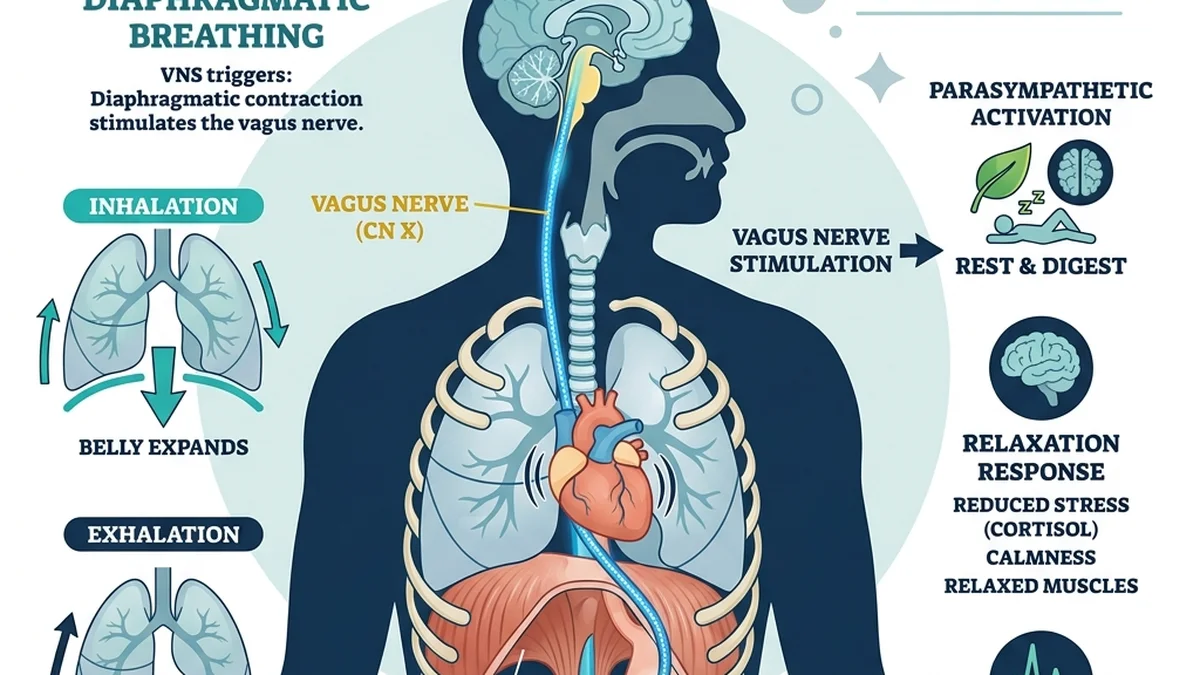
A simple, evidence-based technique is the 4-4-6 Resonant Breathing Protocol:
- Inhale slowly through the nose for 4 seconds, allowing the abdomen to expand outward while keeping the chest relatively still.
- Hold the breath gently for a count of 4 seconds.
- Exhale slowly through pursed lips for 6 seconds, letting the abdomen sink inward. Extending the exhale longer than the inhale is the key to maximizing vagal activation.
- Repeat this cycle for 5 to 10 minutes. Practicing this protocol twice daily can help stabilize Heart Rate Variability (HRV) and build resilience to stress over time.
4. Caffeine Elimination: Mitigating Adenosine Receptor Antagonism
Caff

Ganesh G Kamble
Ganesh G. Kamble is the founder and editor of Health is Heaven. He built this site after losing his father to a preventable condition, with the mission of providing clear, trackable health indicators so others can act early. His background is in the IT industry (16 years as an enterprise consultant) and he is not a medical professional; all medical content, formulas, and guides are reviewed by a credentialed medical reviewer/board before publication.