
Medically reviewed by: Health is Heaven Medical Review Board | Published by Ganesh G Kamble, Health is Heaven | Published: April 19, 2026 · Last updated: August 30, 2026
Eye Movement Desensitization and Reprocessing (EMDR) represents one of the most significant clinical advancements in trauma psychotherapy. First developed by Dr. Francine Shapiro in 1987, this structured, evidence-based modality is widely endorsed by the World Health Organization (WHO), the American Psychological Association (APA), and the Department of Veterans Affairs (VA) for the treatment of Post-Traumatic Stress Disorder (PTSD). Understanding the emdr therapy for ptsd cost and benefits is essential for patients seeking an effective alternative to traditional talking therapies that rely on prolonged verbal exposure to recount traumatic events, as EMDR focuses directly on the brain's physiological ability to process and store memories. Before reading further, you can screen your somatic and cognitive stress levels with our free therapy needs assessment online.
The Neurobiology of Trauma: Why Memories Become Frozen
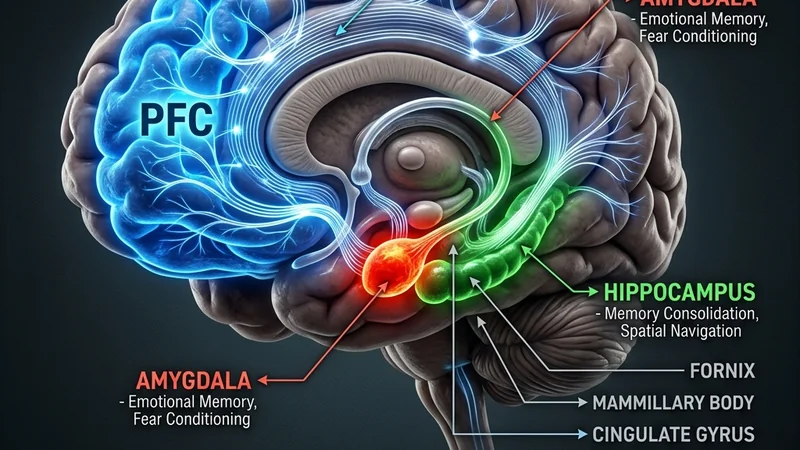
To understand the clinical utility of EMDR, you must examine how the human brain processes normal versus traumatic experiences. During typical day-to-day events, the brain processes sensory inputs through the prefrontal cortex and hippocampus. During the Rapid Eye Movement (REM) stage of sleep, natural bilateral ocular movements facilitate the consolidation of these experiences. The brain transfers them from temporary working memory into long-term cortical storage. The memory is filed away cleanly as historical data, meaning you recall the event, but it no longer triggers an acute physical or emotional response.
Under conditions of extreme trauma or threat, this consolidation system fails. The hypothalamic-pituitary-adrenal (HPA) axis activates a massive surge of catecholamines (adrenaline and noradrenaline). This biochemical storm temporarily down-regulates the prefrontal cortex and the hippocampus, which are responsible for rational contextualization and time-stamping. As a result, the sensory details of the trauma are recorded in an unfragmented, raw state directly within the amygdala, the brain's emotional threat center. The amygdala operates as an alarm system, and when a trauma occurs, this system remains continuously active, unable to signal that the danger has passed.
Because the memory is never properly consolidated or time-stamped, it remains "frozen" in its state of high emotional velocity. Years later, a seemingly unrelated trigger (a loud sound, a specific scent, or a visual pattern) can reactivate the amygdala. This causes the brain to replay the traumatic event as if it were occurring in the present moment, inducing severe somatic distress, hypervigilance, and panic attacks. The memory is not stored as past history, but rather as an active, ongoing threat to survival. This lack of integration prevents the individual from placing the trauma in their personal narrative history, leaving the nervous system locked in a chronic state of fight, flight, or freeze.
How Bilateral Stimulation Hacks the Working Memory
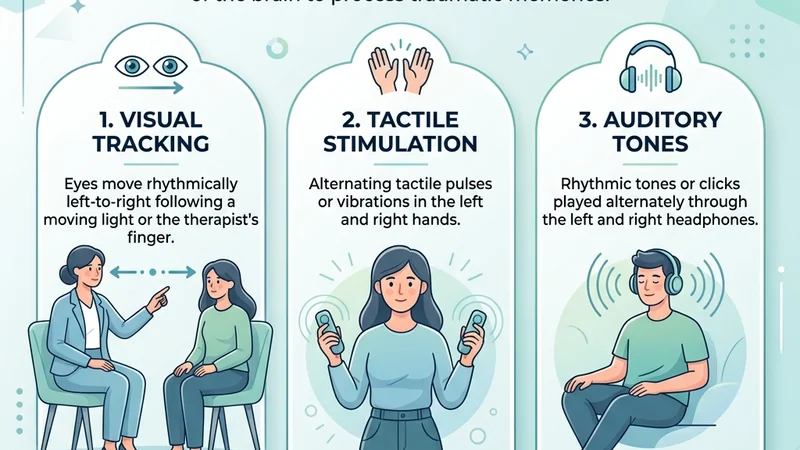
EMDR resolves this neurological block using Bilateral Stimulation (BLS). This process involves alternating sensory stimuli, such as horizontal eye movements, alternating tactile vibrations, or alternating audio tones. Clinicians rely on the Working Memory Overload Theory to explain why this approach is highly effective. The human brain has a strictly limited capacity for active working memory. When you are asked to recall a distressing traumatic memory while simultaneously tracking a clinician's moving fingers or holding vibrating tactile buzzers, the processing limits of your working memory are exceeded.
This dual-attention task prevents the amygdala from fully re-enacting the emotional threat response. Because the brain is forced to allocate significant cognitive resources to tracking the physical movement, the emotional intensity of the traumatic memory fades. Somatic distress drops, and cognitive flexibility increases. This state allows the brain to complete the integration process that was halted by the initial trauma. The memory is transferred from the reactive amygdala to the rational hippocampus, where it is filed away. The memory remains, but its physical and emotional charge is gone, allowing you to recall the event without distress.
Forms of Bilateral Stimulation
Therapists adapt the delivery of bilateral stimulation to suit individual client comfort and clinical requirements. The primary methods used in clinical settings include:
- Visual Tracking: The patient keeps their head still and tracks the clinician's hand or a specialized light bar as it moves horizontally across their field of vision. This method mimics the rapid eye movements observed during REM sleep, activating the parasympathetic nervous system and reducing physiological arousal.
- Tactile Tapping: The patient holds small, handheld devices (commonly called buzzers or tappers) that deliver gentle, alternating pulses to the left and right palms. Alternatively, the clinician may gently tap the patient's hands, or guide the patient to use the self-administered "butterfly hug" technique, crossing their arms over their chest and tapping their own shoulders in an alternating pattern.
- Auditory Tones: The patient wears headphones that deliver soft clicks or tones alternating between the left and right ears. This method is highly effective for individuals who experience visual fatigue, have ocular conditions, or find physical contact uncomfortable.
The Eight-Phase Protocol of EMDR Therapy
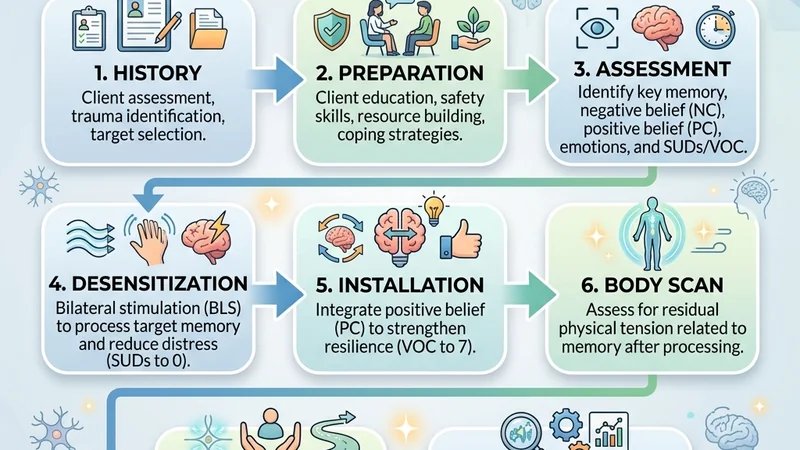
A structured, eight-phase protocol governs clinical EMDR therapy. This framework ensures safety, emotional stability, and targeted processing of traumatic material. The phases are structured as follows:
Phase 1: Client History and Treatment Planning
The clinician conducts a comprehensive diagnostic assessment. This process identifies specific traumatic memories, current triggers, and desired behavioral changes. The therapist also screens for dissociative tendencies and evaluates the patient's coping mechanisms. Together, they create a target roadmap, identifying the past events that created the clinical symptoms, the current situations triggering distress, and the positive templates required for future scenarios. This uses the three-pronged protocol, which ensures that past causes, present triggers, and future adaptive behaviors are all targeted systematically.
Phase 2: Preparation
Before addressing traumatic material, the clinician teaches the patient stress-reduction techniques and grounding exercises. This phase builds emotional tolerance and resilience. A common protocol is the creation of a "Calm Safe Place" (a mental visualization tool that the client can access to self-regulate when distressed). The therapist also guides the client in creating a mental "Container" (a visualization exercise where distressing thoughts or unprocessed memories can be placed and locked away between sessions). The therapist explains the mechanics of bilateral stimulation, establishes clear stop signals, ensures informed consent, and confirms the patient feels secure and adequately resourced before proceeding to active trauma processing.
Phase 3: Assessment
The clinician identifies the specific components of the target traumatic memory to be processed. This involves isolating the worst visual image of the event, the negative belief associated with it (such as "I am helpless"), and the desired positive belief (such as "I am safe now"). Negative cognitions typically fall into themes of safety, control, or self-defectiveness. The patient rates their distress using two standardized clinical scales:
- Subjective Units of Disturbance (SUD): A scale from 0 (no disturbance) to 10 (the worst possible disturbance) to measure current emotional and physical distress.
- Validity of Cognition (VOC): A scale from 1 (completely false) to 7 (completely true) to measure how true the positive belief feels to the patient when focusing on the target memory.
Phase 4: Desensitization
The client focuses on the traumatic image and negative cognition while tracking the bilateral stimulation. After each set of movements (typically lasting 20 to 30 seconds), the clinician directs the client to take a deep breath, clear their mind, and briefly report whatever thoughts, feelings, or physical sensations have surfaced. The clinician guides the client's focus to follow these emerging associations. If the processing loops or blocks, the clinician may introduce a "cognitive interweave", which is a targeted question or statement designed to stimulate new neurological connections and restart processing. This continues until the patient reports a SUD score of 0.
Phase 5: Installation
Once desensitization is complete, the focus shifts to strengthening the positive belief identified in Phase 3. The clinician guides the patient to hold both the target memory and the positive belief in mind while conducting sets of bilateral stimulation. The goal is to install and reinforce this positive cognition until the patient reports a VOC score of 7 (completely true), indicating they believe the positive statement on both an intellectual and emotional level.
Phase 6: Body Scan
Trauma is physically stored within the somatic tissues of the body. In this phase, the clinician asks the patient to close their eyes and scan their body from head to toe while focusing on the target memory and the positive belief. If any physical tension, tightness, pain, or discomfort is reported in areas like the chest, throat, or stomach, the therapist conducts sets of bilateral stimulation until the physical sensation resolves completely. A session is only complete when the client can recall the memory with zero physical tension.
Phase 7: Closure
Every processing session must end with the client in a state of emotional equilibrium, whether the target memory was fully processed or not. The clinician guides the patient through grounding, visualization, and relaxation exercises. They also explain what to expect between sessions (as the brain continues to process information) and instruct the patient to keep a journal of any new thoughts, dreams, or physical sensations that surface, providing a record for the next session.
Phase 8: Reevaluation
At the start of the next session, the clinician evaluates the progress made. They assess whether the positive changes from the previous session have been maintained, check the SUD and VOC scores for the previously processed targets, and determine whether new targets need to be integrated into the treatment plan, ensuring that the three-pronged protocol remains synchronized.

Ganesh G Kamble
Ganesh G. Kamble is the founder and editor of Health is Heaven. He built this site after losing his father to a preventable condition, with the mission of providing clear, trackable health indicators so others can act early. His background is in the IT industry (16 years as an enterprise consultant) and he is not a medical professional; all medical content, formulas, and guides are reviewed by a credentialed medical reviewer/board before publication.