
Medically reviewed by: Health is Heaven Medical Review Board | Published by Ganesh G Kamble, Health is Heaven | Published: April 11, 2026 · Last updated: September 12, 2026
Medically reviewed by the Health is Heaven Medical Review Board on June 4, 2026.
Your liver does not require commercial juice cleanses, liquid fasts, or unregulated herbal supplements to detoxify itself. It is a highly sophisticated, self-cleaning metabolic organ that runs continuous detoxification pathways every second of the day. However, when subjected to chronic dietary stress, environmental toxins, and insulin resistance, these pathways can become severely overloaded. Understanding the signs that your liver is under stress, and recognizing the lifestyle habits that genuinely support hepatic recovery, is essential for long-term health. These lifestyle habits are often closely aligned with those needed to manage upper digestive disorders, which can be addressed using natural home remedies for acid reflux. This clinical guide on hepatic function and fatty liver disease NAFLD explores the physiology of liver stress, the warning signs of hepatic overload, and the science-backed methods to promote true cellular recovery. Among these lifestyle habits, regularly consuming nutrient-dense options from a high fiber foods for gut health list is critical to reduce hepatic fat storage by improving insulin sensitivity.

The Deceptive Cleansing Industry and the Biochemical Wedge
The wellness market is saturated with liver detox teas, liquid cleanses, and herbal capsules. These products are often promoted as quick fixes to purge toxins from the body. From a clinical perspective, many of these interventions are not only useless but can actively damage your liver. Liquid juice cleanses are often rich in free fructose. While glucose can be metabolized by almost every cell in the human body, fructose is metabolized almost exclusively by hepatocytes in the liver. This difference in metabolism is critical because the pathways govern how the body stores and utilizes energy.
Fructose metabolism in the liver bypasses the key regulatory step of glycolysis, which is governed by the enzyme phosphofructokinase. Fructose is instead rapidly phosphorylated by fructokinase-C (ketohexokinase), an enzyme that lacks negative feedback inhibition. This unregulated pathway causes a rapid depletion of intracellular adenosine triphosphate (ATP). The depletion of ATP triggers adenosine degradation, which elevates uric acid production, induces oxidative stress, and stimulates de novo lipogenesis (DNL).
De novo lipogenesis is the biochemical process that converts excess carbohydrates, specifically fructose, directly into fat. These newly synthesized triglycerides pool inside hepatocytes, directly causing Metabolic Dysfunction-Associated Steatotic Liver Disease (MASLD), historically known as nonalcoholic fatty liver disease (NAFLD). In simple terms, consuming high-fructose juice cleanses to detoxify your liver is a metabolic trap that accelerates hepatic fat accumulation, leading to further cellular stress and hepatic dysfunction. Recent 2026 research further demonstrates that fructose-induced lipogenesis activates hepatic stellate cells and enhances the expression of pro-fibrotic cytokines, which may accelerate the progression from simple steatosis to advanced fibrotic liver disease and cirrhosis more rapidly than previously understood.
To establish your current physiological baseline and see how metabolic factors influence your cellular health, you can screen your current symptoms using a specialized assessment. Recording your baseline scores is a vital step toward recognizing early trends. Please take a moment to evaluate your metrics with the biological age calculator online, then record your scores in a personal log for future clinical checkups, or check our guide on how to lower biological age naturally.
The 10 Sentinel Alerts: Reading the Physiological Flags
Because the liver possesses almost no sensory pain receptors within its parenchyma, it cannot signal damage through traditional pain pathways. By the time hepatic swelling stretches the surrounding fibrous capsule (Glisson's capsule) to cause physical discomfort, the structural damage is often advanced. The liver instead projects its distress outward into the peripheral systems of the body. Here are the 10 sentinel alerts that indicate your liver is struggling under a high biochemical load.
1. Jaundice (Scleral and Cutaneous Yellowing)
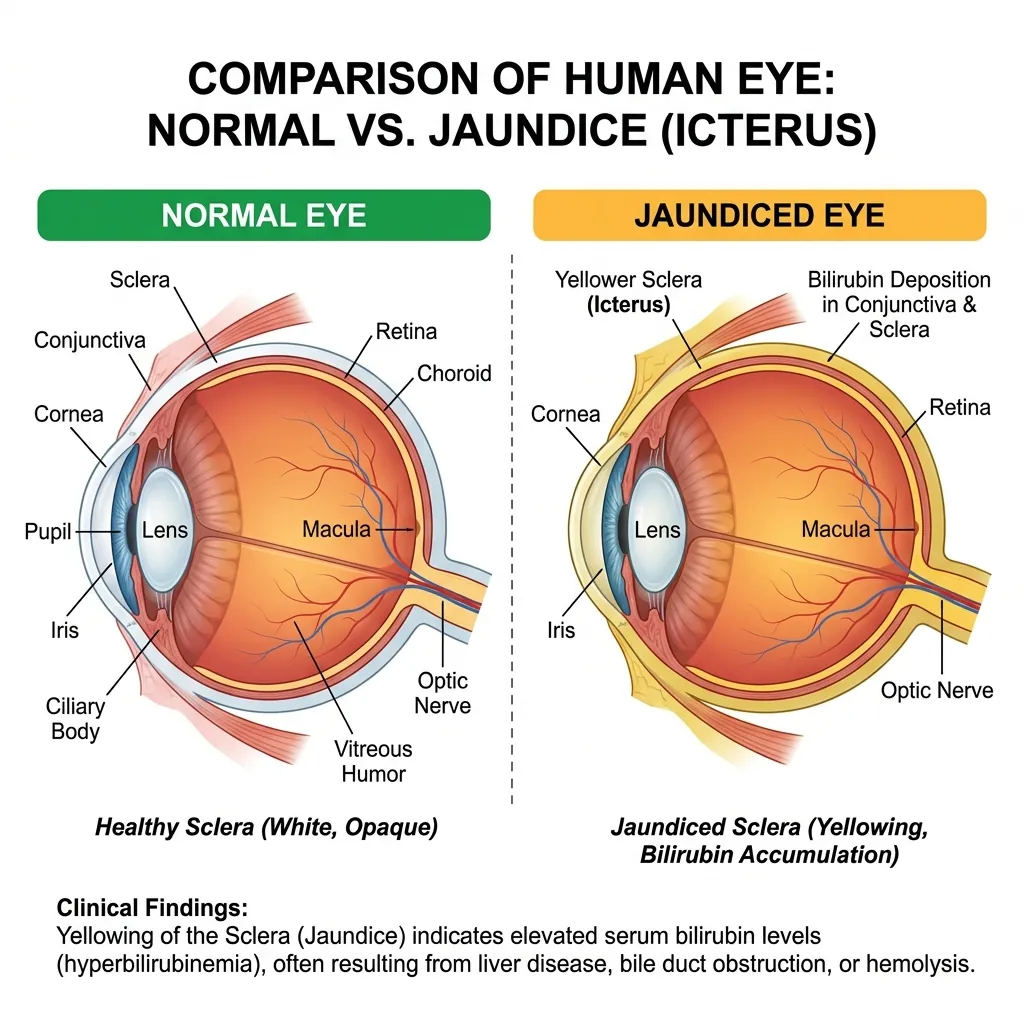
Jaundice is the classic dermatological marker of hepatic dysfunction. The liver is responsible for processing bilirubin, a yellow-green pigment derived from the breakdown of senescent red blood cells. In a healthy state, unconjugated bilirubin is transported to the liver, where hepatocytes conjugate it with glucuronic acid using the enzyme uridine diphosphate-glucuronosyltransferase (UGT1A1). This makes bilirubin water-soluble, allowing it to be excreted into bile and eliminated via the digestive tract. This pathway represents a key detoxification step for the body.
When hepatocytes are damaged or bile flow is obstructed (cholestasis), this conjugation and clearance mechanism breaks down. Unconjugated or conjugated bilirubin builds up in the bloodstream and diffuses into elastic tissues. This manifests first as a yellowing of the sclera (the white portion of the eyes) and subsequently as a yellowing of the skin. Scleral icterus can often be detected earlier than cutaneous jaundice due to the high concentration of elastin in the sclera, which has a strong affinity for bilirubin.
2. Chronic, Unexplained Pruritus (Intense Itching)
Pruritus associated with liver stress is not caused by dry skin or external allergens. It is a systemic itching sensation that is typically most severe on the palms of the hands and the soles of the feet, and it often worsens at night. The primary biochemical driver of this condition is the systemic accumulation of bile salts, pruritogens, and endogenous opioids in the blood and interstitial tissues.
When bile secretion is impaired, bile acids back up into the systemic circulation. These bile acids interact with cutaneous nerve endings and specialized receptors, triggering a severe, refractory itch response that does not respond to standard antihistamines. Chronic pruritus is a sign that hepatic excretory functions are compromised, leading to an accumulation of waste products that would normally be eliminated through bile.
3. Spider Angiomas (Cutaneous Vascular Lesions)
Spider angiomas are abnormal clusters of dilated capillaries close to the surface of the skin. They feature a central red arteriole with thin, radiating capillary legs, resembling a spider web. These lesions typically appear on the face, neck, upper chest, and arms. They are also known as spider nevi or vascular spiders and are markers of vascular changes in the body.
Their formation is driven by hyperestrogenism. The liver is the primary site for the metabolism and clearance of circulating hormones, including estrogen. When hepatic function is impaired, estrogen clearance drops, causing hormone levels to rise. Elevated estrogen exerts a strong vasodilatory effect on cutaneous arterioles, leading to the formation of these spider-like capillary structures. The presence of multiple spider angiomas is strongly associated with progressive hepatic fibrosis.
4. Unexplained, Dark Bruising and Bleeding
If you notice large, dark bruises appearing after minor bumps, or if small cuts bleed for an unusually long time, your liver may be struggling. The liver is the sole factory for almost all blood clotting factors, including fibrinogen, prothrombin, Factor V, Factor VII, Factor IX, Factor X, and Factor XI. It also relies on vitamin K to synthesize several of these essential proteins. The synthesis of these factors is critical for maintaining proper hemostasis.
When hepatic protein synthesis is compromised, the concentration of these clotting factors in the blood drops. This deficiency delays the coagulation cascade, causing easy bruising (ecchymosis), frequent nosebleeds, and prolonged bleeding from minor injuries. A prolonging of the prothrombin time (PT) is a clinical marker used to quantify this synthetic deficit.
5. Ascites (Abdominal Fluid Retention)
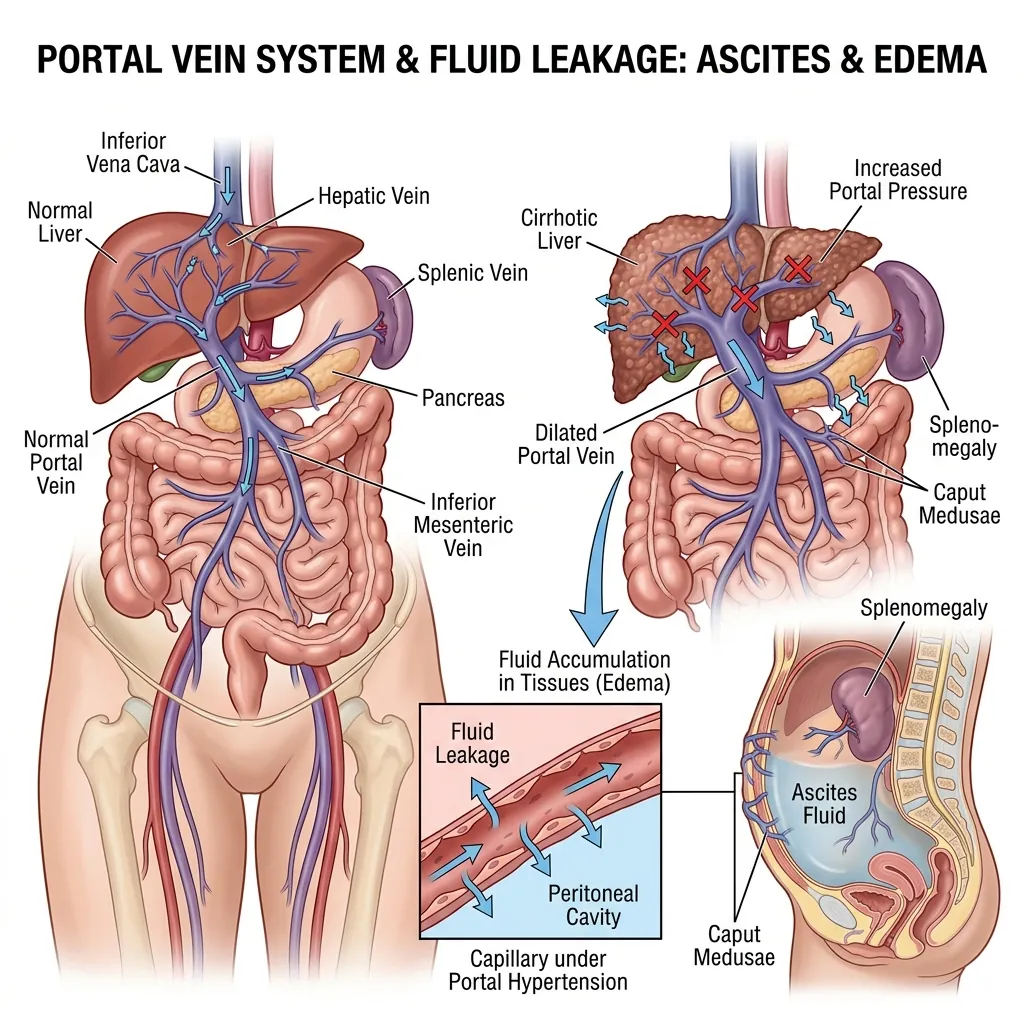
Ascites is the accumulation of protein-rich fluid in the peritoneal cavity, leading to progressive abdominal swelling and discomfort. This symptom represents a major hemodynamic shift. As liver tissue undergoes damage and develops scarring (fibrosis), the normal flow of blood through the portal vein is restricted. This restriction increases portal vein blood pressure, a condition known as portal hypertension. The scarring blocks the sinusoidal channels, creating high resistance to blood flow.
To compensate, blood vessels in the abdomen dilate, which triggers the activation of the renin-angiotensin-aldosterone system (RAAS), leading to fluid retention. Simultaneously, the liver fails to synthesize sufficient albumin, the protein responsible for maintaining plasma oncotic pressure. The combination of low oncotic pressure and high hydrostatic pressure forces fluid out of the blood vessels and directly into the abdominal cavity.
6. Bilateral Ankle and Leg Edema
Similar to ascites, peripheral edema is the swelling of the lower extremities due to fluid retention in the interstitial tissues. It is characterized by pitting, where pressing a finger into the swollen skin leaves a temporary indentation. This fluid pooling can cause skin tightness, warmth, and discomfort.
The mechanism is identical to that of ascites: portal hypertension combined with hypoalbuminemia (low blood albumin). Gravity pulls this retained fluid downward, causing it to pool in the tissues of the ankles, feet, and lower legs. This swelling can make walking difficult, increases the risk of skin breakdown, and can lead to recurrent cellulitis in the lower extremities if left unmanaged.

Ganesh G Kamble
Ganesh G. Kamble is the founder and editor of Health is Heaven. He built this site after losing his father to a preventable condition, with the mission of providing clear, trackable health indicators so others can act early. His background is in the IT industry (16 years as an enterprise consultant) and he is not a medical professional; all medical content, formulas, and guides are reviewed by a credentialed medical reviewer/board before publication.