
Medically reviewed by: Health is Heaven Medical Review Board | Published by Ganesh G Kamble, Health is Heaven | Published: June 14, 2026 · Last updated: October 10, 2026
 By
At 5:00 AM, you wake up to find your hands feeling stiff, heavy, and unresponsive, as if your fingers have been locked in place overnight. This is not the standard wear-and-tear stiffness that fades within five minutes of stretching. For the millions of individuals living with rheumatoid arthritis, this profound morning stiffness represents a systemic, immune-mediated assault on the synovial membranes of the joints. While pharmacological intervention remains the absolute cornerstone of therapy, clinical evidence demonstrates that a targeted rheumatoid arthritis diet and lifestyle protocol incorporating anti-inflammatory foods, cellular hydration, and stress regulation plays a vital role in protecting joint function and reducing systemic inflammatory flare-ups. This guide details the biophysical mechanisms of rheumatoid arthritis, offering evidence-based strategies to complement your medical treatment and optimize your daily joint health.
To construct a highly personalized and effective strategy for managing your symptoms, you must first establish your biological and physiological baseline. Chronic systemic inflammation can significantly impact your cardiovascular health and accelerate cellular aging, making it vital to monitor your biomarkers regularly. You can use our interactive clinical suite tools to generate your baseline profile and calculate your metrics before adjusting your daily lifestyle protocols.
Verify Your Physiological Baseline
Establish your biological metrics and joint hydration targets before starting new diet or exercise protocols.
Understanding Symmetrical Autoimmune Synovitis and Rheumatoid Arthritis Management
To manage joint symptoms effectively, you must understand the underlying pathology. Rheumatoid arthritis is a chronic, systemic autoimmune disease characterized by symmetrical joint inflammation. In contrast to osteoarthritis, which arises from mechanical wear and tear of articular cartilage over time, rheumatoid arthritis is caused by an overactive immune system that mistakenly attacks the body's healthy tissues. Specifically, the immune system targets the synovium, the delicate membrane lining the joint capsule that produces synovial fluid. This autoimmune attack triggers a complex cascade of inflammatory responses, leading to synovitis, joint pain, and eventual joint destruction. Integrating these pathological insights is essential for targeted rheumatoid arthritis management.
Clinical Symptoms of Arthritis Flare-ups
Recognizing the clinical symptoms of arthritis flare-ups is key to timely clinical intervention. During an active flare-up, patients experience a significant escalation in joint swelling, warmth, and tenderness, alongside systemic symptoms such as profound fatigue, low-grade fever, and flu-like malaise. Tracking these shifts in your symptom diary helps differentiate a standard daily fluctuation from an active inflammatory episode. Recent 2026 research has significantly enhanced our understanding of flare-up mechanisms and predictive biomarkers, demonstrating that early recognition and intervention can substantially reduce disease progression and preserve long-term joint function. Studies from 2025-2026 also indicate that patients who maintain detailed symptom logs are better equipped to identify personalized flare-up triggers—such as specific dietary patterns, stress events, or sleep disruptions—enabling more proactive and targeted disease management strategies. This precision approach, sometimes termed "N-of-1" monitoring, represents an evolution in rheumatoid arthritis care, allowing clinicians to tailor interventions to individual patient phenotypes and response patterns.
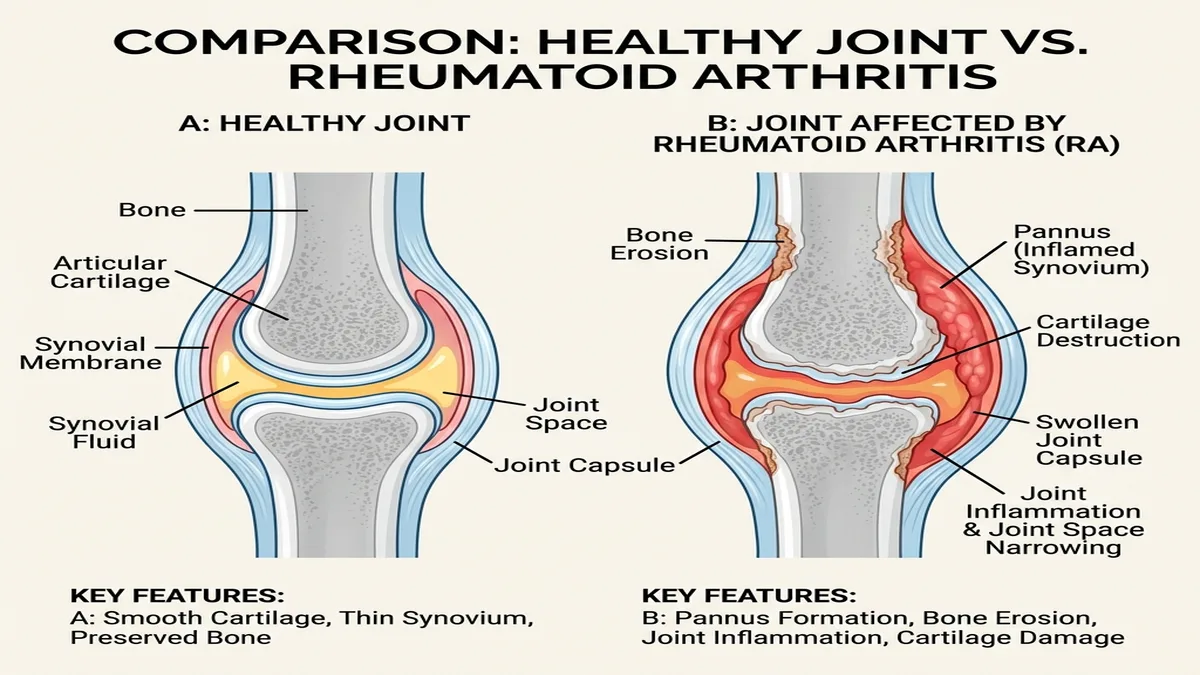
During the progression of rheumatoid arthritis, immune cells, particularly T lymphocytes and B lymphocytes, infiltrate the synovium. These cells release pro-inflammatory cytokines, including tumor necrosis factor-alpha (TNF-alpha), interleukin-1 (IL-1), and interleukin-6 (IL-6). These cytokines stimulate the synovial cells to proliferate rapidly, forming a thickened, invasive tissue mass called a pannus. The pannus grows over the articular cartilage and releases damaging enzymes, such as matrix metalloproteinases, which systematically degrade the cartilage and erode the underlying bone. Over time, this process results in joint instability, severe pain, deformities, and loss of motion.
A primary clinical hallmark of rheumatoid arthritis is its symmetrical presentation. If a joint in your left hand is affected, the corresponding joint in your right hand is highly likely to be affected as well. This symmetry is a key diagnostic differentiator from osteoarthritis, which typically affects joints asymmetrically based on patterns of mechanical load and previous injuries. Furthermore, rheumatoid arthritis is a systemic disease. The inflammatory cytokines circulating in the bloodstream do not remain confined to the joint capsules: they can impact multiple organ systems. This systemic inflammation increases the risk of cardiovascular disease, causes persistent fatigue, and can lead to complications in the lungs, eyes, and blood vessels. Thus, monitoring disease activity and extra-articular manifestations is central to clinical rheumatoid arthritis management.
The Biochemical Impact of Nutrition on Synovial Inflammation
While diet alone cannot cure rheumatoid arthritis, clinical research confirms that specific nutritional patterns can modulate systemic inflammatory pathways. The primary therapeutic objective of nutrition in rheumatoid arthritis is to reduce the production of pro-inflammatory mediators and support the body's natural anti-inflammatory mechanisms. The most thoroughly studied dietary pattern for this purpose is the Mediterranean diet. Recent clinical evidence from 2026 has further validated the Mediterranean diet's efficacy in rheumatoid arthritis management, demonstrating that adherence to this evidence-based nutritional protocol can significantly lower markers of systemic inflammation, such as C-reactive protein (CRP) and erythrocyte sedimentation rate (ESR), while reducing self-reported joint pain, morning stiffness duration, and functional disability scores. Numerous randomized controlled trials have confirmed these benefits, making the Mediterranean diet a cornerstone nutritional strategy for rheumatoid arthritis management.
Anti-Inflammatory Foods for Joint Pain
Incorporating anti-inflammatory foods for joint pain into your daily diet helps inhibit key inflammatory pathways (such as NF-kB and COX). Prioritize foods high in omega-3 fatty acids (like wild salmon and sardines), polyphenols (like extra virgin olive oil), and antioxidants (like blueberries and dark leafy greens) to support synovial health and mitigate cellular oxidative stress in the joints.
The anti-inflammatory efficacy of the Mediterranean diet is largely attributed to its fatty acid profile. The diet emphasizes a high intake of monounsaturated fatty acids, primarily from extra virgin olive oil, and polyunsaturated fatty acids, specifically omega-3 fatty acids from marine sources. In the human body, polyunsaturated fatty acids serve as precursors for signaling molecules called eicosanoids. Omega-6 fatty acids, commonly found in refined vegetable oils and processed foods, are converted into arachidonic acid, which is a precursor for highly pro-inflammatory eicosanoids, such as prostaglandin E2 and leukotriene B4. In contrast, omega-3 fatty acids, specifically eicosapentaenoic acid (EPA) and docosahexaenoic acid (DHA), are converted into anti-inflammatory resolvins and protectins.

By consuming fatty fish, such as wild-caught salmon, sardines, and mackerel, you introduce EPA and DHA that compete with arachidonic acid for entry into the metabolic pathways governed by cyclooxygenase (COX) and lipoxygenase (LOX) enzymes. This competitive inhibition reduces the synthesis of pro-inflammatory molecules and promotes the production of anti-inflammatory mediators. Clinical trials indicate that a daily intake of at least two to three grams of combined EPA and DHA is required to achieve a measurable reduction in joint tenderness, often allowing patients to reduce their reliance on nonsteroidal anti-inflammatory drugs (NSAIDs) under clinical supervision.
In addition to healthy fats, an anti-inflammatory dietary pattern must prioritize high-fiber foods, such as vegetables, fruits, legumes, and whole grains. Dietary fiber is fermented by the gut microbiota to produce short-chain fatty acids (SCFAs), such as butyrate, acetate, and propionate. These molecules exert systemic anti-inflammatory effects by promoting the differentiation of regulatory T cells, which help maintain immune tolerance and suppress autoimmune activity. Conversely, you should avoid foods that promote inflammation, including refined carbohydrates and processed foods.
Lifestyle Strategies for Managing Rheumatoid Arthritis
Diet addresses the systemic inflammatory load, but several lifestyle factors act on rheumatoid arthritis through separate, independent mechanisms and are considered core parts of standard clinical management alongside medication.
- Smoking cessation is non-negotiable: smoking is one of the most well-documented environmental risk factors for developing RA and is independently associated with more severe disease and reduced response to standard biologic medications. Quitting is
 About the Author
Ganesh G Kamble
Ganesh G. Kamble is the founder and editor of Health is Heaven. He built this site after losing his father to a preventable condition, with the mission of providing clear, trackable health indicators so others can act early. His background is in the IT industry (16 years as an enterprise consultant) and he is not a medical professional; all medical content, formulas, and guides are reviewed by a credentialed medical reviewer/board before publication.