
Medically reviewed by: Health is Heaven Medical Review Board | Published by Ganesh G Kamble, Health is Heaven | Published: June 30, 2026 · Last updated: August 20, 2026
Determine Your Daily Baseline Hydration Target
Adequate hydration is essential for facilitating primary esophageal peristalsis and maintaining salivary volume, which dilutes gastric acid. Enter your weight and activity level into the free water intake calculator to discover your customized daily fluid target.
Open Water Intake Calculator →1. Lower Esophageal Sphincter (LES) and Transient Relaxations (TLESRs) Mechanics
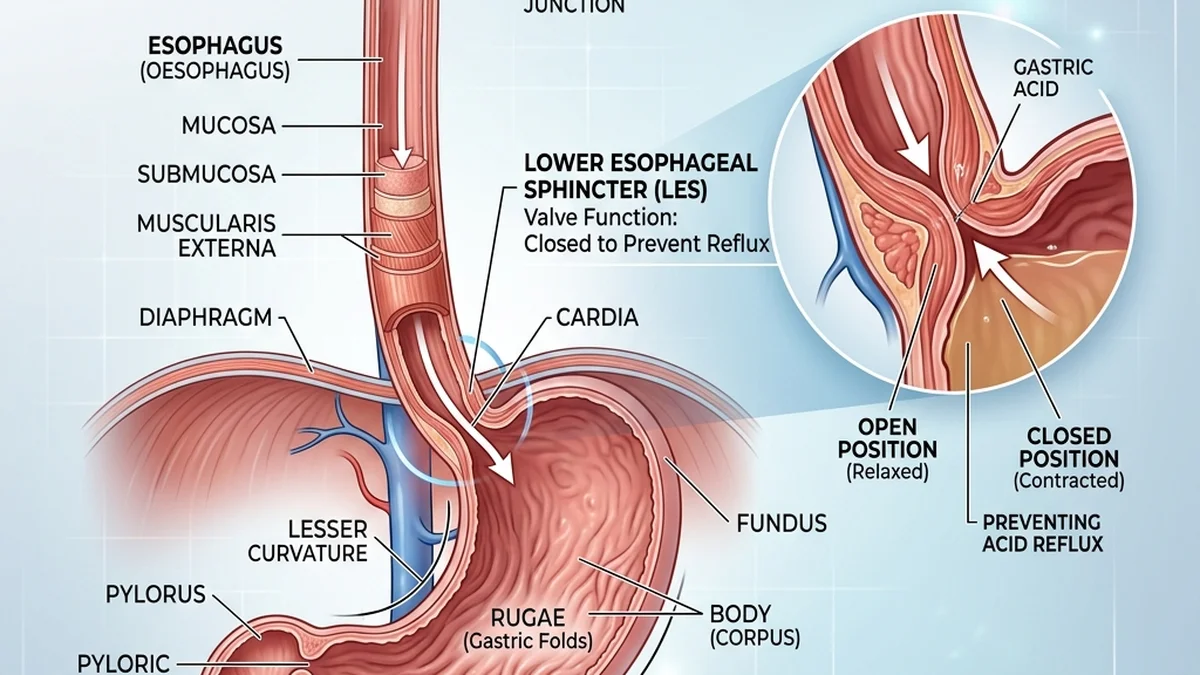
The primary barrier to gastroesophageal reflux is the lower esophageal sphincter (LES), a specialized ring of smooth muscle located at the gastroesophageal junction. The LES maintains a baseline high-pressure zone (resting pressure of 10 to 30 mmHg) that exceeds the intragastric pressure, effectively sealing the gastric cavity from the low-pressure thoracic cavity. The muscle tone of the LES is regulated by complex neurohumoral pathways, including excitatory cholinergic (vagal) inputs that contract the sphincter and inhibitory nitrergic (nitric oxide and vasoactive intestinal peptide) inputs that relax it.
Acid reflux occurs when this pressure barrier is compromised. The most common mechanism for reflux in individuals without structural hiatal hernia is transient lower esophageal sphincter relaxations (TLESRs). TLESRs are neural reflexes mediated by the vagus nerve, triggered by gastric distension (stretching of the stomach walls after a meal). Unlike swallow-induced LES relaxation, TLESRs occur independently of swallowing, last longer (typically 10 to 45 seconds), and are accompanied by inhibition of the crural diaphragm, which acts as an external sphincter. When TLESRs occur frequently or when resting LES tone is chronically low (under 10 mmHg), acidic gastric juice (pH 1.5 to 3.5) escapes into the esophageal lumen, irritating the delicate squamous epithelium.
The biophysical relationship governing the risk of reflux can be expressed by the gastric pressure-gradient equation:
Delta P = P_gastric - P_thoracic
An increase in the pressure gradient (Delta P) due to elevated intragastric pressure (P_gastric) or decreased intrathoracic pressure (P_thoracic) will push gastric contents past a weakened LES. Factors that elevate abdominal pressure, such as visceral obesity, pregnancy, or tight clothing, directly increase P_gastric, thereby increasing the driving force for acid reflux. Modifying lifestyle factors to minimize this pressure gradient is a core therapeutic goal.
2. Sleep Position Anatomy and Gravity Assist (Left-Side Sleeping)
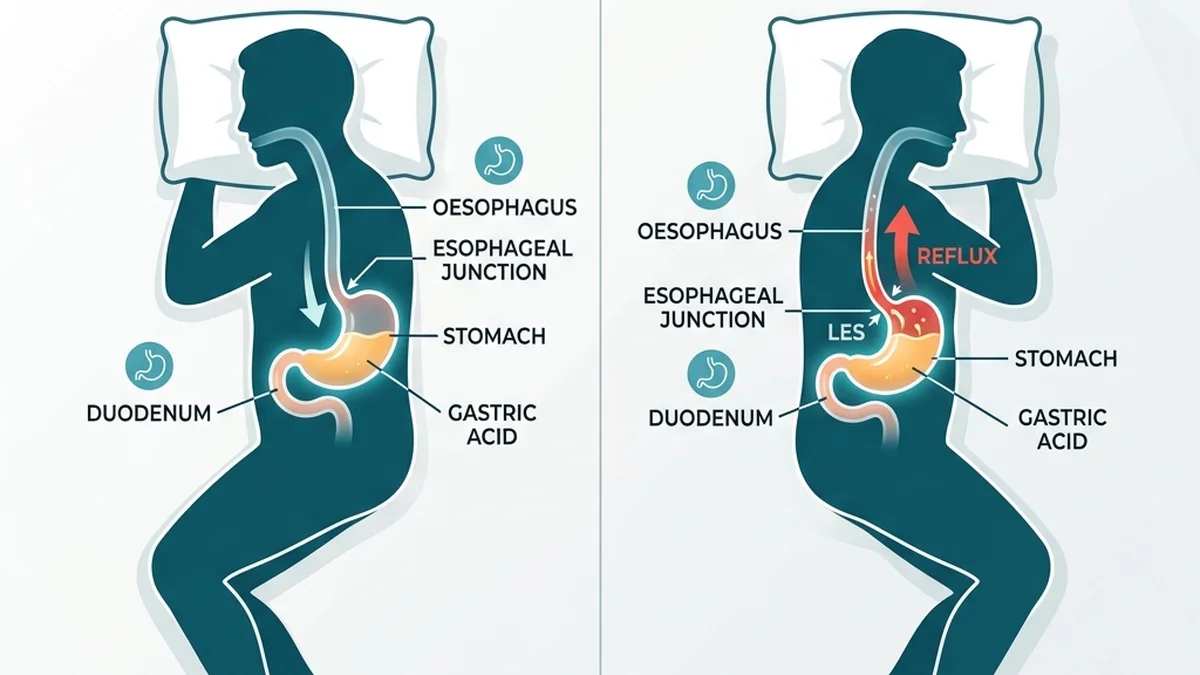
Nighttime reflux (nocturnal GERD) is associated with more severe esophageal mucosal damage because swallowing frequency and salivary flow decrease during sleep, prolonging acid contact time. Clinical research demonstrates that sleeping in the left lateral decubitus position (on the left side) significantly reduces esophageal acid exposure compared to the right lateral or supine (flat on the back) positions.
The efficacy of left-side sleeping is explained by the asymmetrical anatomy of the human stomach. The esophagus enters the stomach on its right side, creating an anatomical junction known as the cardias. The rest of the stomach body, including the fundus, curves toward the left side of the body. When a person sleeps on their left side, the gastric acid pool settles in the large curvature of the stomach, below the level of the gastroesophageal junction. In this position, gravity keeps the acidic pool away from the LES. Even if the LES relaxes transiently, the air bubble in the stomach, rather than liquid acid, is positioned near the junction, preventing reflux.
Conversely, when sleeping on the right side, the gastroesophageal junction is positioned beneath the stomach body. Gravity causes the pool of gastric acid to submerge the LES. Any transient relaxation of the sphincter allows acid to flow directly into the esophagus. Additionally, sleeping on the back (supine) allows acid to pool evenly, eliminating the gravity barrier and slowing down the clearance of refluxed acid. Clinical trials using pH-impedance monitoring have shown that while the number of reflux episodes may remain similar, the average acid clearance time is significantly shorter when sleeping on the left side, thereby protecting the esophageal lining from prolonged exposure.
3. Portion Sizes and Gastric Volumetric Pressure
One of the most effective dietary strategies for managing acid reflux is regulating meal size. Large meals stretch the stomach wall, triggering mechanoreceptors that initiate the vagal reflex loop responsible for TLESRs. As the volume of food in the stomach increases, the pressure within the gastric cavity rises, challenging the resting pressure of the LES.
Splitting daily food intake into 4 to 5 smaller meals rather than 2 to 3 large portions helps maintain low gastric volume and minimizes postprandial stomach stretching. Smaller meals also reduce the physical surface area of food in contact with gastric acid, which helps optimize digestion and limits the elevation of the gastric acid pool. Clinical guidelines from the American College of Gastroenterology (ACG) suggest that portion control is a foundational lifestyle intervention that can reduce the need for pharmacological antacids in patients with mild symptoms.
4. Gastric Emptying Kinetics and Fat-Induced CCK Release
The rate at which the stomach empties its contents into the duodenum (gastric emptying rate) directly influences the duration of the postprandial reflux window. Delayed gastric emptying (gastric stasis) keeps food in the stomach longer, extending the period of gastric distension and increasing the frequency of TLESRs.
Dietary fats are potent triggers for the release of cholecystokinin (CCK) from I-cells in the duodenum. CCK is a peptide hormone that coordinates digestion by stimulating pancreatic enzyme secretion and gallbladder contraction. However, CCK also acts on the stomach to delay gastric emptying and directly relaxes the smooth muscle of the LES. High-fat meals (such as fried foods, fatty meats, and heavy cream) delay gastric emptying, reduce LES pressure, and prolong the presence of highly acidic chyme in the stomach, creating ideal conditions for severe reflux. Choosing low-fat meals helps maintain optimal gastric emptying kinetics and supports sphincter closure.

Dietary Triggers for Acid Reflux
Common dietary triggers for acid reflux include high-fat meals, chocolate, peppermint, caffeine, and acidic fruits. These substances relax the lower esophageal sphincter (LES) or delay gastric emptying, increasing gastric volume and elevating the risk of reflux events.
5. Salivary Bicarbonate Buffering and Esophageal Clearance
When acid reflux occurs, the body relies on two primary defense mechanisms to clear the acid and protect the esophagus: esophageal peristalsis and salivary buffering. Esophageal peristalsis refers to the coordinated wave of muscle contractions that pushes refluxed liquid back down into the stomach. Primary peristalsis is initiated by swallowing, while secondary peristalsis is a local reflex triggered by the stretching or acidity of the esophagus itself.
Although peristalsis clears the majority of the refluxed volume, a thin film of acidic residue remains on the esophageal mucosa. To neutralize this residual acid, the salivary glands increase secretion of bicarbonate-rich saliva, which is swallowed and coats the esophageal lining, raising its surface pH back toward neutral. This buffering process is slow relative to peristalsis — full neutralization of a reflux event's acidic residue can take several minutes — which is why behaviors that stimulate salivation, such as chewing gum, can meaningfully shorten symptomatic exposure time.
6. Chewing Sugar-Free Gum to Stimulate Salivary Bicarbonate
Because salivary bicarbonate is the body's primary chemical buffer against residual esophageal acid, directly increasing saliva production is a mechanistically sound remedy. Chewing sugar-free gum for roughly 30 minutes after a meal has been shown in controlled studies to increase swallowing frequency and salivary bicarbonate output, which measurably raises intraesophageal pH following a reflux episode. Sugar-free gum specifically is recommended because sugared gum can itself lower oral and esophageal pH and contribute to dental erosion, undermining the benefit.
7. Ginger as a Prokinetic and Anti-Inflammatory Agent
Ginger has demonstrated prokinetic activity in clinical research, meaning it accelerates gastric emptying rather than simply neutralizing acid after the fact. A faster-emptying stomach spends less time at the elevated intragastric pressure that drives TLESRs, indirectly reducing reflux frequency. Ginger also contains gingerols and shogaols with documented anti-inflammatory and mild antiemetic properties, which can ease the nausea that frequently accompanies reflux. Clinical use typically favors small doses — one to one and a half grams daily, such as steeped tea or grated fresh root — since very high concentrated doses have been associated with mild gastrointestinal irritation in some individuals rather than relief.
8. Sodium Bicarbonate (Baking Soda) as a Short-Term Acid Buffer
A half teaspoon of baking soda dissolved in a glass of water is a fast-acting home remedy because sodium bicarbonate is a direct chemical base: it reacts immediately with hydrochloric acid in the stomach and refluxed esophageal residue, neutralizing it on contact and producing rapid, if temporary, symptom relief. This mechanism is identical to that of over-the-counter antacids, just without buffering agents like calcium carbonate. Because of its high sodium content, this remedy is not appropriate for daily long-term use, and is contraindicated for anyone on a sodium-restricted diet for hypertension or kidney disease, or for anyone using it more than occasionally, as excessive bicarbonate intake can disrupt acid-base balance and, in rare cases documented in case reports, contribute to milk-alkali syndrome.
9. Weight Management and Intra-Abdominal Pressure
Excess visceral fat mass increases intra-abdominal pressure in a manner mechanically similar to a large meal, pushing upward on the stomach and lower esophageal sphincter and increasing the frequency of TLESRs and the likelihood that any reflux event reaches higher into the esophagus. Population research published in the New England Journal of Medicine found a clear, dose-dependent relationship between body mass index and GERD symptom frequency, and separately found that even modest, intentional weight loss (a 10-pound reduction on average) was associated with significant symptom improvement. Central abdominal fat carries more of this risk than overall body weight, which is one reason waist circumference is often tracked alongside BMI in reflux management. Readers managing weight as part of a reflux-reduction plan may find it useful to also review our liver health and fatty liver disease guide, since visceral adiposity affects both systems together.
10. Head-of-Bed Elevation and Avoiding Tight Clothing
Elevating the head of the bed by six to eight inches — using a wedge pillow or blocks under the bedframe rather than simply stacking pillows, which can flex the torso and increase abdominal pressure instead of reducing it — uses gravity to keep gastric contents lower than the esophagus throughout the night, extending the same mechanical principle behind left-side sleeping (mechanism 2). Clinical trials measuring esophageal pH have confirmed that bed-head elevation significantly reduces nighttime acid exposure time compared to sleeping flat. Similarly, tight waistbands, compression garments, and tight belts mechanically compress the abdomen and raise intragastric pressure in the same way obesity or overeating does, so loosening clothing after meals is a low-effort mechanical fix rather than a placebo measure.
These ten mechanisms work best in combination rather than in isolation. Home remedies address the physical and biochemical drivers of reflux, but they do not replace medical evaluation for anyone with weekly symptoms, difficulty swallowing, unintentional weight loss, or symptoms that persist despite these changes — those warning signs warrant an evaluation for GERD complications such as esophagitis or Barrett's esophagus.
How quickly do home remedies for acid reflux start working?
Mechanical remedies act fastest: baking soda neutralizes acid within minutes, and left-side sleeping or head-of-bed elevation reduces nighttime symptoms the same night. Remedies that depend on tissue or behavioral change, such as weight loss, ginger's prokinetic effect, or portion-size habits, typically take one to several weeks of consistent practice to show a measurable reduction in reflux frequency.
Is it safe to take baking soda for acid reflux every day?
No. Baking soda is appropriate as an occasional, short-term remedy only. Its high sodium content makes daily use unsuitable for people managing blood pressure or kidney disease, and habitual overuse can disrupt the body's acid-base balance. Speak with a healthcare provider before using it more than a few times a week.
Why does sleeping on the left side help with acid reflux?
Anatomically, the stomach and the junction where it meets the esophagus sit slightly to the left of the body's midline. Lying on the left side keeps the gastroesophageal junction above the pooled stomach contents, using gravity to keep acid away from the sphincter, while lying on the right side positions the stomach contents closer to that junction.
Can losing weight actually reduce acid reflux symptoms?
Yes. Research published in the New England Journal of Medicine found that even a modest, intentional weight loss of about 10 pounds was associated with a significant reduction in GERD symptoms, because excess abdominal fat increases pressure on the stomach and lower esophageal sphincter.
Does chewing gum really help with acid reflux?
Yes, chewing sugar-free gum for about 30 minutes after meals increases saliva production, and saliva contains bicarbonate that helps neutralize acid remaining in the esophagus after a reflux event. Sugared gum should be avoided since it can itself contribute to lowering oral pH.
What foods should I avoid if I have frequent acid reflux?
Common triggers include high-fat meals, chocolate, peppermint, caffeine, carbonated beverages, and acidic foods like citrus and tomato products. These either relax the lower esophageal sphincter directly or slow gastric emptying, both of which increase reflux risk. Trigger foods vary by individual, so tracking symptoms against meals is the most reliable way to identify personal triggers.
How is home-remedy management different from GERD medication?
Home remedies address the mechanical and physiological drivers of reflux — posture, gastric pressure, gastric emptying speed, and acid buffering — while medications like proton pump inhibitors and H2-receptor antagonists reduce the amount of acid the stomach produces in the first place. They are complementary, not interchangeable, and home remedies alone are not sufficient for diagnosed GERD requiring medical management.
When should acid reflux be evaluated by a doctor instead of managed at home?
Seek medical evaluation for reflux occurring more than twice a week, difficulty or pain when swallowing, unintentional weight loss, chest pain, or symptoms that persist despite consistent lifestyle changes. These can indicate esophagitis, strictures, or Barrett's esophagus, which require diagnosis and monitoring beyond home management.
Sources
- National Institute of Diabetes and Digestive and Kidney Diseases (NIDDK). Acid Reflux (GER & GERD) in Adults.
- Avidan B, et al. Walking and chewing reduce postprandial acid reflux. Alimentary Pharmacology & Therapeutics, 2001.
- Moazzez R, et al. The effect of chewing sugar-free gum on gastro-esophageal reflux. Journal of Dental Research, 2005.
- Wu KL, et al. Effects of ginger on gastric emptying and motility in healthy humans. European Journal of Gastroenterology & Hepatology, 2008.
- Jacobson BC, et al. Body-mass index and symptoms of gastroesophageal reflux in women. New England Journal of Medicine, 2006.
- Person E, et al. A novel sleep positioning device reduces gastroesophageal reflux. Journal of Clinical Gastroenterology, 2015.
- American College of Gastroenterology. Acid Reflux Patient Guide.
Medical Disclaimer: This article is for general educational purposes only and does not constitute professional medical advice, diagnosis, or treatment. Always consult a qualified healthcare provider before changing your diet, sleep habits, or medication use, especially if you have frequent, severe, or worsening reflux symptoms. See our full Medical Disclaimer and Editorial Policy.

Ganesh G Kamble
Ganesh G. Kamble is the founder and editor of Health is Heaven. He built this site after losing his father to a preventable condition, with the mission of providing clear, trackable health indicators so others can act early. His background is in the IT industry (16 years as an enterprise consultant) and he is not a medical professional; all medical content, formulas, and guides are reviewed by a credentialed medical reviewer/board before publication.