
Medically reviewed by: Health is Heaven Medical Review Board | Published by Ganesh G Kamble, Health is Heaven | Published: June 11, 2026
The United States faces a structural mental health crisis. According to the Substance Abuse and Mental Health Services Administration (SAMHSA) 2023 National Survey, 57.8 million Americans experienced a mental illness in the prior year — yet 57% received no treatment. The three systemic barriers: cost ($150–$300 per in-person session), provider scarcity (the US shortage of mental health professionals is projected to reach 250,000 by 2025 per HRSA), and the persistent neuroscientific reality that the prefrontal cortex’s threat-avoidance circuitry generates stigma-driven avoidance behavior even when rational decision-making recognizes the need for help.
Online therapy platforms were engineered to dismantle all three barriers simultaneously. This clinical guide evaluates the major platforms — BetterHelp, Talkspace, Cerebral, Brightside, and emerging alternatives — using the lens of evidence-based outcome data, therapist credentialing standards, modality availability, and pricing transparency. The goal is not to recommend one platform universally, but to match your clinical profile to the platform architecture that produces the best therapeutic outcome for your specific condition.
🌟 Free Clinical Tool
SPONSORED CONTENT
Unsure If You Need Therapy? Take Our Free Self-Assessment
Our Therapy Needs Self-Assessment and Sleep Debt Calculator help you identify your clinical risk profile before choosing a platform. Match your symptoms to the right therapy modality for better outcomes.
The Two Fundamental Platform Architectures
Before comparing individual platforms, you must understand the two structurally different product models that define the online therapy market. Confusing them leads to systematic mismatches between clinical need and platform capability — the most common reason patients report dissatisfaction with online therapy.
Asynchronous (Messaging-First) Platforms
In the asynchronous model, patients submit text, audio, or video messages into an encrypted portal, and a licensed therapist responds within a defined window (typically 24–72 hours). The primary clinical limitation is the absence of real-time interruptive logic. In cognitive behavioral therapy and dialectical behavior therapy, the therapeutic moment — the precise instant a maladaptive cognition, dissociative episode, or crisis state is occurring — is when the intervention is most powerful. A therapist reading a transcribed message 36 hours later cannot interrupt the neural entrenchment of the cognitive distortion.
Asynchronous platforms are clinically appropriate for: mild anxiety, adjustment disorders, life transitions, relationship coaching, productivity stress, and patients using messaging as a supplement to synchronous sessions. They are contraindicated for: active suicidal ideation, PTSD, borderline personality disorder (BPD), bipolar disorder (any type), psychosis, substance use disorders requiring medical detox, and eating disorders below 85% ideal body weight (where medical monitoring is required).
Synchronous (Video-First) Platforms
Synchronous platforms deliver scheduled 45–60 minute video sessions with a licensed therapist in real time. A 2022 meta-analysis in JAMA Psychiatry analyzing 17 RCTs found that video-delivered CBT and DBT achieved clinical outcomes statistically equivalent to in-person therapy for major depressive disorder (MDD), generalized anxiety disorder (GAD), social anxiety disorder (SAD), and PTSD — with a pooled effect size of d=0.83 versus d=0.87 for in-person (p=0.42, non-significant difference).
Video therapy maintains the core therapeutic alliance mechanisms: non-verbal communication (micro-expressions, postural cues), real-time crisis assessment, immediate suicide risk protocol activation, and the rhythmic co-regulation of the parasympathetic nervous system that occurs through synchronized conversation — a key mechanism in trauma processing protocols like EMDR.
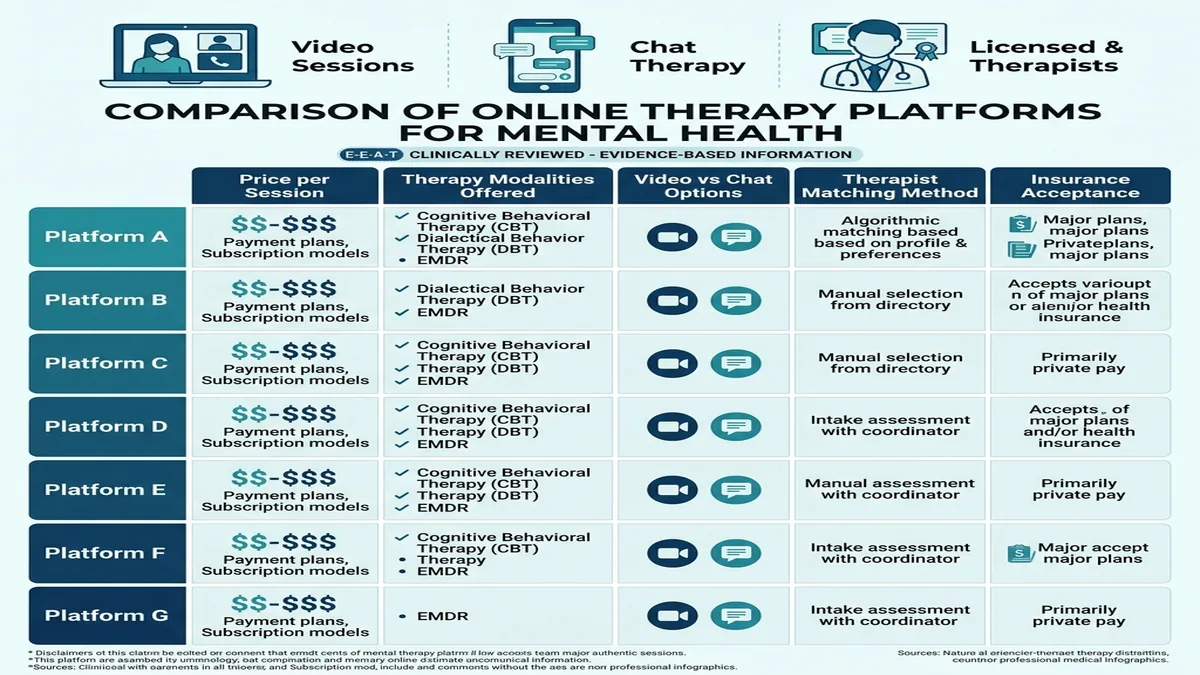
Platform-by-Platform Clinical Review
BetterHelp
Model: Hybrid asynchronous (unlimited messaging) + synchronous (4 live sessions/month). Price: $60–$100/week ($240–$400/month). Therapist network: 35,000+ licensed therapists.
BetterHelp is the largest online therapy platform by user volume. Its matching algorithm pairs patients with therapists using self-reported symptom questionnaires and preference data, typically completing matches within 24–48 hours. The platform does not accept insurance — all plans are self-pay subscription structures. Financial assistance is available on a sliding scale basis based on reported income.
Clinical strengths: Largest therapist pool with broad specialty coverage (anxiety, depression, relationships, LGBTQ+ affirming therapy, grief, OCD). The messaging feature provides genuine therapeutic continuity between sessions. Clinical limitations: No psychiatrists (cannot prescribe medications), does not accept insurance, therapist matching algorithm is opaque, and the platform received FTC scrutiny in 2023 for data privacy practices.
Best clinical match: Adults with mild-to-moderate anxiety or depression, relationship concerns, grief, burnout, or identity questions who do not require medication management and can afford self-pay subscription pricing.
Talkspace
Model: Hybrid messaging + video sessions sold in session packages. Price: $99/month (unlimited messaging only), $276–$396/month (messaging + video sessions). Psychiatry add-on: Available ($249 initial eval + $125/follow-up). Insurance: Accepted by many major insurers including Cigna, Aetna, UnitedHealth, and Blue Cross.
Talkspace’s differentiating feature is its psychiatry service integration. Patients requiring medication management for MDD, anxiety disorders, ADHD, or PTSD can access psychiatric evaluation and prescribing within the same platform — creating a coordinated therapy-plus-medication treatment model. This is particularly relevant given the efficacy data: for moderate-to-severe MDD, the combination of SSRIs and CBT produces response rates of 55–85% versus 40–55% for either alone (NIMH STAR*D).
Best clinical match: Adults with moderate-to-severe symptoms who may need both therapy and medication, insured patients wanting to minimize out-of-pocket costs, and those who need the flexibility of messaging between synchronous sessions.
Cerebral
Model: Psychiatry-primary with therapy add-on. Price: $85/month (care management only) to $349/month (therapy + medication management). Insurance: Accepted.
Cerebral is designed for patients whose primary need is psychiatric medication management — particularly ADHD, anxiety disorders, and depression. A licensed prescriber (MD, DO, NP, or PA) conducts an intake evaluation and, where clinically appropriate, initiates pharmacotherapy. Therapy is offered as an add-on service. Important note: In 2022–2023, Cerebral faced DEA and congressional scrutiny for prescribing practices around controlled substances (stimulants for ADHD). The company has since revised its clinical protocols significantly.
Best clinical match: Adults seeking diagnosis and medication management for ADHD or anxiety, with therapy as a secondary need.
Brightside Health
Model: Structured CBT-based therapy with precision prescribing. Price: $95/month (therapy), $349/month (therapy + psychiatry). Insurance: Accepted by major carriers.
Brightside differentiates on clinical outcome tracking. The platform uses validated standardized assessments (PHQ-9 for depression, GAD-7 for anxiety) at every session, and its proprietary algorithm uses this longitudinal data to predict which antidepressant will achieve remission for each patient — a form of precision prescribing backed by the patient’s treatment history rather than trial-and-error. Published in JMIR Mental Health, Brightside reported that 71% of patients with depression and 72% of those with anxiety achieved clinical remission at 12 weeks — substantially above the 30–40% remission rates typical of standard care.
Best clinical match: Adults with treatment-resistant depression or anxiety who have had prior medication failures and want data-driven precision prescribing integrated with structured CBT.
Evidence-Based Therapy Modalities Available Online
The clinical effectiveness of online therapy is inseparable from the specific modality being delivered. Not all therapy types translate equally to the video or text medium. Below is a clinical evidence summary for the five most commonly available online therapy modalities:
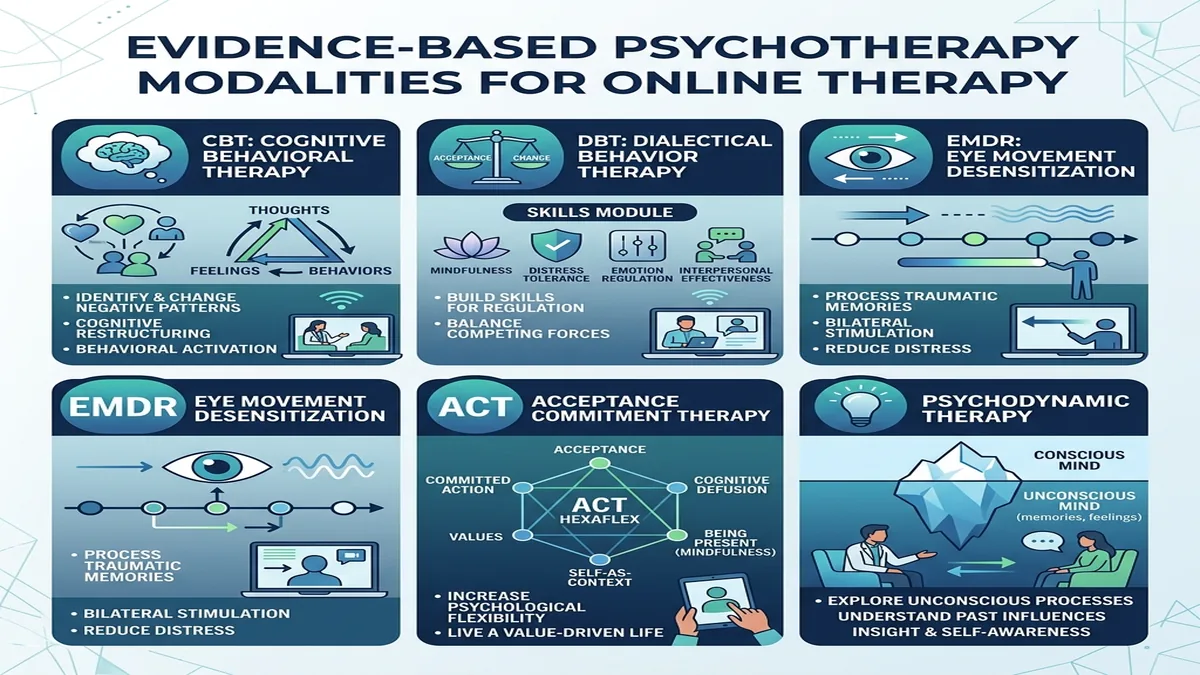
| Modality | Best For | Online Delivery | Evidence Level |
|---|---|---|---|
| CBT | Anxiety, depression, OCD, eating disorders | ✅ Video + messaging | Highest (1,000+ RCTs) |
| DBT | BPD, self-harm, emotion dysregulation | ✅ Video only | High (gold standard for BPD) |
| EMDR | PTSD, trauma, complex trauma | ✅ Video only (bilateral stimulation adapted) | High (WHO-endorsed for PTSD) |
| ACT | Chronic pain, depression, anxiety, values clarification | ✅ Video + messaging | High (3rd-wave CBT) |
| Psychodynamic | Personality patterns, relationship issues, long-standing emotional difficulties | ✅ Video only | Moderate (longer-term evidence) |
The Treatment Access Crisis Online Therapy Is Solving
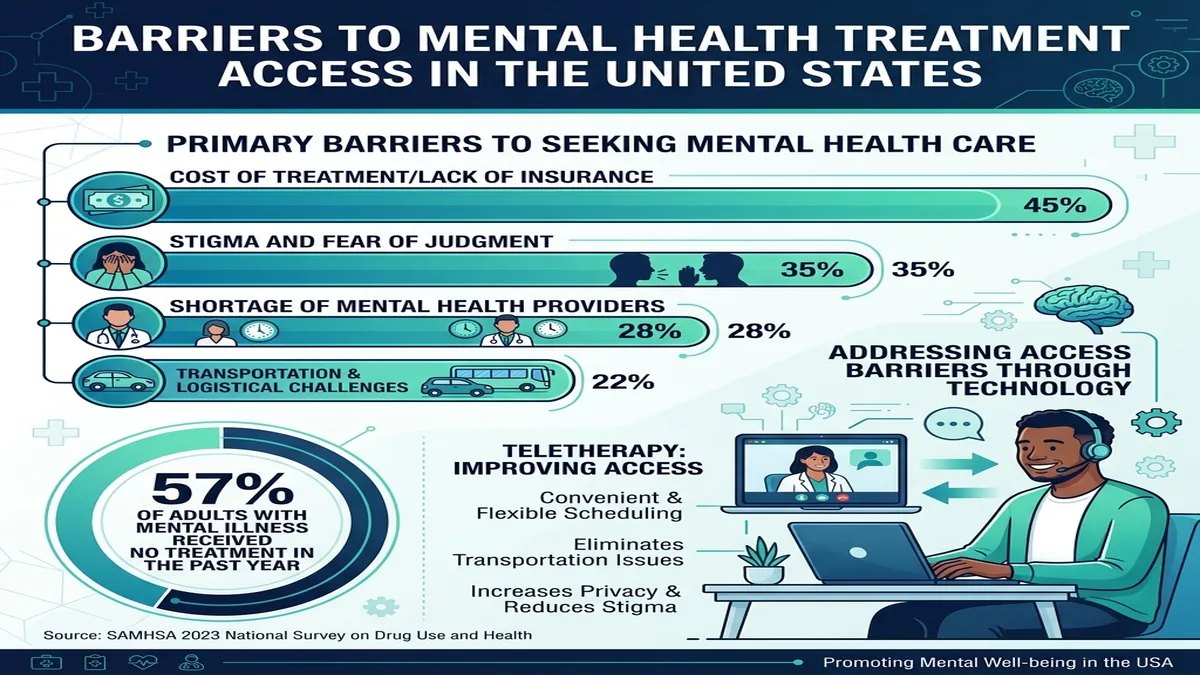
The structural inadequacy of the US mental health system is well-documented. The psychiatric provider shortage is geographically concentrated: 60% of all mental health providers are located in metropolitan areas serving 35% of the total population. Rural and suburban Americans routinely wait 6–12 weeks for a first in-person therapy appointment, and the average out-of-pocket cost of $175/session creates a cost-prohibitive barrier for uninsured and underinsured households.
Online therapy eliminates geographic and wait-time barriers by routing licensed therapists nationally and typically achieves appointment booking within 3–7 days. For conditions where early intervention dramatically improves prognosis — particularly first-episode depression, adolescent anxiety, and acute PTSD — reducing time-to-treatment is itself a clinical outcome.
What to Look for When Choosing an Online Therapy Platform
Use this clinical checklist when evaluating platforms:
✓ Online Therapy Platform Selection Checklist
- ☐ Platform offers synchronous video sessions (not messaging-only) for my condition
- ☐ Therapists are licensed at master's or doctoral level in my state (LCSW, LPC, MFT, PhD, PsyD)
- ☐ Platform accepts my insurance, or pricing fits my budget with financial aid available
- ☐ Modality offered matches my condition (e.g., EMDR for PTSD, DBT for BPD)
- ☐ Platform has a crisis protocol (clear pathway to emergency services if needed)
- ☐ Privacy practices are HIPAA-compliant with end-to-end encryption
- ☐ I can switch therapists if the match is not right
- ☐ Platform provides psychiatry services if medication may be needed
Online Therapy vs. In-Person Therapy: When to Choose Each
The JAMA Psychiatry meta-analysis cited earlier establishes that video therapy is clinically equivalent to in-person for the most prevalent conditions. However, in-person therapy retains clear clinical superiority for specific scenarios:
- Active suicidal ideation or recent attempt — in-person or inpatient psychiatric care is required for safety assessment and crisis management protocols
- Severe eating disorders (below 85% ideal body weight) — require medical monitoring and often residential treatment
- Active psychosis or manic episodes — require in-person psychiatric evaluation for medication management and safety
- Substance use disorders requiring medical detox — alcohol and benzodiazepine withdrawal can be life-threatening without medical supervision
- Severe trauma with significant dissociation — some complex PTSD presentations require physical co-presence for effective somatic interventions (somatic experiencing, sensorimotor psychotherapy)
For all conditions outside this high-acuity set, evidence-based online therapy from a licensed provider is an appropriate, clinically validated treatment option — and often the more accessible, consistent, and affordable one.
Frequently Asked Questions
Is online therapy as effective as in-person therapy?
For the most prevalent conditions — generalized anxiety disorder, major depressive disorder, social anxiety, and PTSD — meta-analyses including a 2022 JAMA Psychiatry review of 17 RCTs found that video-delivered CBT and DBT achieve clinical outcomes statistically equivalent to in-person therapy. The key qualifier is that synchronous video therapy (real-time sessions) is required to achieve these outcomes; asynchronous messaging-only therapy has a weaker evidence base for moderate-to-severe conditions.
Does insurance cover online therapy platforms?
It depends on the platform. Talkspace, Brightside, and Cerebral accept major commercial insurance (Cigna, Aetna, UnitedHealth, BCBS). BetterHelp does not accept insurance and is self-pay only. Even for platforms that accept insurance, benefits vary significantly by plan and state. Always verify with both your insurer and the platform before enrolling. The Mental Health Parity and Addiction Equity Act (MHPAEA) requires that mental health benefits be covered at parity with medical benefits — but enforcement and plan designs vary.
How much does online therapy cost per month?
Self-pay online therapy ranges from $60–$400/month depending on the platform and service level. BetterHelp costs $240–$400/month (4 video sessions + unlimited messaging). Talkspace ranges from $99–$396/month. Brightside and Cerebral are comparable at $85–$349/month. Financial assistance programs are available on most platforms for lower-income users. If you have commercial insurance, your actual cost depends on your plan’s behavioral health benefit — many insured patients pay only their normal copay ($20–$60) per session.
Which online therapy platform is best for anxiety?
For generalized anxiety disorder (GAD), social anxiety disorder (SAD), or panic disorder, CBT is the gold-standard modality (APA Division 12 Empirically Supported Treatments). Talkspace and BetterHelp both have large therapist pools with CBT specialists. Brightside is particularly strong for anxiety as it combines precision prescribing (for cases where medication is warranted) with structured CBT. If you think medication might be needed, Talkspace, Brightside, or Cerebral offer integrated psychiatry services.
Can I get a diagnosis and prescription through an online therapy platform?
Yes — through platforms that offer integrated psychiatry services. Talkspace (psychiatry add-on), Brightside, and Cerebral all provide psychiatric evaluations and can prescribe medications where clinically appropriate, including SSRIs, SNRIs, and non-controlled anxiolytics. For controlled substances (stimulants for ADHD, benzodiazepines), prescribing through telehealth is possible under the DEA's current regulations but requires an initial evaluation and stricter clinical protocols than in-person care.

Ganesh G Kamble
Ganesh G Kamble is the founder and editor of Health is Heaven. He spent 14 years as a techno-functional consultant on enterprise ERP systems in Bangalore before turning his attention to health publishing. His background is technical, not clinical, and he is not a medical professional. He started Health is Heaven because most online health information is either too vague to act on, too technical to understand, or too commercial to trust. The site's mission is to provide clear, evidence-based answers to common health questions, with sources you can verify, alongside free interactive calculators built using standard medical formulas published by recognised authorities including the World Health Organization, the U.S. Centers for Disease Control and Prevention, the American Heart Association, the American Diabetes Association, and the National Institutes of Health. Every article is reviewed against authoritative sources before publishing, dated with both publish and last-updated timestamps, and clearly marked as informational only when covering medical topics. Articles dealing with diagnosis, treatment, or medication recommend speaking with a qualified healthcare provider. The site does not accept paid placements that influence editorial content; any future advertising is clearly labelled and separated from articles. Ganesh is based in Bangalore, India, and connects with readers and collaborators on LinkedIn.