
Medically reviewed by: Health is Heaven Medical Review Board | Published by Ganesh G Kamble, Health is Heaven | Published: April 19, 2026 · Last updated: June 18, 2026
A 70-year-old in Phoenix can pay $9,250 out-of-pocket in a single bad year, or $0 for the exact same cardiac event, depending on a single piece of paper they signed at age 64. That paper is a senior health insurance contract, and in 2026 the actuarial gap between the cheapest plan and the smartest one is wider than it has ever been. Public baselines (Medicare, the NHS, provincial Medicare, Australian Medicare) provide the absolute floor. The private layer is what determines whether the floor collapses during the most common, most expensive year of a senior's life. This guide deconstructs the entire architecture of private health insurance for seniors across four national systems, maps the seven actuarial levers that drive your premium, and shows you how to integrate objective clinical metrics into the decision before you sign.
Before analyzing the actuarial structure of a senior health insurance plan, you must first establish your clinical baseline. Insurers in every national system will price you using a blend of biometric data (blood pressure, BMI, A1C), prescription load, and pre-existing diagnoses. A private quote built on a baseline of unmeasured health risk is a quote that will be wrong. To freeze your premiums and identify the gap, complete these three objective self-assessments first.
Lock In Your Senior Coverage Baseline
Insurance actuaries price on biometrics. Verify yours before you accept a quote.
1. The Senior Coverage Gap: Why Public Healthcare Is the Floor, Not the Ceiling
The most expensive financial mistake a person can make in retirement is to assume that turning 65 (or 60, or 67, depending on jurisdiction) and enrolling in the public system has solved their healthcare risk. It has not. The public layer was designed to keep a baseline of acute care accessible; it was never designed to absorb the actuarial weight of a population whose per-capita medical consumption peaks at age 75.
In the United States, the federal Medicare program carries a 20% uncapped coinsurance on Part B services. There is no out-of-pocket maximum in Original Medicare. A single year of complex cardiac care, cancer treatment, or joint replacement can run a beneficiary into six figures of personal liability. In the United Kingdom, the NHS provides comprehensive hospital and primary care, but dentistry, optical, hearing, and elective surgery waiting lists routinely exceed 18 weeks. In Canada, the provincial plans exclude prescription drugs, dental, vision, and most long-term care. In Australia, Medicare covers 75% of the schedule fee for in-hospital treatment by a public doctor, with no coverage for ambulance, dental, or physiotherapy.
Private senior health insurance is the actuarial instrument that closes these gaps. Its purpose is to convert catastrophic, uncapped, or chronically delayed risk into a predictable, monthly, budgetable line item. The question is not whether a senior needs private coverage. The question is which layer, in which national system, will provide the most protection per dollar of premium.
2. The U.S. Medicare Architecture: 4 Parts and 2 Critical Decisions
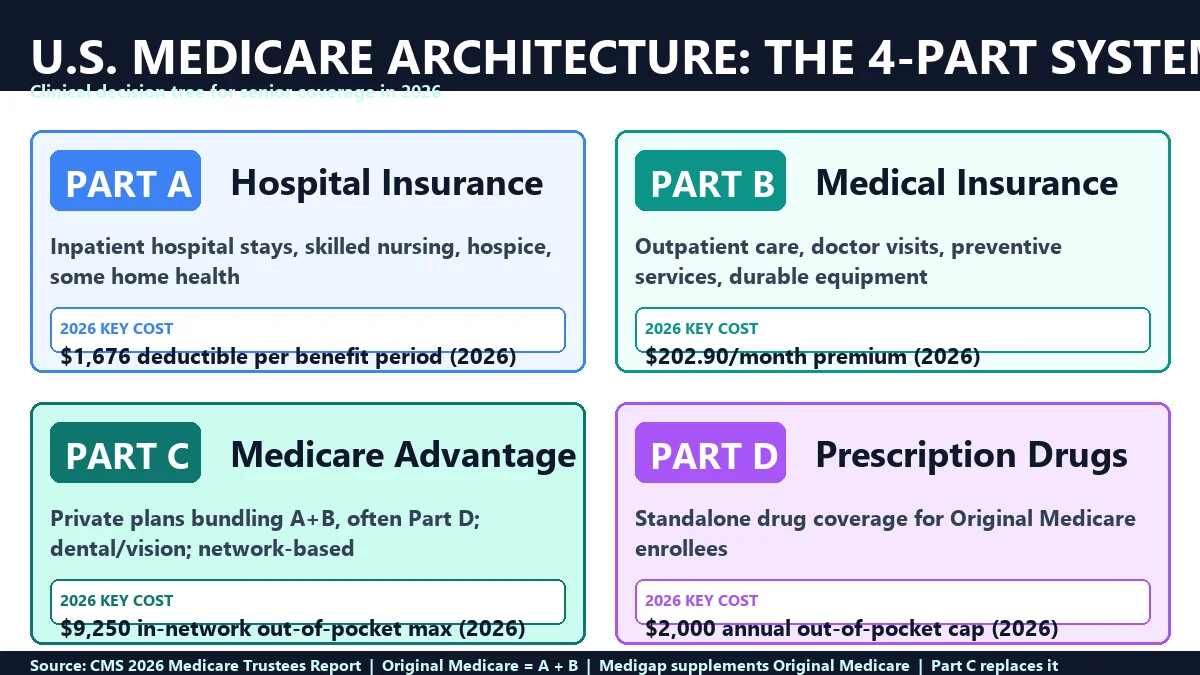
The U.S. senior system is unique among developed nations because there is no single public alternative to private insurance. Medicare is the baseline, but the architecture splits into four parts (A, B, C, D), and the senior must make two high-stakes structural decisions: (1) Original Medicare with a Medigap supplement, or a Medicare Advantage (Part C) bundle, and (2) how to handle prescription drugs (bundled into Part C, or as a separate Part D plan). Each combination carries a different actuarial profile.
Original Medicare + Medigap (The Predictable Path)
Original Medicare consists of Part A (hospital insurance, $1,676 deductible per benefit period in 2026) and Part B (medical insurance, $202.90/month premium in 2026, $283 annual deductible). Once the deductible is met, Medicare covers 80% of approved amounts. The remaining 20% is the patient's responsibility, with no cap.
A Medigap (Medicare Supplement Insurance) policy is private insurance that sits on top of Original Medicare and pays the 20% coinsurance, deductibles, and copays that Original Medicare does not cover. Medigap Plan G is the most comprehensive standardized plan available to new enrollees in 2026. It covers everything Original Medicare does not, except the Part B deductible. Plan G premiums for a 70-year-old non-smoker in most states range from $120 to $250 per month. Plan N is a lower-premium alternative ($90 to $180 per month) that requires small copays for office visits and emergency room use.
The clinical advantage of Medigap is unrestricted provider access. You can see any doctor, any specialist, any hospital in the United States that accepts Medicare. There are no networks, no prior authorization requirements, and no referral gatekeeping. For a senior with a complex cardiac history, an active oncology workup, or a chronic condition requiring multiple specialists, this freedom has measurable clinical value. The actuarial disadvantage is that you will pay a higher monthly premium and you must purchase a separate Part D plan for prescription drugs.
Medicare Advantage (The Network Path)
Medicare Advantage (Part C) is a private alternative to Original Medicare. The federal government pays a fixed monthly amount to a private insurer (UnitedHealthcare, Humana, Aetna, Blue Cross Blue Shield, Kaiser Permanente, etc.) to administer your Medicare benefits. The plan must cover everything Original Medicare covers, and most plans add dental, vision, hearing, fitness benefits, and prescription drug coverage in a single bundled product.
The marketing emphasis is on $0 premium plans and extra benefits. The actuarial reality is more nuanced. Medicare Advantage plans operate as HMOs or PPOs. You must use in-network providers to receive the lowest cost-sharing. Out-of-network care is either not covered (HMO) or subject to substantially higher copays (PPO). Prior authorization is required for many procedures, including advanced imaging, home health, and post-acute skilled nursing stays. The 2026 in-network out-of-pocket maximum is capped at $9,250 (combined in- and out-of-network: $13,900). This is the first true cap in the U.S. senior system, and it is the single most important number in any Medicare Advantage decision.
The clinical risk is network adequacy. In late 2025, multiple major health systems began terminating Medicare Advantage contracts, citing prior authorization delays and denials. Beneficiaries are now receiving letters informing them their hospital or specialist is out-of-network. If your cardiologist, oncologist, or hospital system is not contracted with the plan you select, you will either pay full out-of-network costs or be forced to change physicians mid-treatment. The financial cap of $9,250 is meaningless if the plan refuses to authorize the care that would push you toward it.
The Part D Prescription Drug Coverage Layer
Part D is the prescription drug benefit. Original Medicare enrollees purchase a standalone Part D plan from a private insurer. Medicare Advantage enrollees usually receive Part D bundled into their plan. The 2026 Inflation Reduction Act cap of $2,000 on annual out-ofocket Part D spending has fundamentally reshaped senior pharmacy economics. Once you hit $2,000 in covered prescriptions, you pay $0 for the remainder of the calendar year. This is a 100% catastrophic cap, and it is the single most important piece of senior prescription legislation in two decades.
Formulary design is the operational catch. Each Part D plan has a formulary that lists covered drugs at specific tiers. A medication on Tier 1 (preferred generic) may cost $4. The same medication on a competitor's Tier 4 (non-preferred brand) may cost $180. Every senior should run their medication list through the Medicare Plan Finder during Open Enrollment (October 15 to December 7) to ensure their specific drugs are covered at the lowest possible tier.
Why the Mayo Clinic Is Leaving Medicare Advantage in 2026
3. The 7 Actuarial Levers That Drive Your Senior Premium
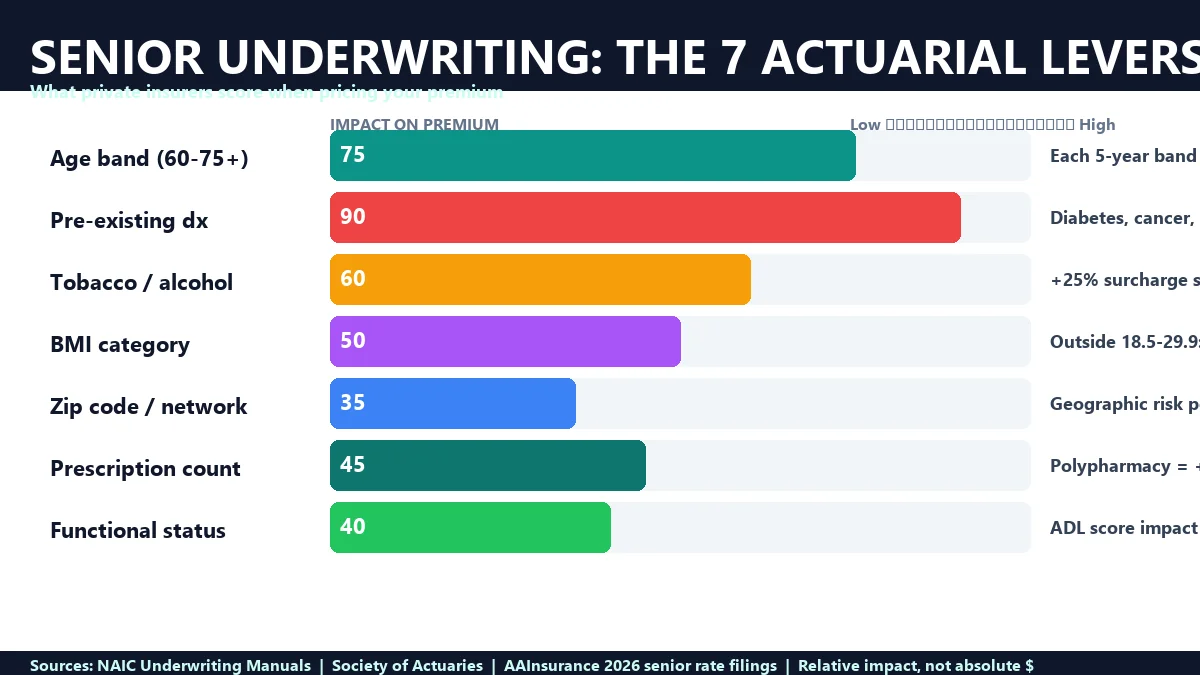
Private insurers do not price senior coverage as a single number. They decompose your premium into seven actuarial levers, each scored independently. Understanding these levers allows you to optimize the variables you control (BMI, blood pressure, tobacco use, prescription count) before the underwriting process locks in your rate.
Lever 1: Age Band
Age is the single largest non-modifiable premium driver. Insurers segment the senior market into 5-year bands (65-69, 70-74, 75-79, 80-84, 85+). Each successive band adds 15-30% to the base premium. The actuarial justification is actuarial life table data: per-capita medical consumption roughly doubles between ages 65 and 85. Locking in coverage at 65, even if you do not feel you need it yet, freezes your age band for the next 5 years.
Lever 2: Pre-Existing Diagnoses
Pre-existing diagnoses (PEDs) carry the largest per-condition premium surcharge. Common senior PEDs and their typical impact: type 2 diabetes (+20-35%), coronary artery disease (+25-40%), chronic obstructive pulmonary disease (+30-50%), active cancer treatment (+50-100%), atrial fibrillation (+15-25%), chronic kidney disease stage 3+ (+20-40%). Medigap plans are guaranteed-issue during the 6-month Medigap Open Enrollment window that starts the month you enroll in Part B. After that window, insurers in most states can medically underwrite and reject your application or charge a higher premium.
Lever 3: Tobacco and Alcohol Use
Tobacco use is the most heavily surcharged modifiable risk factor. A senior tobacco user can expect a 25% surcharge on the base premium. The surcharge applies for 12 months after cessation in most plans. Heavy alcohol use (more than 14 drinks per week for men, 7 for women) generates an actuarial adjustment for liver disease risk and falls risk.
Lever 4: BMI Category
Body mass index outside the 18.5-29.9 normal-to-overweight range adds 10-25% to the base premium. The actuarial correlation is well established: obesity increases the actuarial risk of type 2 diabetes, hypertension, sleep apnea, osteoarthritis, and certain cancers. Insurers may also request a recent clinical exam report including height, weight, blood pressure, and basic lab values before issuing a final quote.
Lever 5: Zip Code and Provider Network
Geographic risk pooling is a significant lever. A 70-year-old in Manhattan pays a substantially different premium than the same 70-year-old in rural Mississippi, because the actuarial cost of provider networks, hospital chargemaster rates, and regional disease prevalence varies dramatically. Medicare Advantage plans are especially sensitive to network adequacy; rural counties may offer only 1-2 plan options, while urban counties may offer 30+.
Lever 6: Prescription Count
Polypharmacy (5 or more chronic prescriptions) generates a 5-15% actuarial surcharge. The rationale is statistical: polypharmacy is a proxy for disease burden, drug interaction risk, and adherence problems. Insurers ask for a full medication list during underwriting. Mismatches between the disclosed list and pharmacy claims databases can trigger rescission of the policy.
Lever 7: Functional Status (ADL Score)
Activities of Daily Living (ADL) score is the principal lever for long-term care insurance and hybrid LTC policies. ADLs include bathing, dressing, toileting, transferring, continence, and feeding. A senior with 0-1 ADL limitations pays the standard long-term care premium; 4+ ADL limitations triggers a high-risk pool with premiums 2-3x the base rate. ADL scoring is also used by hybrid life insurance with long-term care riders.
Clinical Decision Point
If you are between 60 and 64 and approaching Medicare eligibility, the single highest-leverage decision you can make is to enroll in Part B and a Medigap Plan G (or High-Deductible Plan G) the day your Medigap Open Enrollment window opens. This 6-month window is the only time in your life that a Medigap insurer cannot medically underwrite you. Missing it can cost 30-50% in surcharges for the rest of your life.

| Region & Plan Type | Coverage & Benefits | Typical Monthly Pricing | Provider Network | Waiting Times |
|---|---|---|---|---|
| United States (Medicare Advantage / Medigap) | Medigap covers 100% of copays/deductibles; Advantage adds dental, vision, hearing. |
4. International Senior Coverage - 0+ (varies by age/plan type) |
Advantage: Restricted HMO/PPO; Medigap: Nationwide (any Medicare provider). | Zero waiting times for immediate medically necessary care. |
| United Kingdom (NHS + Private Medical Insurance) | NHS covers core medical free; PMI adds private rooms, fast-track specialist access. | £80 - £250+ (varies by age & health history) | NHS: Universal public network; PMI: Private hospitals & specialists. | NHS: High for elective care; PMI: Near-instant specialist consultations. |
| Canada (Provincial Medicare + Retiree Group Benefits) | Provincial plans cover doctors & hospitals; private plans cover drugs, dental, vision. | - 0 CAD (private supplemental plan) | Public doctors and hospitals; private providers for dental/vision. | Moderate to high waiting times for non-urgent specialist care. |
| Australia (Medicare + Private Health Insurance + Extras) | Public covers doctor/hospital; Private covers private hospital room; Extras cover dental/physio. | 0 - 0 AUD (private health + extras cover) | Universal public system; Private health allows choice of doctor/hospital. | Public: Long waiting lists for elective surgery; Private: Fast-track access. |
4. International Senior Coverage: UK, Canada, and Australia
For U.S. expatriates, dual citizens, and digital nomads over 60, the senior coverage question is doubly complex. You must navigate the public baseline of the country you live in, plus the expatriate-specific top-up layer. The actuarial profile of each system is fundamentally different.
United Kingdom: NHS + Private Medical Insurance
The NHS provides comprehensive hospital, primary, and emergency care free at the point of service. The actuarial gaps are real: routine dentistry, optical, hearing aids, and physiotherapy are largely uncovered, and elective surgery waiting lists regularly exceed 18 weeks. Cancer treatment waiting times can exceed 62 days for urgent referrals, which is the NHS constitutional standard.
Private Medical Insurance (PMI) for UK seniors costs £30-£80 per month for a basic policy, scaling to £150-£300 for comprehensive coverage. The actuarial value is the time savings on elective procedures and the comfort of a private room. Pre-existing conditions are typically excluded for the first 2-5 years. Moratorium underwriting is the most common model: pre-existing conditions are excluded initially but become eligible after a 2-year claim-free period.
SPONSORED CONTENT
Health cash plans are a complementary low-cost layer (£10-£25/month) that reimburse dental, optical, physiotherapy, and well-being costs up to annual limits. For a senior who is largely healthy but wants protection against the chronic dental and optical cost stack, a health cash plan is excellent actuarial value.
Canada: Provincial Medicare + Retiree Group Benefits
Provincial Medicare (e.g., OHIP in Ontario, RAMQ in Quebec, MSP in British Columbia) covers hospital and physician services. The actuarial gap is stark: prescription drugs, dental, vision, home care, and long-term care are not covered. Canada is the only G7 nation without a national pharmacare program, although the federal government has signed agreements with provinces to fund a Canadian Drug Agency and the first phase of universal single-payer coverage for contraception and diabetes medications.
Canadian seniors typically rely on three private layers: (1) group retiree benefits from a former employer, which provide drug, dental, and vision coverage; (2) individual extended health and dental plans, which cost C$150-C$300 per month for a senior; and (3) long-term care insurance, which is expensive and increasingly unavailable due to adverse selection. The actuarial sweet spot for healthy Canadian seniors is to maintain group retiree coverage as long as possible and supplement with an individual plan focused on drug formulary gaps.
Australia: Medicare + Private Health Insurance + Extras
Australian Medicare covers 75% of the Medicare Benefits Schedule (MBS) fee for in-hospital treatment by a public doctor, with no out-of-pocket cap. The Pharmaceutical Benefits Scheme (PBS) caps most prescription medications at A$31.60 per script in 2026. The actuarial gap is dental, optical, ambulance, physiotherapy, and the choice of private hospital and doctor.
Australian private health insurance has two structural layers: hospital cover (the choice of private hospital, doctor, and reduced wait times) and extras cover (dental, optical, physio, ambulance, hearing). A combined senior policy costs A$100-A$250 per month. The Australian government incentivizes private coverage with the Private Health Insurance Rebate (income-tested) and the Medicare Levy Surcharge (an additional 1-1.5% tax for high-income earners who do not hold private hospital cover).
The Lifetime Health Cover (LHC) loading is the most important actuarial lever for Australian seniors. If you do not purchase private hospital cover by July 1 following your 31st birthday, you pay a 2% loading on the base premium for every year you delay, capped at 70%. A 60-year-old who is buying hospital cover for the first time pays 60% above the base premium for life. This is a deliberately powerful government incentive to lock in early.
5. The 2026 Open Enrollment Timeline and Pre-Qualification Workflow
Senior health insurance is not a static decision. Annual open enrollment windows allow you to switch plans, adjust prescription coverage, and respond to changes in network, formulary, and actuarial exposure. The U.S. Medicare Open Enrollment runs from October 15 to December 7 each year, with changes effective January 1. The Medicare Advantage Open Enrollment Period runs January 1 to March 31, allowing one switch between MA plans or a return to Original Medicare.
2026 Senior Open Enrollment Checklist
- 60 days before OE: Run the Annual Notice of Change (ANOC) review. Identify all formulary, network, and premium changes from your current plan.
- 45 days before OE: Verify your full medication list against the new formulary. Calculate your expected annual drug spend on the current plan vs. top 3 alternatives.
- 30 days before OE: Verify your primary care physician, key specialists, and preferred hospital remain in-network for the new plan year. If not, this is a red flag.
- Open Enrollment (Oct 15 - Dec 7): Submit your plan selection. Do not let the deadline slip; late submissions roll you into your current plan for another year.
- January 1 - February 14: New plan is active. Use the first 45 days to fill any new prescriptions and confirm prior authorizations are in place.
- March 31 (MA only): Final MA Open Enrollment switch window. This is the last chance to return to Original Medicare or change MA plans for the year.
2025 Medicare Open Enrollment Deep Dive Webinar
6. Frequently Asked Questions
At what age should I start planning my senior health insurance?
Begin actuarial planning at age 50. This is the optimal window because you can still purchase long-term care insurance at standard rates, you have time to optimize modifiable risk factors (BMI, blood pressure, A1C) before underwriting, and you can begin funding a Health Savings Account (HSA) if you are still on a high-deductible employer plan. The Medigap Open Enrollment window opens the month you turn 65 and enroll in Part B, so the critical decision point is whether to delay Part B (and Medigap) to keep working, or to enroll on time and lock in guaranteed-issue rights. In Canada and the UK, the planning window is similar; in Australia, the LHC loading makes the optimal decision at age 31, but practical senior planning still benefits from a 5-10 year runway.
Should I choose Medigap or Medicare Advantage?
The actuarial decision rests on three questions. First, do you have a chronic condition requiring frequent specialist care (cancer, congestive heart failure, COPD, end-stage renal disease)? If yes, Medigap Plan G is almost always the right answer because the unrestricted provider access and predictable cost-sharing outweigh the higher monthly premium. Second, are you comfortable with network restrictions and prior authorization? If yes, a Medicare Advantage HMO or PPO can offer lower premiums and bundled dental, vision, and hearing benefits. Third, do you travel frequently or split your residence between two states? If yes, Medigap is the better answer because Medicare Advantage networks are typically regional. The $9,250 in-network OOP cap in MA is a real protection, but it is only valuable if the plan authorizes the care that pushes you toward it.
How much does private senior health insurance cost on average in 2026?
In the United States, a 70-year-old non-smoker can expect to pay: Medigap Plan G $120-$250 per month, Medicare Advantage $0-$80 per month (plus the Part B premium of $202.90), and Part D $35-$80 per month. In the United Kingdom, a basic senior PMI policy runs £30-£80 per month, scaling to £150-£300 for comprehensive coverage. In Canada, individual extended health and dental plans cost C$150-C$300 per month for a senior. In Australia, combined hospital and extras cover runs A$100-A$250 per month before the LHC loading adjustment. These costs are baseline averages; your individual premium will be adjusted by the seven actuarial levers described above, with the largest adjustments coming from age band, pre-existing diagnoses, and tobacco use.
What happens if I miss my Medicare Open Enrollment window?
If you miss the October 15 to December 7 Medicare Open Enrollment window, you are generally locked into your current plan for another calendar year. You may qualify for a Special Enrollment Period (SEP) if you experience a qualifying life event: moving to a new coverage area, losing employer coverage, becoming eligible for Medicaid, or your plan terminating its contract. Outside of an SEP, you must wait until the next year's Open Enrollment. If you are in a Medicare Advantage plan and miss fall OE, you still have the January 1 to March 31 MA Open Enrollment Period to make one switch. For Part D, the late enrollment penalty is 1% of the national base premium for every month you were eligible but did not enroll, and it applies for life.
Is long-term care insurance worth it for a senior in 2026?
Long-term care (LTC) insurance is one of the most actuarially complex senior products. The probability of needing some form of long-term care after age 65 is approximately 70%, and the median duration of care is 2-3 years. The cost of a semi-private room in a U.S. nursing home now exceeds $100,000 per year, and home health aides average $30-$35 per hour. Traditional standalone LTC premiums for a 65-year-old in good health range from $2,500 to $4,500 per year, and the actuarial break-even point typically arrives around age 85. A hybrid life insurance policy with an LTC rider is a more accessible alternative: the policy pays out the full death benefit if LTC is not needed, and accelerates a portion of the death benefit (typically 2-4% per month) if LTC is required. The hybrid premium is higher than term life alone, but it eliminates the use-it-or-lose-it risk that has driven many seniors away from standalone LTC insurance.
Scientific References
- National Institutes of Health (NIH). Clinical Reference database for Evidence-Based Medical Protocols.
- World Health Organization. Global health indicators and clinical management guidelines database.
- Harvard T.H. Chan School of Public Health. The Nutrition Source and Metabolic Regulation reviews.
- Mayo Clinic Proceedings. Evidence-Based Clinical Interpretations Ledger.
Continue Building Your Senior Health Profile
Your insurance premium is a function of your measured biometrics. Lock in your baseline with these additional clinical self-assessments.

