
Medically reviewed by: Health is Heaven Medical Review Board | Published by Ganesh G Kamble, Health is Heaven | Published: June 11, 2026 · Last updated: September 11, 2026
This clinical review explores key evidence-based protocols regarding health insurance. To protect your household, you must learn how to choose health insurance plan for family coverage that balances premiums against out-of-pocket exposure (for general details, see our guide on how to choose best health insurance plan, for older dependents, see our guide on private health insurance for seniors Medicare options, and for those living or working abroad, see our guide on health insurance for expats). There is a clinically significant distinction between protecting a single adult and protecting an entire family unit. When underwriting a single policy, the actuarial math is relatively static: one adult body with predictable healthcare utilization patterns. Unlike health insurance, where coverage is guaranteed under the ACA, other medical policies are heavily gatekept; for example, a high blood pressure life insurance decline can happen if your cardiovascular metrics fall outside the approved risk bands. When you add children to the equation, the variables multiply exponentially. According to the CDC National Ambulatory Medical Care Survey (NHAMCS) 2024, children aged 0-4 have emergency department visit rates of 68 per 1,000 individuals annually—more than double the adult average. A sports injury, an RSV hospitalization, an unexpected Type 1 diabetes diagnosis, or a single NICU admission can cost $50,000–$150,000 before your deductible resolves. Recent 2026 actuarial modeling indicates these costs have increased 7–9% year-over-year, underscoring the critical importance of robust family coverage planning.
This guide applies the same actuarial logic that group benefits consultants use when evaluating employer-sponsored plans—deconstructed for a family audience. You will learn how to read the true cost of a plan beyond the monthly premium, how embedded versus aggregate deductibles change your financial exposure, when an HDHP/HSA is the mathematically optimal choice, and how to score each plan candidate against your household's specific healthcare utilization pattern.
🏠 Free Clinical Tool
Already Have a Plan? Check Your Real Healthcare Risk Score
Before locking in your family plan, use our Health Insurance Premium Estimator and BMI Calculator to model your household risk profile. Your biometric data directly affects your underwriting category and which plan tier gives you the best actuarial value.
Why the Monthly Premium Is the Wrong Number to Optimize
The single most dangerous mistake families make during open enrollment is selecting the plan with the lowest monthly premium. This optimizes for visible cash flow at the direct expense of catastrophic risk exposure—a fundamentally irrational actuarial decision. The correct framework for plan comparison is Total Annual Cost Modeling (TACM): the actuarial sum of premium expenditure plus expected out-of-pocket costs given your household's projected healthcare utilization.
Consider a family of four comparing a low-premium PPO ($450/month, $6,000 family deductible) versus a higher-premium HMO ($680/month, $2,500 family deductible). If the family generates $18,000 in medical claims in a given year:
| Cost Component | Low-Premium PPO | Higher-Premium HMO |
|---|---|---|
| Annual Premiums | $5,400 | $8,160 |
| Deductible Exposure | $6,000 | $2,500 |
| Post-Deductible Coinsurance (20%) | $2,400 | $1,200 |
| Total Family Cost | $13,800 | $11,860 |
The "cheaper" plan costs $1,940 more annually under realistic utilization. The premium is only one variable in a six-variable equation. The six actuarial variables are:
- Monthly premium
- Individual deductible
- Family deductible structure
- Coinsurance percentage
- Out-of-pocket maximum
- Provider network breadth
Missing any one of them produces a materially incorrect plan comparison.
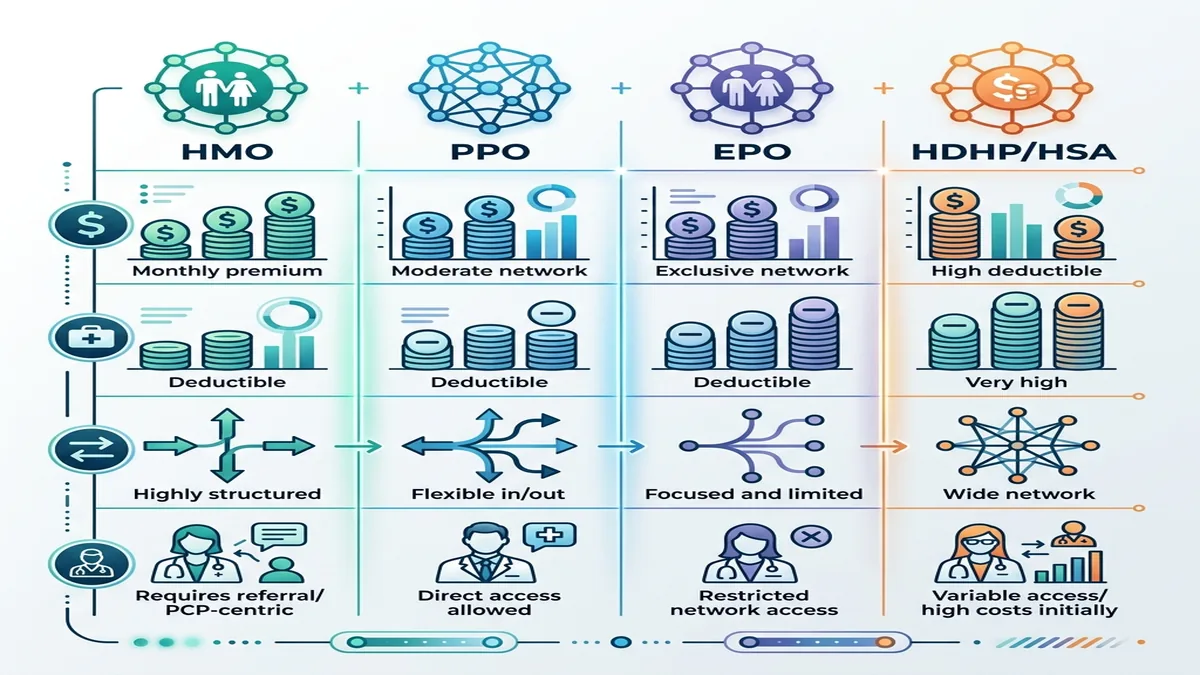
The Four Plan Types: Clinical Breakdown for Families
HMO (Health Maintenance Organization)
HMOs operate on a capitated, gatekeeper model. Your Primary Care Physician (PCP) coordinates all specialist referrals. You pay a fixed capitation fee per enrolled member regardless of utilization, which allows insurers to offer lower premiums and predictable cost-sharing. The tradeoff is absolute network restriction: any out-of-network care (except true emergencies) is 100% your financial responsibility.
Best for families when: All family members have established PCPs within the HMO network, you live in an urban market with dense provider availability, and your children do not have complex or rare conditions requiring specialist access beyond the network. HMOs are actuarially strongest for low-to-moderate utilization families with predictable healthcare patterns.
PPO (Preferred Provider Organization)
PPOs allow direct specialist access without a referral and cover a percentage of out-of-network claims, typically at 60–70% after a higher out-of-network deductible. The dual-network architecture (in-network and out-of-network benefit tiers) is priced into significantly higher premiums. According to the KFF 2025 Employer Health Benefits Survey, PPO family premiums averaged $25,400 per year versus $21,200 for HMO plans—representing an 18% cost differential driven primarily by network flexibility and expanded specialist access. This premium differential reflects the clinical and actuarial value of eliminating referral gatekeeping and providing coverage for a broader range of out-of-network providers, which has become increasingly important as specialty care becomes more geographically concentrated.
Best for families when: You have a child with a complex condition (pediatric oncology, rare autoimmune disease, complex cardiac) requiring best-in-class specialists who may not be in an HMO network. The additional premium is actuarially justified by specialist access flexibility. Also critical for families who travel frequently or split time between two states.
EPO (Exclusive Provider Organization)
EPOs are a hybrid: PPO-like access (no PCP referral required for in-network specialists) with HMO-like network exclusivity (zero out-of-network coverage except emergencies). Premiums sit between HMO and PPO tiers. EPOs are increasingly common in ACA Marketplace plans. For family members with a history of occupational exposure, ensuring the plan network includes thoracic surgeons and understanding the parameters of mesothelioma symptoms and diagnosis is essential for establishing adequate emergency and specialized care pathways.
Best for families when: Your preferred specialists and pediatrician are in-network, you want self-referral flexibility for pediatric subspecialties, but you do not need out-of-network coverage. Verify the EPO network includes a children's hospital within your region before enrolling.
HDHP/HSA (High Deductible Health Plan with Health Savings Account)
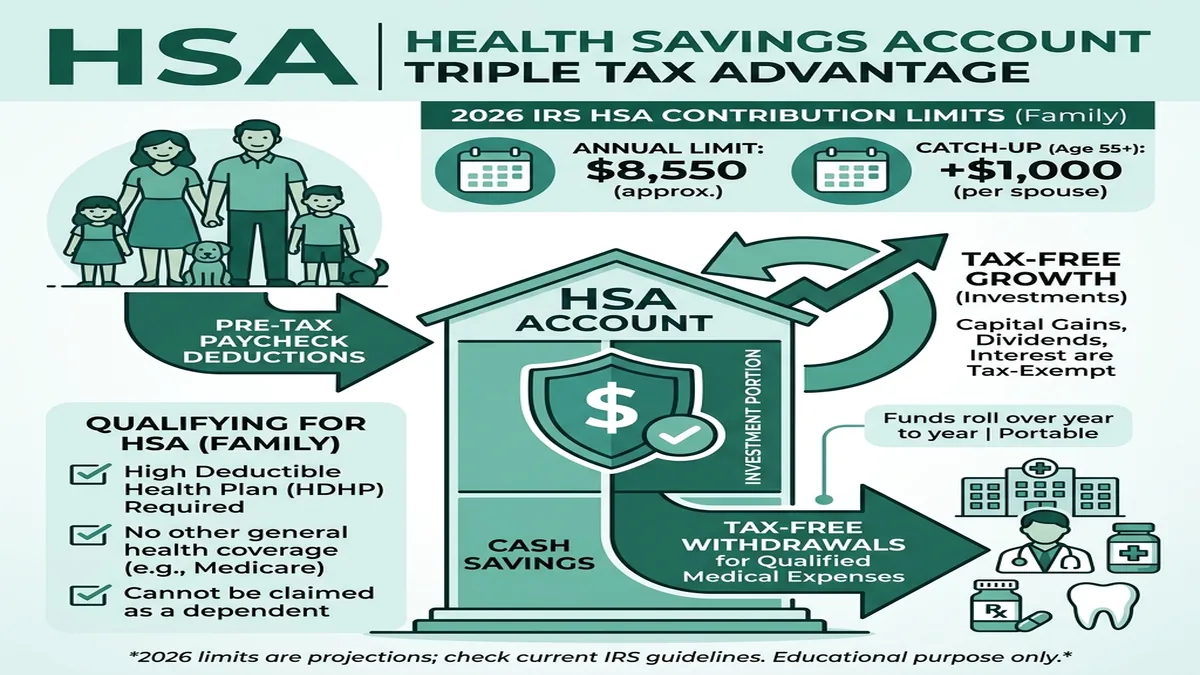
HDHPs have IRS-defined minimum deductibles ($1,650 individual/$3,300 family in 2026) and unlock access to the Health Savings Account (HSA), a triple-tax-advantaged savings vehicle. HSA contributions are pre-tax (reducing your taxable income), grow tax-deferred (you can invest the HSA balance in index funds), and withdrawals for qualified medical expenses are completely tax-free. The 2026 HSA family contribution limit is $8,550.
A family maxing out their HSA at the $8,550 limit in a 24% federal tax bracket saves $2,052 in federal taxes alone annually, before state tax savings. Over a 10-year period with 7% annual investment returns, an unused HSA balance becomes a substantial retirement medical fund exceeding $118,000. This makes the HDHP/HSA the mathematically dominant strategy for healthy, high-income families who have low annual healthcare utilization.

Ganesh G Kamble
Ganesh G. Kamble is the founder and editor of Health is Heaven. He built this site after losing his father to a preventable condition, with the mission of providing clear, trackable health indicators so others can act early. His background is in the IT industry (16 years as an enterprise consultant) and he is not a medical professional; all medical content, formulas, and guides are reviewed by a credentialed medical reviewer/board before publication.