
Medically reviewed by: Health is Heaven Medical Review Board | Published by Ganesh G Kamble, Health is Heaven | Published: April 10, 2026 · Last updated: August 26, 2026
Consulting a clinically vetted best omega-3 supplements buying guide is the first step to building a solid anti-inflammatory baseline regime. For a broader look at other essential micronutrients, see our overview of the top best health supplements. Navigating omega-3 options requires analyzing a complex matrix of concentration ratios, molecular structures, and purity certifications. This clinical guide breaks down the biochemistry of omega-3 fatty acids, analyzes the therapeutic differences between various marine sources, and provides a structured protocol to help you select a high-fidelity supplement that supports cardiorenal health, brain function, and systemic anti-inflammation.

Understanding the Inflammation-Aging Axis (Inflammaging)
To establish your physiological baseline and track the cellular impact of omega-3 fatty acids, you can evaluate your systemic biomarkers using the biological age calculator online (which is a vital baseline tool when studying how to lower biological age naturally). Chronic, low-grade inflammation, often termed "inflammaging," is a primary driver of cellular senescence, telomere attrition, and cardiorenal decline. Supplementing with high-quality omega-3 fatty acids directly alters the lipid composition of your cell membranes, restoring fluidity and suppressing the inflammatory pathways that accelerate biological aging (the cellular mechanisms of which are analyzed in our guide: science of biological aging explained). Recording your baseline score before beginning a clinical-grade supplementation protocol allows you to systematically monitor improvements in your physiological vitality over time.
Omega-3 fatty acids are polyunsaturated fatty acids (PUFAs) characterized by the presence of a double bond at the third carbon atom from the methyl end of the carbon chain. The three primary forms that dictate human physiology are alpha-linolenic acid (ALA), eicosapentaenoic acid (EPA), and docosahexaenoic acid (DHA). While ALA is a short-chain plant-based precursor, EPA and DHA are long-chain marine-derived lipids that directly integrate into the cellular membranes of cardiac, neurological, and vascular tissues. Current clinical research through 2026 continues to validate that EPA and DHA deficiency impairs mitochondrial autophagy (cellular waste clearance), dysregulates endothelial tight junction integrity, and leaves vascular pathways vulnerable to micro-inflammation—mechanisms particularly relevant in chronic inflammatory conditions. This is why omega-3 remains a cornerstone recommendation in a rheumatoid arthritis diet and lifestyle protocol to suppress joint inflammation and support synovial tissue integrity.
When cell membranes are deficient in EPA and DHA, they incorporate arachidonic acid, an omega-6 fatty acid, in their place. Upon cellular stress, arachidonic acid is cleaved by enzymes to produce pro-inflammatory eicosanoids, including prostaglandin E2 and leukotriene B4. These molecules recruit inflammatory cytokines that damage blood vessels and speed up aging. Conversely, when cell membranes are saturated with EPA and DHA, cellular stress releases these omega-3 molecules instead, leading to the synthesis of anti-inflammatory resolvins, protectins, and maresins. These specialized pro-resolving mediators actively terminate the inflammatory cascade, protect the vascular lining, and preserve biological youth.
Marine EPA and DHA vs. Plant-Based ALA: The Conversion Bottleneck
The biochemical conversion of plant-based alpha-linolenic acid (ALA) to eicosapentaenoic acid (EPA) and docosahexaenoic acid (DHA) is highly inefficient in the human body, with conversion rates typically falling under 5 percent for EPA and under 1 percent for DHA. For this reason, plant sources like flaxseeds and chia seeds cannot serve as reliable vectors for clinical-grade omega-3 supplementation. Direct consumption of marine-derived EPA and DHA is mandatory to achieve therapeutic concentrations in cell membranes and actively suppress chronic inflammatory pathways.
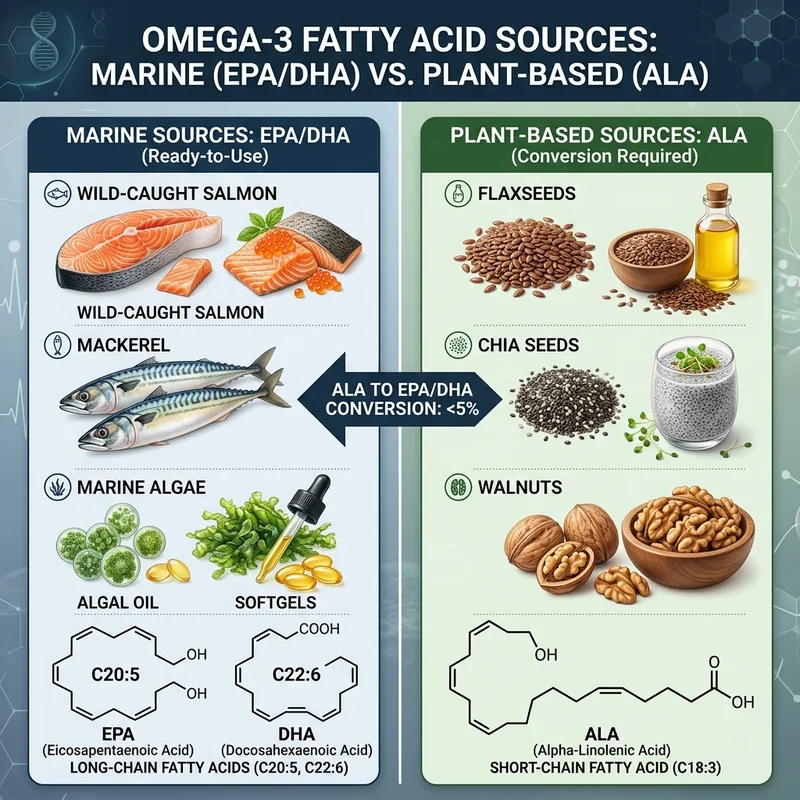
This conversion pathway relies on the enzyme delta-6-desaturase to desaturate the carbon chain of ALA, followed by elongase enzymes to extend the chain, and finally delta-5-desaturase to produce EPA. To synthesize DHA, the molecule must undergo further elongation and beta-oxidation in the peroxisomes. Because delta-6-desaturase is a shared pathway that is heavily utilized by the high abundance of omega-6 linoleic acid in modern diets, the enzyme becomes saturated. This biochemical competition, combined with genetic variations, limits the conversion of plant-based ALA. Nutritional studies consistently demonstrate that relying solely on ALA sources does not increase tissue concentrations of DHA, leaving neurological tissues in a state of subclinical deficiency.
Furthermore, the structural role of these fatty acids is highly tissue-specific. DHA is the predominant structural lipid in the retina and cerebral cortex, where it maintains the curvature and electrical conductivity of synaptic membranes. EPA is distributed throughout the vascular endothelium, where it competes with arachidonic acid to prevent blood clotting and vessel constriction. Because plant-based ALA cannot fulfill these structural demands without undergoing conversion, relying on flax, chia, or hemp seeds as a primary omega-3 source fails to support neurological and cardiovascular systems. As detailed in our guide to cardiovascular nutrition, direct ingestion of pre-formed marine lipids bypasses this metabolic bottleneck, ensuring immediate availability for cellular repair.
Triglyceride vs. Ethyl Ester Forms: Bioavailability Dynamics
The chemical structure of an omega-3 supplement determines its rate of absorption and bioavailability within the gastrointestinal tract. Commercial fish oils exist in two primary forms: natural or reconstituted triglycerides (TG/rTG) and synthetic ethyl esters (EE). Triglyceride forms exhibit up to 70 percent higher absorption rates than ethyl ester forms because they match the natural lipid structures that human pancreatic enzymes are evolved to process. Ethyl ester forms require significantly more enzymatic breakdown and must be consumed with a high-fat meal to achieve even moderate absorption rates.
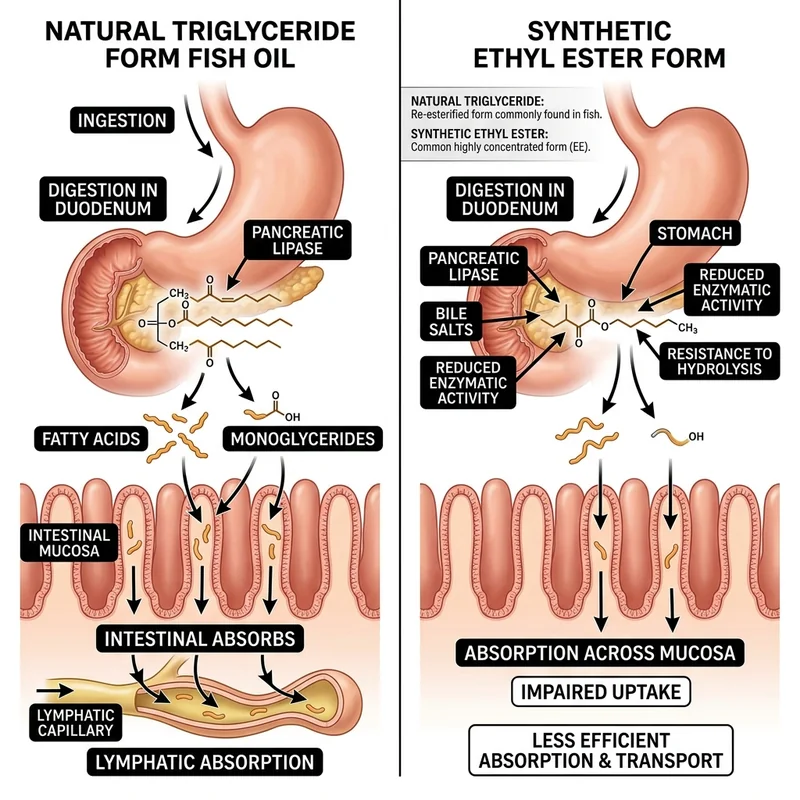
During the concentration process of fish oil, manufacturers react natural crude oil with ethanol in a process called transesterification. This replaces the glycerol backbone of the triglyceride molecule with an ethanol molecule, producing concentrated ethyl esters. While this step allows manufacturers to distill and concentrate the EPA and DHA content, it results in an artificial chemical structure. To return the oil to its highly bioavailable form, premium manufacturers perform an additional re-esterification step to remove the ethanol backbone and synthesize reconstituted triglycerides. This extra manufacturing step increases the cost, but it ensures that the lipids can be rapidly absorbed by the intestinal lining.
When you consume a triglyceride supplement, pancreatic lipase enzymes in the small intestine easily cleave the fatty acids from the glycerol backbone, leaving free fatty acids and monoglycerides. These molecules associate with bile salts to form micelles, which diffuse across the intestinal cell wall. Inside the mucosal cells, they are reassembled into triglycerides, packed into chylomicrons, and released into the lymphatic system. In contrast, ethyl ester structures resist pancreatic lipase cleavage. The intestinal cells must pull glycerol from other dietary sources to rebuild triglycerides before absorption can occur. If taken on an empty or low-fat stomach, ethyl ester supplements often pass through the digestive tract unabsorbed, frequently causing gastrointestinal distress, fishy burps, or worsening heartburn, which can be managed using natural home remedies for acid reflux. For optimal cardiorenal performance, you should also calculate your daily fluid needs using our free hydration calculator.
Clinical Selection Criteria: IFOS, Oxidation, and Purity Standards
Evaluating an omega-3 supplement requires verifying its third-party testing credentials to ensure absolute safety from heavy metals, environmental toxins, and industrial oxidation. The gold standard for fish oil purity is the International Fish Oil Standards (IFOS) certification, an independent third-party testing program that verifies EPA/DHA content matches label claims and screens for heavy metals, PCBs, dioxins, and oxidation byproducts. A product's IFOS rating (

Ganesh G Kamble
Ganesh G. Kamble is the founder and editor of Health is Heaven. He built this site after losing his father to a preventable condition, with the mission of providing clear, trackable health indicators so others can act early. His background is in the IT industry (16 years as an enterprise consultant) and he is not a medical professional; all medical content, formulas, and guides are reviewed by a credentialed medical reviewer/board before publication.